

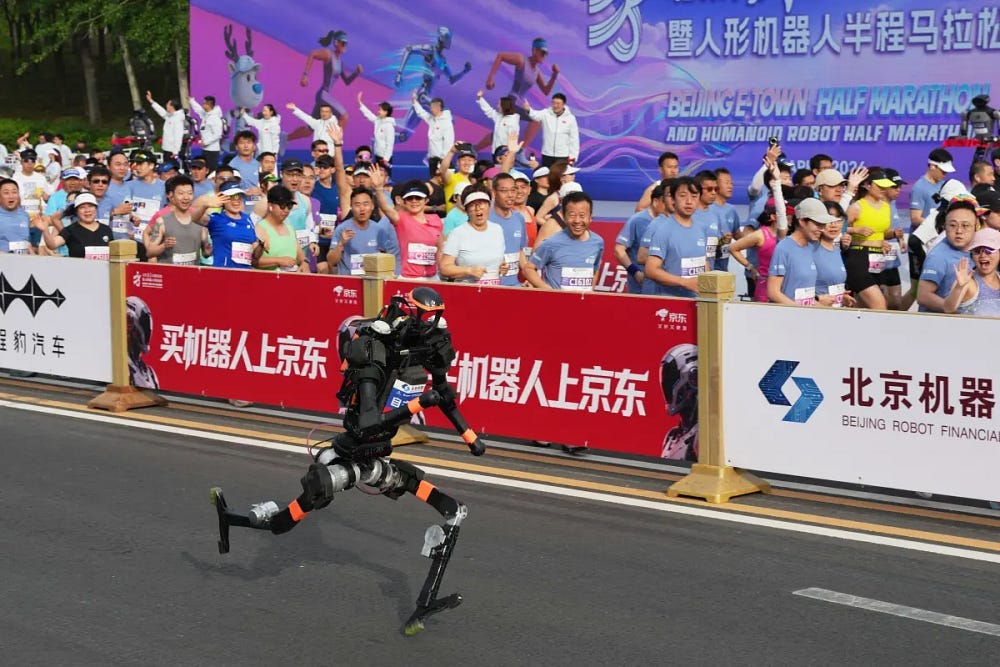
In January, at CES in Las Vegas, someone asked Jensen Huang when humanoid robots would reach human-level capability. He answered word for word: this year.
Jensen Huang has been right about one big thing in every decade since 2000. He predicted the AI revolution before almost anyone in the industry, and that prediction turned Nvidia into the most valuable company on Earth. We are now at the end of August 2026, and the last five days in Beijing just proved him right again. Except nobody is saying it clearly. Not the news, not the papers, not anywhere.
What happened in Beijing this week was not one breakthrough. It was five, landing simultaneously in the same city during the same seven days. And the convergence is the story.
The Week in Order
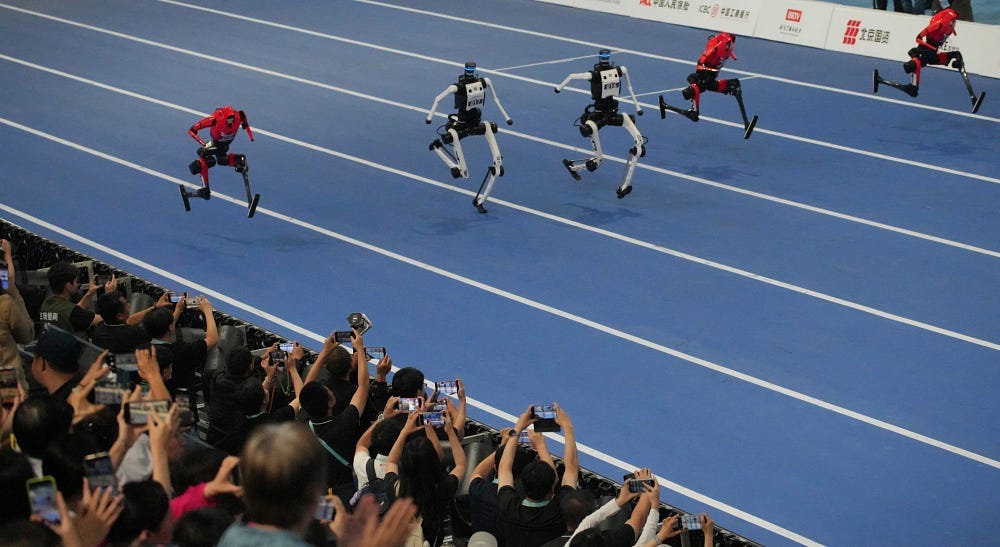
A robot ran 100 meters in 8.86 seconds, then lowered it to 8.64 seconds in the final the next day. Usain Bolt’s world record is 9.58. Another robot played a full tennis match against a former world №15, in complete autonomy, sustaining over 100 consecutive rallies. A robotics company went public and surged 629% on its first trading day, briefly reaching a $66 billion valuation. A manufacturer sold out its entire stock of hyper-realistic companion robots with human faces on day one of pre-orders. And a single country now accounts for approximately 97% of global shipments of humanoid robots.
All of that happened in one week, in one city.
A Robot That Outruns Every Human on Earth
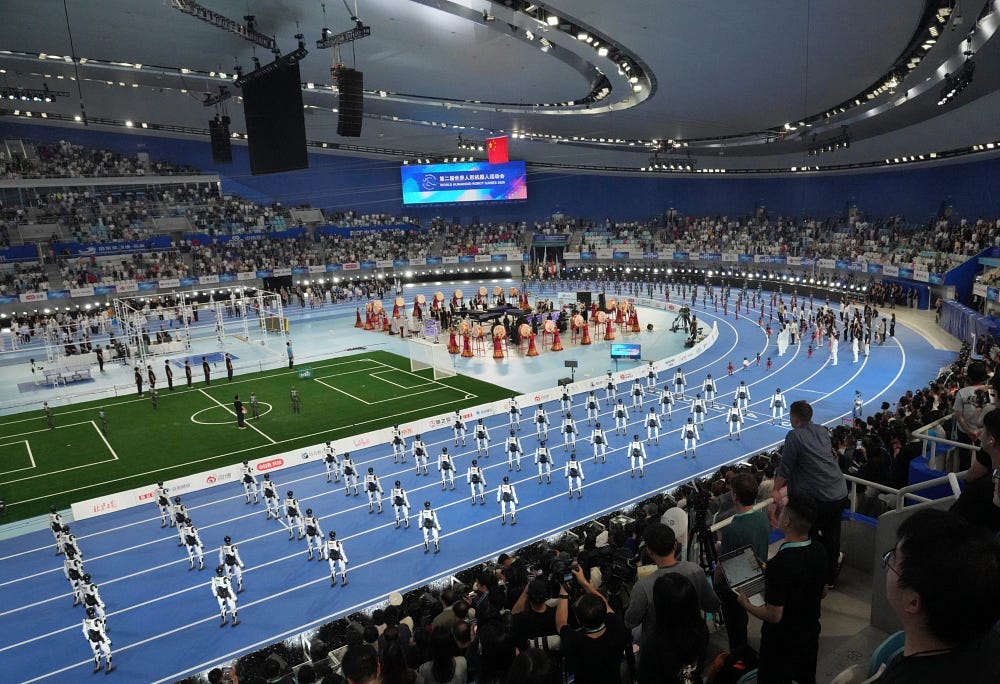
The World Humanoid Robot Games opened in Beijing on August 22 at the National Speed Skating Oval. It’s now in its second year, and the scale shift from the first edition tells its own story: from 200 teams to 670, from 500 robots to 2,056, from 26 events to 51, and from 1 country to 16.
For context, the 100-meter robot record from the inaugural Games in 2025 was 21.5 seconds. A casual jogger would have beaten the best robot on Earth over that distance twelve months ago.
On opening day, Honor’s Lightning robot (yes, the smartphone company, not a robotics firm) posted 9.32 seconds in a test run. During the official heat, Tiangong Ultra from the Beijing Humanoid Robot Innovation Center clocked 9.39 seconds, overtaking Lightning in the final meters. Then it beat its own record five times in two hours. By the semifinal on August 25, Tiangong Ultra ran 8.86 seconds. In the final the following day, it lowered that to 8.64 seconds, nearly a full second faster than Bolt.
The 100-meter time went from 21.5 seconds to 8.64 seconds in twelve months. In human athletics, it took a century to go from 10.6 to 9.58 seconds. I’ve looked through the history of technology benchmarks, and I cannot find a single measurable, chronometric physical record that improved this fast.
The other disciplines told the same story.
The 400 meters: 38.15 seconds (human record: 43.03). Then, the 1,500 meters: 2 minutes 21 seconds. The high jump: 2.88 meters, compared to the human record of 2.45 that has stood since 1993. Every major athletics record was broken in a single weekend by machines with roughly one year of competitive existence.

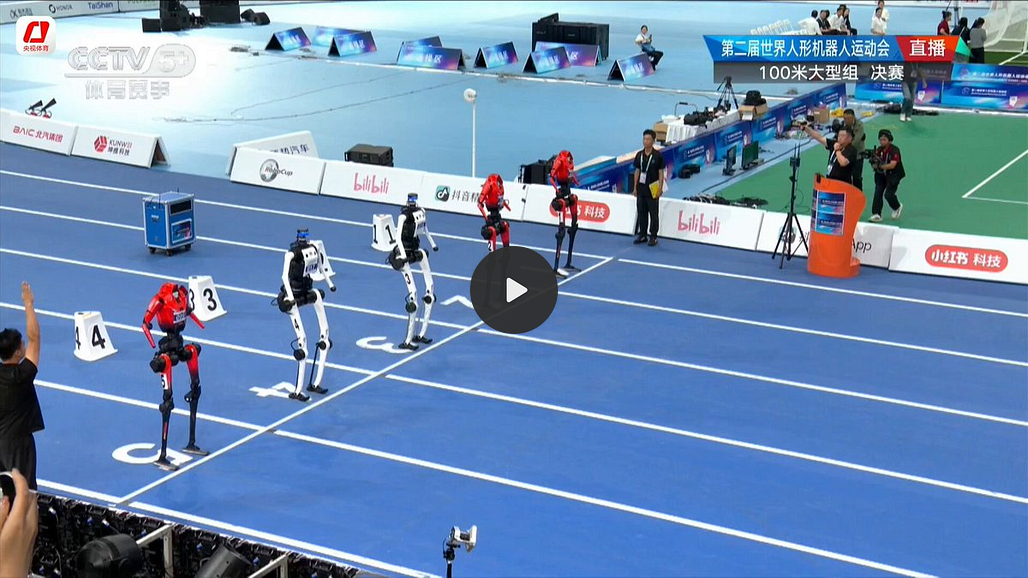
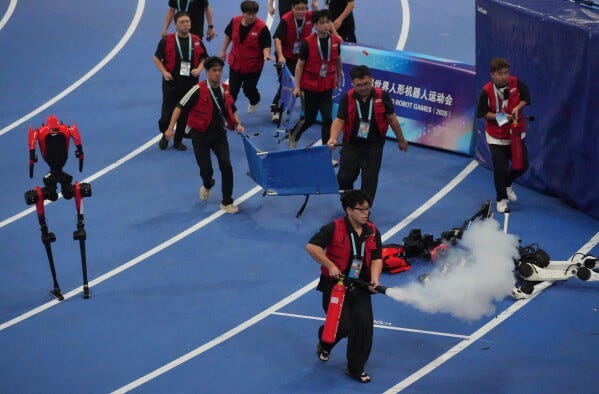
The footage of Tiangong Ultra finishing its 8.86-second run is worth watching for one specific reason: it couldn’t stop. It crashed into the padding at the end of the track. After each sprint, technicians arrived with stretchers to evacuate the machines. Stretchers. Like the actual Olympics, except more absurd. Fast enough to beat every human alive, not yet capable of braking.
That contrast is the precise snapshot of where humanoid robotics stands in August 2026. Impressive enough to be undeniable. Not yet reliable enough to be boring.
A Robot Played Tennis Against a Wimbledon Semi-Finalist
Sprinting in a straight line is spectacular, but it’s a linear movement: legs push, body advances, no decision-making required after the start. The actual test of whether a robot can function in the real world is a sport that demands perception, decision-making, and adaptation at every instant.

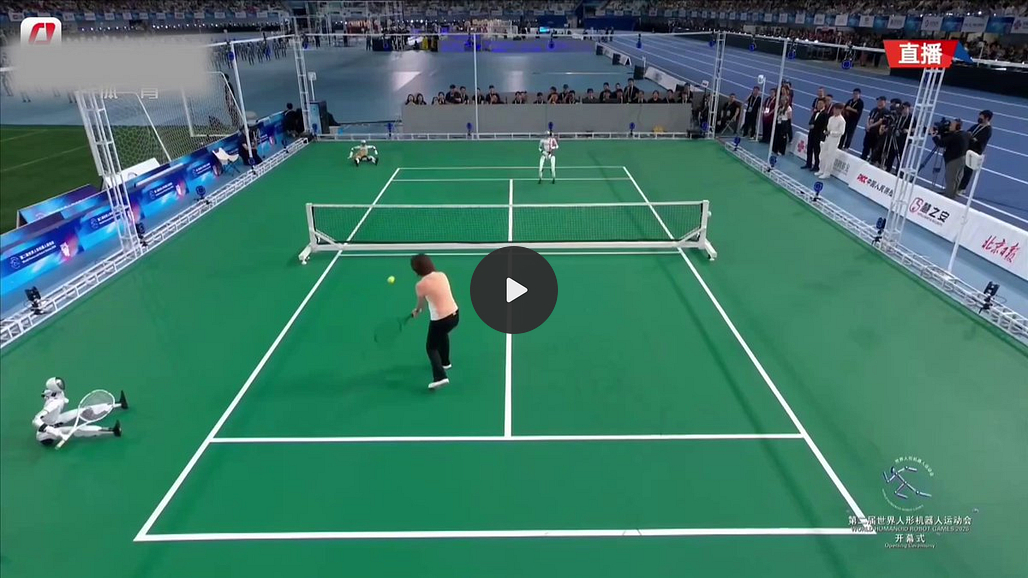
During the opening ceremony, a Galbot humanoid played a live tennis match against Zheng Jie, the former world No. 15 who reached the Wimbledon semi-finals in 2008. There was no teleoperation, no scripting, no human with a controller backstage. The robot tracked the ball, positioned itself on the court, chose between forehand and backhand, adjusted power and spin, and adapted its strategy in real time. Galbot claims over 100 consecutive autonomous rallies.
Caveats matter here: the rally count, the autonomy claim, and the world-record framing all come from Galbot’s own press release, with no independent audit published. Zheng Jie retired from professional tennis a decade ago and was not playing at competitive intensity. Chinese state media reported speeds above 100 km/h and noted the robot fell backward on a high lob but recovered within seconds.
Even with those caveats, this is a different demonstration than anything the robotics industry has shown before. In 2016, AlphaGo beat the world champion at Go — pure strategic intelligence in a fully digital environment. Ten years later, Galbot plays tennis in the physical world, with gravity, friction, spin, and a ball arriving from unpredictable angles. The gap between those two demonstrations is enormous.
Unitree’s IPO Broke Records, Then Broke Hearts
On August 19, the same day the Robot Games opened, Unitree went public on Shanghai’s STAR Market. It’s the first humanoid robotics company listed on mainland China’s exchange. The IPO was oversubscribed approximately 8,000 times. On its first trading day, the stock surged 629% from its IPO price. In intraday trading, its valuation hit $66 billion, exceeding that of most significant European car companies.
Among the strategic investors in the offering: DeepSeek, the Chinese AI lab that upended Silicon Valley in January.
Then reality intervened. Within days, Unitree’s stock dropped 45% from its peak, erasing roughly $30 billion in market value. Reuters reported that the company’s first-quarter adjusted net profit had fallen 53% year-over-year. The wild swing prompted immediate bubble comparisons, and they’re not unreasonable.
But the IPO itself signals something that transcends whether the stock price holds. A humanoid robotics company, in existence for only a few years, debuted at a valuation that would have been considered science fiction for this industry eighteen months ago. The financial market is pricing something specific: the belief that humanoid robots are about to follow the same trajectory as Chinese smartphones between 2011 and 2014, or drones between 2015 and 2024. Whether Unitree specifically captures that trajectory is an open question. That the trajectory exists is increasingly hard to argue against.
The Companion Robot You Can Pre-Order for $17,000
At the World Robot Conference, running concurrently with the Games, UBTech Robotics unveiled the UWORLD U1 series. These are not factory workers. They are companion robots with hyper-realistic human faces: micro-expressions, eyelid movements described as unsettlingly fluid, eyes that track visitors, heads that tilt and pivot.
UBTech positions the U1 explicitly as a presence — a robot that lives in your home, talks to you, reads your mood, and adapts to your personality. Their launch event’s tagline: “Eternal Love.” We are squarely in the territory of emotional companionship marketed as a consumer product.
The full-body premium version costs 990,000 yuan, roughly €130,000. UBTech has disclosed 13,361 pre-orders. The first deliveries in China are scheduled for September, not 2030. The production target for 2026 is 50,000 units per year. This is not a research project. It is a factory running on an industrial scale.

I don’t know exactly what it means when people pre-order a robot companion at that price point by the thousands. But I know what the pattern looks like: first a curiosity, then a product, then an industry. We’ve seen it before.
97% of the World’s Humanoid Robots Come From One Country
Behind the spectacle, the numbers tell the structural story.
In the first half of 2026, approximately 20,000 humanoid robots were shipped worldwide, three times the volume of the same period last year. AgiBot leads with roughly 8,400 units (44% global share). Unitree follows with approximately 5,900. Together, those two companies account for 75% of the global market. Approximately 97% of global shipments of humanoid robots come from China.
According to Omdia’s data for the entirety of 2025, China accounted for 87% of global shipments, with 13,317 units delivered worldwide. US manufacturers Tesla, Figure AI, and Agility Robotics each shipped about 150 units. The projections for all of 2026: 60,000 units. For 2028: 500,000.
While most Western humanoid robotics companies are still raising funding on promises, China has already shipped 20,000 robots in six months. The time from product announcement to release is critical for success and is currently extending.
Jensen Huang Wasn’t Talking About One Robot
When Huang said “this year” at CES in January, he wasn’t talking about a single machine or a single record. He was talking about convergence. Physical performance surpassing humans. Production volumes tripling. Financial markets value these companies at tens of billions of dollars. Companion robots moving from fiction to pre-order. All of it, simultaneously.
That is exactly what happened in Beijing this week. Not one front advanced. All fronts advanced at the same time.
Twelve months ago, 5,000 humanoid robots had been shipped in total. Today, the count exceeds 25,000. A year ago, no robotics company was publicly listed. Today, Unitree briefly touched $66 billion. Behind every robot that sprints, there’s an AI foundation model. Behind every UBTech face that reads your emotions, there’s natural language processing, computer vision, and neural networks working in concert. Robotics is AI that has learned to walk. It’s what researchers call embodied intelligence, and this week was the moment it stopped being a concept and started being an industry.
The only real question now is what you do with this information.
If watching robots outrun Bolt and play tennis against Wimbledon semi-finalists makes you rethink what’s actually happening in tech, follow us and subscribe here.
Thought I'd accomplished a lot this week but now cannot help but feel like the robots are already putting me to shame.....and tbh thought we still had a little more time before that became such a glaringly obvious reality 😅