

Watch this game character for a second. An AI is playing, and you couldn’t even say hello to it.
It’s called Jev. It can’t write a paragraph, can’t code, and can’t hold a conversation. Three weeks ago, almost nobody had heard of it. Then its creator, Diogo Almeida, a former OpenAI researcher the public had never heard of, posted a launch video, and by his own count, it passed 38 million views.
For an unknown name, that is absurd. The closest comparison for that reaction is ChatGPT’s first week in 2022.
So why would an AI that does less than ChatGPT or Claude set the industry off? To answer that, look at how ChatGPT answers you first.
What Is Jev? An AI That Ticks Boxes Instead of Writing Essays.
When you ask ChatGPT something, it doesn’t hand you the answer in one piece. It writes word by word, and often it thinks for a while before it starts. That’s why these models feel a little slow. They have to find the answer and write it out. And that’s by design, because they were built for humans, for people who come to chat. So they answer like a person would: politely, at length, in well-turned sentences. For a conversation, perfect.
Now take a dumb minor example. You paste an email into ChatGPT and ask whether it’s important. All you want back is yes or no. You get a short essay. It analyzes, adds nuance, summarizes, and finally says yes. Once is fine. You wait three or four seconds, read it, and move on. But imagine it’s no longer you asking. It’s software sorting every email in a company, a million times a day. That’s a million essays written word by word, and each time only one word gets kept.
So, flip the problem. Remove the text from the equation. What’s left of an AI that doesn’t speak? Something very simple. You ask it a question; you give it several answers, and it scores each one. It’s a multiple-choice exam. It explains nothing, ticking the most likely box. Take a scam text, a text most of us have received: “Your parcel could not be delivered. Click this link.” Jev gets three boxes: legitimate, doubtful, scam, and puts a score on each. The riskiest one lands on scam, and that’s all. No sentence, no “brilliant question,” no “friendly call on suspecting it.” A number and an answer. TechCrunch describes it as a model that outputs probabilities, which its makers call “calibrated decisions,” and because you define the allowed answers in advance, it can’t write anything outside them.
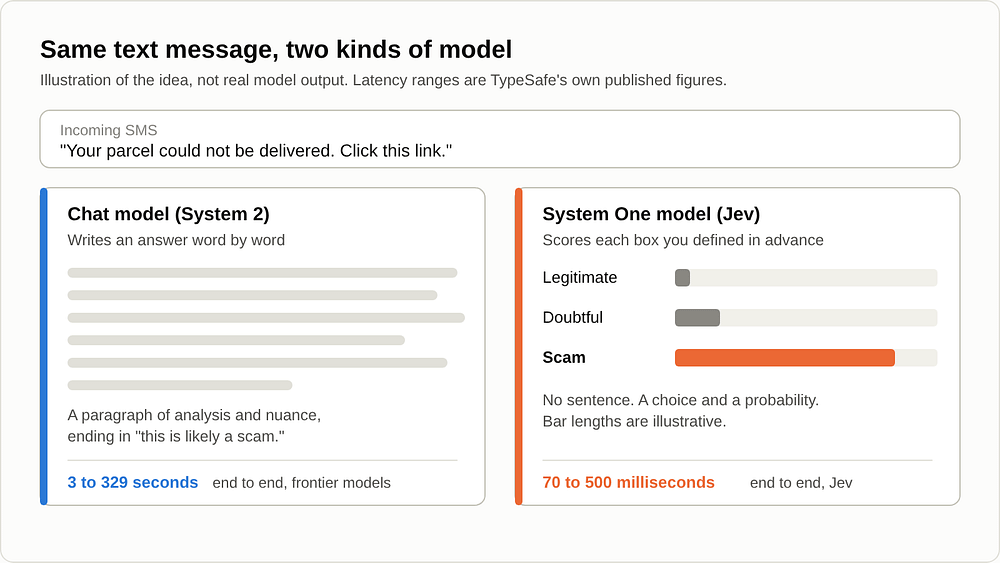
That changes how you use AI. With a chat model, you ask, “What do you think?” With Jev, you’re the one who has to ask the right question and pick the right boxes. Cutting a problem into good questions is the skill that carries over to every model, ChatGPT, Claude, Gemini, or this one.
You might object that this already exists. Your mailbox’s spam filter has done it for years, and you’d be right. But those filters are trained for only one task. A spam filter spots spam. If you want it to spot urgent emails instead, someone has to build another one from scratch with thousands of examples. Jev understands language the way ChatGPT does. You write any question, give it to your boxes, and it answers on the spot. ChatGPT-level language understanding at the speed of a filter. That’s why it’s not just another model; it’s another kind of AI.
And we all know the kind, because we carry it in our heads. You have two ways of deciding. The first is instinct. A glass slides off the table, and your hand catches it before you’ve thought about it. The second is reflection. You compare two phone plans, weigh the pros and cons, and take the time you need. ChatGPT and its cousins are your reflection. Jev is your instinct. Almeida’s name for the family is System One models, and Sanity’s glossary notes it’s borrowed from Daniel Kahneman’s Thinking, Fast and Slow, where System 1 is the fast, intuitive mode and System 2 the slow, deliberate one.
You never pick one or the other. When you drive, your reflection chooses the route and your instinct brakes when a pedestrian steps out. One doesn’t replace the other. The duo makes you effective, and that’s exactly what’s being set up for AI: one that thinks and one that reacts, working together.
How do you build something like that? Picture two students. The first was prepared for years to write essays.
The second drilled on multiple-choice questions again and again. Both know the course, but facing a tick-the-box question, the second has already answered while the first is still writing an introduction. ChatGPT is the first student. It swallowed an enormous amount of internet text, and was then trained for one precise job: following your instructions and answering you. Jev wasn’t taught to answer. It was taught to decide, and to decide for programs, not for humans. TypeSafe says it trained Jev only on synthetic data with a method it calls reinforcement learning from calibrated decisions, and it won’t disclose the architecture. Outside observers suspect it sits on top of an open-weight language model.

On paper, multiple choice sounds limited. Spam scams, sorting email, fine, but that’s about it. Except almost everything can be turned into a multiple-choice question. In a video game, at every instant there is only one question: what’s the best next action? And when you can answer that kind of question in milliseconds, everything changes.
How fast is Jev? Milliseconds Change What Software Can Ask.
Go back to the pile of emails. A model that reasons before answering, like GPT-6 Astra or Claude, takes several seconds to sort a single message. TypeSafe says Jev responds in 70 to 500 milliseconds, and that this is 40 to 200 times faster than frontier models for questions shaped like this. Those figures are TypeSafe’s own, measured from laptops on the US West Coast, so treat them as a claim to test. Still at the low end, a whole pile of mail gets sorted about as fast as a blink.
At that speed, you stop asking an AI a question now and then. You ask it constantly. Take a game. A developer describes the scene to Jev in text at every moment: where is the character, which enemy is coming, what’s on the ground just ahead? Then three minor questions. Which button should be pressed? Should the character jump now? Is there danger ahead? That opening clip works on the same principle, except the multiple choice has only four boxes: jump, duck, go left, go right.
Since launch, demos like that have exploded online. MindStudio lists a Minecraft bot, a self-driving-style simulation, a Subway Surfers-style game, and a simulated drone flying an obstacle course, some of them reportedly built in under an hour, one Minecraft session for about a cent. All of it runs in simulators, not on actual roads or real hardware. So you could dismiss this as demos built for buzz. But there’s real money behind it, and an actual customer. Vercel had been using an OpenAI Luna 5.6 classifier, and according to TechCrunch, swapping in Jev made the same job five to 18 times faster, with better accuracy.
Think about an online shop. You type “running shoes for the rain that don’t look too sporty.” The site’s filters know size, color, and price. They don’t understand that sentence. ChatGPT could, but it would take several seconds, and you’d probably have left by then. Jev could read your sentence, score each pair of shoes, and show you the right ones instantly. Until now, AI has waited for your questions. You wrote, it answered, it waited for the next one. Jev gets plugged into the middle of a piece of software and left to decide continuously. It doesn’t answer anymore. It acts.
Here’s my take, for what it’s worth. The place this could matter most is in robotics. A robot reaching for a cup or walking on a sidewalk can’t write an essay before each movement and run it past itself. By the time it has finished thinking, the cup is on the floor. What it needs is what we have: a reflection that decides what to do and an instinct that executes in a fraction of a second. I’m not saying someone will plug Jev into a robot tomorrow. But this artificial instinct may be the piece of robotics that was still missing.
Why Jev Is Named After Jevons: The Intelligence-per-Dollar Bet
Back to the email pile, Jev sorted faster than a blink. The complete operation cost a few thousandths of a dollar, not even a cent. That price is TypeSafe’s entire project, and the name wasn’t chosen at random. Jev comes from an old economist’s idea, the Jevons paradox, and Almeida says the model exists for one thing: as much intelligence as possible per dollar spent. TypeSafe’s list price is $0.042 per million input tokens with output free, where frontier models charge from $0.20 to $10 per million input tokens and about five times more for output.
The paradox runs against intuition. When something gets much cheaper, you’d logically expect to save money, paying less to use it just as much. That isn’t what happens. We use it so much more, and for so many things that weren’t worth it before, that we often spend more than we did. I went through the full mechanism, from coal in 1865 to AI bills today, in my article “Cheaper AI Is Making You Pay More. Jevons Saw It Coming in 1865,” and Jev is that bet applied head-on to intelligence.
Because most of the time we don’t use AI to chat. We use it to sort, classify, read documents, and decide the next step of an automated task. Small decisions. If those small decisions turn into billions of them, handing them to an AI used to cost far too much. Take a large retail chain. For years, it has gathered hundreds of thousands of customer reviews — happy, disappointed, furious — all saved somewhere but seldom read. Having ChatGPT read them one by one would be very slow and very expensive. The term for it is dark data, mountains of data companies keep and never analyze. With Jev, the equation changes, because each review, each email, each text becomes one question at a fraction of a cent. At that price, you stop asking whether it’s worth it, and you do it everywhere. Jev makes billions of small decisions profitable that nobody ever trusted to an AI.
How Jev Started at OpenAI and Ended Up at TypeSafe
An idea this simple, you’d assume OpenAI had it first. In a way, it did. Almeida had it while he was still there, and by the interviewer’s account in that Latent Space conversation, Sam Altman’s reaction was basically: do it. And yet Jev never came out of OpenAI.
To see why, go back a few years. Almeida is working at OpenAI; ChatGPT hasn’t even launched publicly, and he asks himself a simple question. The day AI really runs the economy, who will send it most of its questions? Humans like you and me, or programs? At OpenAI, everyone was working to make AI pleasant for humans, and nobody was building it for software. He wrote the idea down, and Altman’s answer, by the interviewer’s account, was for it. But Almeida was busy, so the idea sat. Meanwhile, the team teaching the model to follow instructions was declaring victory. For them it was settled: AI means obeying humans, no need to look further.
So Almeida tried it on his own, expecting it to take about a week. It took years. TechCrunch reports he left two years ago to start TypeSafe AI. And once Jev shipped on September 15, the callers weren’t humans. They were programs. Almeida told the Wall Street Journal that Jev was handling a trillion tokens a day, about three weeks after launch, and that roughly 25% of the Fortune 500 used it. Both figures come from Almeida alone, and the WSJ doesn’t define what “in use” means, so hold them loosely. It is exactly the traffic pattern he predicted in the OpenAI offices years earlier.
Jev Won’t Replace ChatGPT, and OpenAI Already Cloned It
Back to the question at the start. Why does an AI that does less than ChatGPT or Claude set the industry off? Because the most useful AI may not be the one that talks best.
Now, careful, that doesn’t mean Jev replaces ChatGPT. It answers on instinct and never takes time to think, so the moment a question needs calculation or several chained steps, it can clearly get it wrong. “No hallucinations” here means it can’t answer outside your boxes, not that it can’t pick the wrong one. TechCrunch put the open question plainly:
“A key question is how well calibrated each of these decision models’ outputs will be to real life.”
For talking, writing, and working through a problem, ChatGPT and its cousins remain the right tools. The two complement each other, exactly like instinct and reflection in your head. In Almeida’s own picture, every time you make an AI reason, you could call Jev ten or a hundred times. He has a bigger dream too, an AWS of intelligence, the way much of the internet runs on Amazon’s servers. He wants software to come to him for its intelligence.
The speaker I’m working from predicted that OpenAI or Anthropic would put out their own version soon, because agents, those autonomous AIs that chain tasks together on their own, need exactly this: decide fast and for almost nothing. It turns out that the prediction was already late. On September 29, two weeks after Jev, OpenAI announced a Decisions API at DevDay, built on its small Luna model and available only as a limited preview. TechCrunch’s headline called it “OpenAI’s Jev clone.” Two days later, CloudFlare shipped Clef, open weights, in a format compatible with Jev’s. That’s three decision models in two weeks, and OpenAI’s is the one we know least about, with no public pricing.
The reason they’re rushing is that the agents are. TechCrunch’s example is monitoring every action an AI agent takes against the task it was given. In its example, that costs $2.94 with Jev against $372 with a frontier model. An instinct that cheap can run on every single step, which is a layer of review no one could afford before.
I’d say the next big shift in AI won’t happen only inside a chat window. It will run in the background of your apps, in your mailbox, in your games, and Jev may be the missing brick for the productivity gains AI has promised for years. Those gains won’t go to everyone, though. The more powerful AIs get, the less the tool itself matters. What counts is whether you know what to ask it.
If the part about the model mattering less and the surrounding ecosystem mattering more is what stuck with you, my piece on what OpenAI is building around its model at DevDay goes into the lock-in side of it, and why the new model got about a minute of the keynote.
If a fast, cheap AI that can’t talk surprised you as much as it did me, follow Nov Tech and subscribe for more breakdowns of where AI is actually heading. Don’t forget to support my newsletter for early access.