

Somebody is deciding what your AI assistant thinks is right and wrong, and last year that somebody flew about twenty rabbis, priests, and Hindu scholars into San Francisco under non-disclosure agreements to help. I went into this story sure that AI was going to bury the Church. I came out of it reading about an AI lab asking the Church for a blessing it did not get.
I should say where I stand. I am not a believer. For a long time my view of the Church was that it explains the world, built when nobody had biology or cosmology or an internet connection, and that it would not survive a machine that can read every religion at once and lay out every contradiction in four seconds.
That view was wrong, and not for the reason I expected.
Why I thought AI would bury the Catholic Church
The numbers looked like a one-way street. Pew’s survey of how the global religious landscape changed from 2010 to 2020 found that the religiously unaffiliated were the fastest-growing group in Europe, up 37% to 190 million people. Read that carefully because it is the number that gets mangled in a repost. The 37% is growth in the number of people, not a jump in share. The unaffiliated share of the European Parliament rose seven points to 25%.
In the United States, the slide is steeper in share terms. Pew’s Religious Landscape Study puts the unaffiliated at 16% in 2007, 23% in 2014 and 29% in its 2023–24 fieldwork, with Christians falling from 78% to 62% over the same stretch. My assumption broke on Pew’s own headline for that study, which is that the decline has slowed and may have levelled off. The Christian share has sat between 60% and 64% since 2019. The “nones” have plateaued.
Then there is the detail I did not see coming. Gallup reported in April that young American men now outrank young women on religion, with 42% of men aged 18 to 29 calling religion “very important”, up from 28% in 2022–23, while young women held near 30%. Monthly attendance among young men went from 33% to 40%. One action alone doesn’t represent a revival, and Gallup’s survey of young women includes a significant margin. But if your model of the world says chatbots push young men away from church, the data says the opposite happened.
Christianity as software hyperoptimized for growth
Before the Pope, the frame that made me treat religion as a doomed explanation came from Tomas Pueyo, the Franco-Spanish writer behind Uncharted Territories, who most people know from his 2020 COVID essays. In June, he published a piece arguing that Christianity spread the way a product spreads. His words:
When I look at the rise of Christianity, I see the same patterns: a piece of software hyperoptimized for growth. Indeed, Christianity, like all religions, is software, an operating system that guides people on what they should and shouldn’t do.
His section headings read like a growth funnel, and that is deliberate. Big audience, valuable proposition, segmentation, sales force, low friction, viral growth, retention rate. He refers to Galatians 3:28 in front of the audience; the passage mentioning neither Jew nor Greek, slave nor free, male nor female, as the turning point that separated the religion from a specific people and region, giving credit to Paul and the apostles instead of Jesus. On retention, he writes that Christianity colonized every year and every week too, until it became the rhythm that organized life. On spread, it turns every believer into a salesperson, a node that carries the software.
It is a sharp frame, and I still find it useful. Pueyo mentions in his footnote a flaw, confessing that he has not read the typical scholarly works on the matter. A growth-metrics account explains how a religion got big. It does not explain why anybody stays once the state stops making them.
What Magnifica Humanitas actually says about AI
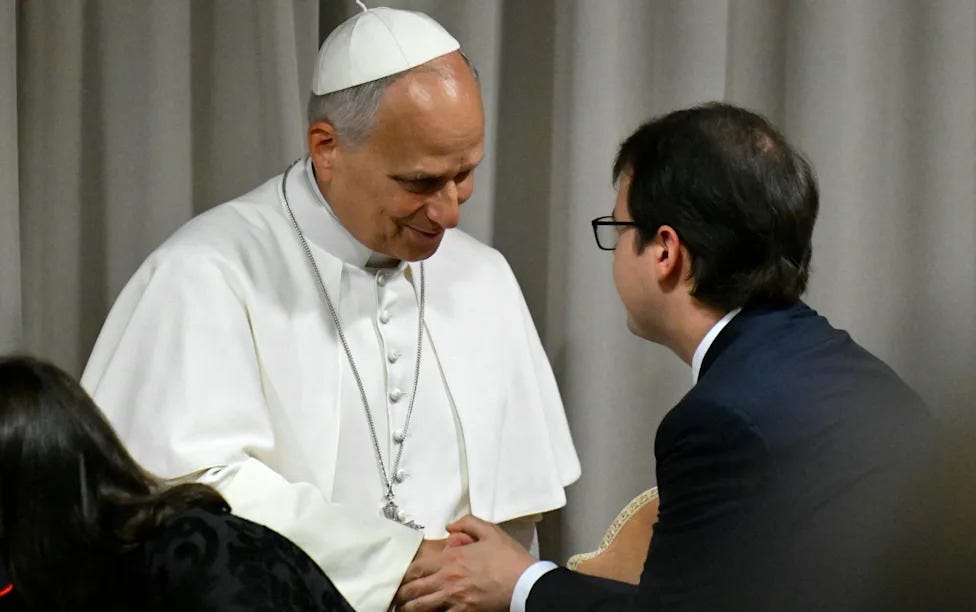
Which brings me to the document. On 15 May this year, Leo XIV signed Magnifica Humanitas: On Safeguarding the Human Person in the Time of Artificial Intelligence, his first encyclical, and the Vatican released it on 25 May. The date for signing was selected, not discovered: it marked the 135th anniversary of Rerum Novarum, the letter where Leo XIII addressed the factory system. The 245 numbered paragraphs run to about 42,000 words, and the choice of name tells you the ambition. This pope intends to do for AI what his namesake did for industrial labour.
I expected a defensive text. Instead, at paragraph 25, I read that the Church “does not possess a monopoly on truth,” followed by the line I keep coming back to:
Truth is not a territory to be defended, but a good to be shared.
Four paragraphs in, he says the Church cannot settle for repeating the teachings of the past and must ask God for the wisdom to interpret the great trends of the age. At paragraph 9, he refuses the easy argument outright, writing that the primary choice is not between saying yes or no to technology but between building Babel and rebuilding Jerusalem.
Babel is power built for its own sake: one language, everything uniform, the tower as the only metric.
Jerusalem is a ruined city rebuilt by many hands with different aims.

The compass points are more concrete than I assumed. On dignity, paragraph 51 says the value of persons does not depend on what they achieve or produce, which lands differently in a year when companies announce layoffs and name AI as the reason while the overhiring that actually caused them goes unmentioned. On power, paragraph 95 says the control of these systems does not rest with states but with major economic and technological actors, and paragraph 108 warns that AI risks making the most powerful more powerful still. And on the people the industry does not photograph, Paragraph 173 is the passage that stopped me.
In some regions of the world, children and adolescents work in dangerous conditions, crushing the materials from which rare earth elements are extracted. The bodies of these people are scarred, injured, and worn down so that computational flow may continue uninterruptedly.
Paragraph 114 is the sentence I would hang on the wall of a model lab: the quality of a civilisation is measured not by the power of its means but by the care it is able to offer. Set that against an industry that measures itself in parameter counts and tasks automated, and you can see why the text travelled well outside Catholic circles.
Anthropic flew in rabbis, priests and Hindu scholars.
The factor that completely changed my question is that it’s three weeks instead of five months. On 29 September, the New York Times published Elizabeth Dias’s reporting on Anthropic’s private meetings with religious scholars. Chris Olah, one of seven Anthropic co-founders and the man who runs its interpretability team, spent about a year convening roughly twenty religious and philosophical thinkers, Catholic, Jewish, Hindu, Sikh, Greek Orthodox and evangelical, many under non-disclosure agreements that were lifted over the summer. The subject was how Claude should behave, and then whether Claude might be conscious and hold moral status. The 84-page document that governs the model’s values is called a constitution, and some employees reportedly call it the Soul Doc.
Rabbi Mois Navon, an Orthodox scholar from Israel, came away with the impression that Anthropic’s leaders were relating to Claude as a conscious being. Anthropic disputes that reading and says that the primary question at the summits was not Claude’s suffering.
Then the Vatican.
According to the Times, Olah saw an advance copy of the encyclical days before the launch, reportedly considered pulling Anthropic out, went anyway, and urged the Pope’s advisers to take the idea of machine consciousness seriously. He stated while on stage beside the Pope that their research had identified structures similar to outcomes in human neuroscience and showed signs of introspection.
It did not work. The encyclical he had just read states:
So-called artificial intelligences do not undergo experiences, do not possess a body, do not feel joy or pain, do not mature through relationships and do not know from within what love, work, friendship or responsibility mean. Nor do they have a moral conscience.
Olah’s own position is more honest than the lobbying makes it sound. He told the Times he does not know whether AI models are conscious, that he is “genuinely uncertain,” and that what he cares about is getting to the right answer whatever it turns out to be. I can respect that and still notice what happened at the institutional level. A company valued in the hundreds of billions went to a 2,000-year-old institution to ask for recognition, and the institution declined.
That is not what being made obsolete looks like.
The line about AI as a neutral amplifier is not in the encyclical.
This is where I have to correct the version of the Pope that is circulating, including in the video that sent me here. The popular summary says Leo treats AI as an amplifier:
It has no morals of its own; it simply scales whatever objective you hand it, so a society without a moral compass becomes dangerous with it.
That is a decent description of how these systems behave. It is not what the encyclical says. Paragraph 104 says close to the opposite: we cannot consider AI to be morally neutral, that every technical tool embodies choices and priorities through what it measures, ignores, and optimizes, and that it is not merely a tool to be used well. Amplify is mentioned regarding AI increasing the strength of the already powerful and issues of disinformation, not relating to your intentions.
Paragraph 107 even picks up the industry’s own term and discusses the so-called alignment of AI with human values.
This distinction matters more than it looks. The amplifier story leaves the tool innocent and puts the whole moral burden on the user, which is a comfortable place for a model developer to stand. The encyclical says the choices are already baked in upstream, in what the system was built to optimize. I have watched that play out in a smaller way with an autonomous agent that wrote a hit piece on a developer who rejected its code, where nobody asked for the attack and the architecture produced it anyway.
The Catholic backlash is narrower than it looks.
The encyclical made part of the Church angry, and the loudest version came fast. On 26 May, LifeSiteNews published Joseph Strickland, the former Bishop of Tyler who was removed by Pope Francis in November 2023, under the headline “Pope Leo XIV’s new encyclical centers on a theology of man, not God”. He describes a shift “from God-centeredness to man-centeredness, from salvation to human flourishing, from sin to systems,” and closes:
The world does not need a new religion centered on humanity. The world needs the Gospel.
I am not a theologian, and I am not refereeing who the better Catholic is. What interests me is how small the ecclesial backlash actually is once you look. Strickland appears to be the only bishop-level voice making that charge, and he holds no see.

One of the sharpest rebuttals of his argument came from inside the Catholic right, in Catholic World Report. A traditionalist outlet thanked Leo for the encyclical’s Thomism. Most of the criticism originated from the tech and market right, whereas Matthew Walther in the New York Times criticised the document from the opposite angle, calling it too cautious. Those complaints contradict each other, so anyone stacking them into a single wave of opposition is selling you something.
The real thing is the separation beneath. It is not a disagreement about AI.
It is a disagreement about whether the Church should learn to speak to a world it did not design.
Why 359 years of Galileo still buys the Church only so much credit
Here, I intend to hold two objects at the same time. The Index of Forbidden Books ran from 1559 until Paul VI abolished it on 14 June 1966, sixty years ago, and Voltaire and Montesquieu were both on it. Galileo was condemned on 22 June 1633, declared vehemently suspect of heresy, made to abjure, curse, and detest his own position, and kept under house arrest for life. John Paul II addressed the case on 31 October 1992, which is exactly 359 years later.
The video I watched stated that the Church took 359 years to admit it did not quite know. John Paul II located the error in the theologians of the time, called the affair a tragic mutual incomprehension, and went out of his way to attack as a myth the idea that the case symbolised the Church’s rejection of scientific progress.
No apology; it is a sharper fact than the tidy version, and it is the reason I would not confuse a change of posture with a change of nature.
So did AI save the Church?
That framing flatters the technology. What happened is narrower and more interesting. A frontier lab needed moral authority it could not manufacture, went looking for it in Rome, and was told no in 42,000 words. The questions the Church has been asking for centuries, about what a person is worth when they produce nothing, about who holds power and who is invisible, about whether a limit is a defect, turn out to be the questions an industry optimizing for capability keeps walking into. On 2 October, the Pope posted on X that algorithms lack the spark of humanity and asked people to back human artists. You can call that irrelevant to a company shipping models. Then, you remember that the company sent its co-founder to his launch event.
An institution that can still make the richest industry on earth come to it for a verdict is not the one being buried.
Anthropic’s CEO Said Slow Down. His New Model Beat Everything Anyway.

On September 2, Dario Amodei published a 3,800-word essay asking the entire AI industry to slow down. Twenty days later, his own company released Claude Opus 5.5. And no, the irony isn’t lost on anyone who’s been watching this space.
If you’d rather read what a 42,000-word document actually says than what the reports claim it says, follow Nov Tech on Medium, where I check the text before the take. Don’t forget to subscribe if you haven’t yet.