


Claude Duet comes with the $20 Claude Pro plan, and it looks at your inbox every few hours. The open-source agents that started this category check every 30 minutes by default, on a machine you control, and the first big one had to change its name because Anthropic asked.
Anthropic opened a research preview of Claude Duet on 21 October. It’s an app, not a new model, and it runs on Claude Opus 5.5 as a proactive agent. You get a quick brief each morning, a message when something needs you, and tasks you hand over keep running after you close your laptop. One can gain access by joining a waitlist.
What Claude Duet Does and Who Can Use It
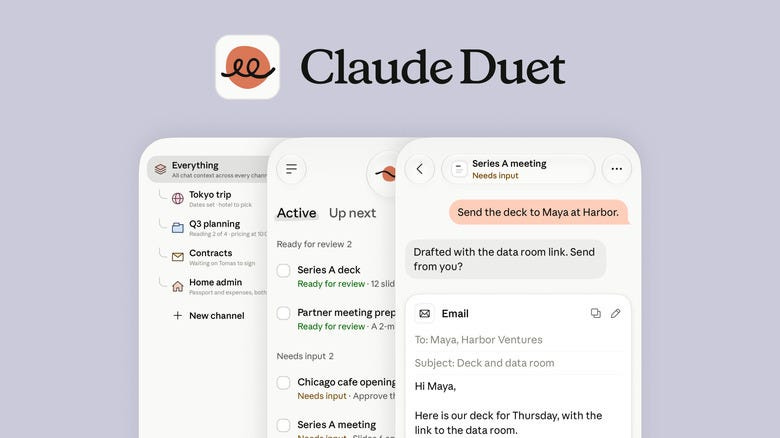
Duet carries over the memory, skills, and connected apps from your Claude account, so there’s almost nothing to set up. With its own virtual machine and browser, it doesn’t require your phone or laptop to be on and can tap into over 6,000 connectors and plugins from the Claude Marketplace. Before it sends a message, makes a payment, signs a document, or deletes anything, it shows you the exact action and waits for a yes.
DataCamp’s review describes two tabs worth knowing. Tasks show active work and anything waiting on you, and only you can mark a task complete. Make holds the bigger results, like editable briefs, financial models, slide decks, and dashboards. Anthropic is upfront about the rough edges too, and its own caveat says, “It still might misread a thread or miscalibrate what’s urgent.” Early testers are split. Dan Shipper used it for two weeks and liked it, and Claire Vo said she tested it and then forgot about it, according to the same review.
An AI Agent Is a Timer With a Job
Take the scheduled tasks you may already run in Claude or ChatGPT. Now stop tying them to a clock time and give them a frequency instead: every hour, every 30 minutes.
Why not every minute? That’s an agent. The timer wakes a piece of software, hands it instructions and a set of tools, lets it look through your email or your code or your calendar, and it speaks up only when something matters. A timer. That’s the trick, and it’s why the interval matters more than the logo.
OpenClaw’s docs say it runs a heartbeat every 30 minutes by default, or every hour when Anthropic OAuth or token auth is configured. Duet checks every few hours, and Anthropic’s reason is a budget reason: “checking nonstop would use up your plan’s limits much faster.” You can tell Duet what you want to hear about and how often, but the checks still count against the same limits as the rest of Claude.
That turns “proactive” into a number on a planning page. An agent rationed by your subscription is proactive on a budget. I don’t think that’s a scandal because I’d guess a cloud computer and an Opus-class model running for every subscriber aren’t cheap. It means the most autonomous setup is the one where you hold the dial.
OpenClaw Got Renamed by Anthropic, Then Its Creator Joined OpenAI
The category didn’t start at a big lab. Peter Steinberger, an Austrian developer, published OpenClaw in late 2025 as an agent you talk to through apps like Telegram, WhatsApp, and Slack. It started life as Clawdbot, a nod to Claude Code’s mascot, and in January, Anthropic asked the project to change its name over trademark concerns. Steinberger put it more bluntly on X: “I was forced to rename the account by Anthropic.”
By mid-February, he was joining OpenAI, with OpenClaw moving to a foundation and staying open source. His stated next mission was to “build an agent that even my mum can use.” Nous Research followed with a public launch of Hermes Agent on 12 March, according to a comparison by innFactory, and OpenClaw 2.0 landed on 30 August with a rebuilt browser app, dashboards and shared sessions. Then the labs arrived one by one. Grok Bot went into beta on 11 August. Meta’s Muse launched on 8 September, OpenAI’s dots on 29 September, and Duet on 21 October, per AIMultiple’s tracker.
I took the OpenAI side apart in my article “OpenAI Gave Its New Model One Minute at DevDay. It’s Building a Cage Around Your Workday.”, and the pattern is the same here. An open-source idea gets packaged inside a subscription.
Nothing about that sequence is illegal or even unusual. It’s still hard to unsee. The hobby project proved people want an always-on agent was asked to rename in January; its creator was at OpenAI by February, and by October Grok Bot, Muse, dots and Duet all existed, each with its own price list, waitlist or ecosystem to keep you inside.
What You Give Up for $20 a Month
On price, Duet wins in the US. OpenAI says a dot is included with ChatGPT Pro or Business Premium, and AIMultiple lists dots from $100 a month, against a free starting tier for Muse and $20 for Duet through Claude Pro. Anthropic’s annual billing brings that to $17 a month, per DataCamp.
What you sacrifice are choice, vision, and, I would say, ownership. Duet runs on Opus 5.5, and you can’t pick another model. It can’t show you its browser, while OpenAI’s dots let you open the cloud computer and take over. It doesn’t connect to Microsoft 365 and can’t see files on your computer. Then there’s memory. Duet uses your Claude account’s memory, which lives with Anthropic, and after you disconnect an app, Anthropic says, “What Claude Duet already learned from it stays until you reset its memory.”
That last point is the one I care about.
I think about my setup the way a company thinks about assets. If I share my habits, skills, planned jobs, and memories with an agent, I want them to belong to me, not be stored as part of someone else’s application. That’s why I run an open-source agent every day, OpenClaw in my case, and why you should weigh my bias. The interface has changed a lot since I first tried it early this year: a chat on the home screen, several agents working in parallel, dashboards, automations including that 30-minute heartbeat, plugins, and sessions you can organize. It isn’t the hype right now, and I don’t understand why.
The trade is clear, though. OpenClaw’s software is free, but you pay for the server and the model usage, and it still suits advanced users better than someone who wants to sign up and go. Duet is a reasonable first step for people who will never run a server, and the price is hard to argue with. As soon as my invite arrives, I’ll give it a test.
What I keep coming back to is who should hold the dial. If the best agent is the one that checks most often, do you want the interval set by you, or by your plan? I need your opinion in the comments section.
AI Is Getting More Expensive for You and More Expensive for Everyone Building It. Only One of Those Groups Is Celebrating.

You’ve noticed this, even if you haven’t put a number to it. The things that used to be free in AI are becoming paid features. The messages you used to get in bulk now run out faster. Image generation that came included is now metered or gated behind higher tiers. Enterprise companies that enthusiastically pushed their employees toward AI tools are now looking at monthly invoices in the millions and having difficult conversations about whether any of it is worth it.
Thanks for reading. Follow Nov Tech for AI coverage that sorts out who owns what, and subscribe on my newsletter to get early access.