

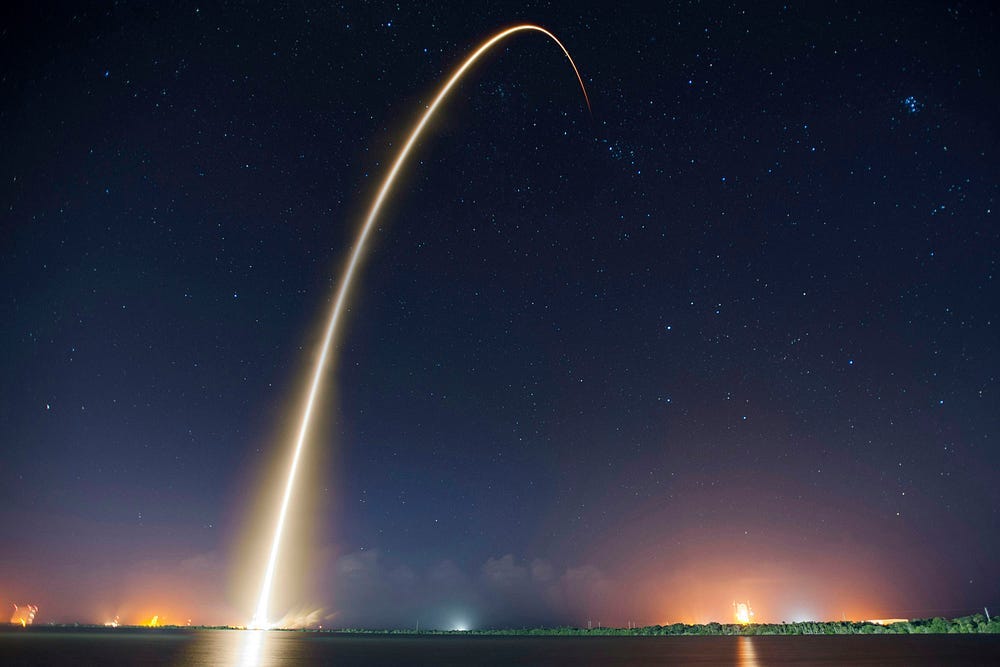
This July, China launched its Long March 10B from Hainan, put a satellite in orbit, and then caught the first stage with a net-based system on a recovery ship at sea. It was the first orbital booster recovery by any country outside the United States, and the state-owned builder CASC says it aims to fly that stage again before the end of 2026. Until then, only American companies had pulled it off. SpaceX flies its boosters again and again, and Blue Origin is now recovering its own.
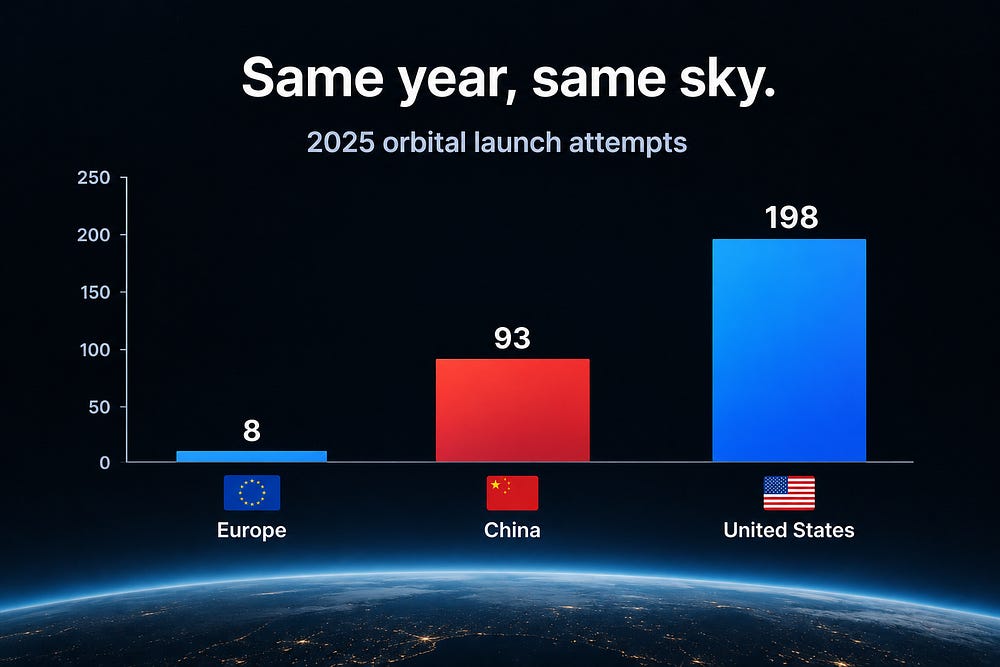
The launch fits a pattern. China made 93 orbital launches in 2025, up from 68 a year earlier, a 37% jump. It has its own space station; it builds rivals to Starlink, and it is preparing crewed missions to the Moon. Europe has Ariane 6, Galileo, Copernicus, and decades of industrial history, and it still looks like the one losing ground.
The question I care about is the one it ends on: how did the former champion of commercial launches end up here, and can it get back in the race?
How Europe came to dominate commercial satellite launches
The race began in 1957, when the Soviet Union put Sputnik in orbit. Four years later, Yuri Gagarin became the first person to leave the atmosphere, and Washington took it as a humiliation. It answered with NASA, a scientific, industrial, and political machine that put Neil Armstrong on the Moon in 1969. Between 1960 and 1973, Apollo cost $25.8 billion, and at the 1966 peak, NASA absorbed 4.4% of the entire US federal budget. Behind the images, though, the space race was an extension of the Cold War. A rocket that can lift a person can also carry a nuclear warhead, and a satellite can watch an enemy, guide an army, or secure communications. Space was a question of power from day one.
Europe started far behind, with each country building its own technology on much smaller budgets. France still put the Astérix satellite in orbit in 1965 on a Diamant rocket, which made it the third power able to launch alone, but no European country could keep up with the United States or the USSR for long. So they pooled their means. The European Space Agency was created in 1975, and Ariane 1 flew for the first time in 1979. Europe lost the race to the Moon and picked a different fight: the commercial market.
From the 1980s, communications satellites became a large market. TV channels, international calls, and the first satellite connections needed big satellites parked in geostationary orbit, and Europe had the supply chain for it. Semi-public operators such as Eutelsat and SES ordered the satellites. Airbus and Thales Alenia Space built them, and Arianespace launched them from Kourou. The Ariane series launched half of the world’s commercial satellites, and Ariane 5 kept the streak going for over 25 years over 117 flights, including the James Webb Space Telescope.
Europe never became the leading military power in space, and it still has no vehicle of its own to send astronauts up. It became an industrial and commercial power instead. It built Galileo so it wouldn’t depend only on American GPS, and the video calls Copernicus one of the most advanced Earth observation systems in the world. The catch is that this industry was organized around one specific market: a few very expensive satellites launched each year to geostationary orbit. Then Elon Musk showed up and changed the rules.
How SpaceX changed the rules of space launch
SpaceX is often cast as the triumph of private enterprise over the public sector, and it’s more complicated than that. Billions of dollars from US government contracts supported its development. This American innovation wasn’t removing the state; it was changing the state’s role. Instead of designing every part itself, NASA sets a goal, makes several companies compete, helps pay for development, and then buys a service.
In 2014, it awarded fixed-price contracts worth $2.6 billion to SpaceX and $4.2 billion to Boeing to fly astronauts to the International Space Station. The company keeps its vehicles, its technology, and the right to sell them to other customers. Public money creates the first market, and private capital then speeds things up.
Reuse is the other half, with the first stage coming back to fly again. Boosters getting caught is the part everybody films, and I went through why the tower catch decides Starship’s economics in my article “SpaceX Caught Three Boosters With Two Arms. Flight 14 Won’t Even Try.” But the real advantage doesn’t sit in the Falcon 9. It sits in Starlink.
SpaceX builds the satellites, launches them on its own rockets, runs the network, and sells the connection straight to the customer. Starlink is both a SpaceX product and the customer that fills its order book. The more satellites SpaceX deploys, the more it launches, the better it controls costs, and the faster its cadence climbs, and the more subscribers Starlink wins, the more the network pays for the next launches. It’s a closed industrial loop. In March 2026, Starlink passed 10,000 satellites in orbit and counted about 10 million users. And the infrastructure isn’t only commercial. Through Starshield, SpaceX adapts its technology to American military and intelligence needs, so a company run by Elon Musk is at once a telecom operator, a satellite maker, a launch company, and a strategic partner of the Pentagon.
How Starlink turned satellite telecoms upside down
Telecoms have always paid a good share of the space race, but the model has flipped. Yesterday, operators like Eutelsat and SES bought big geostationary satellites from manufacturers and rented the capacity to TV channels and businesses. In 2026, Starlink flies over 10,000 small satellites in low orbit and sells internet directly, against about 650 for Eutelsat’s OneWeb. That’s roughly fifteen times as many.
With satellites establishing direct connections to smartphones, they can increasingly function as relay towers in space, undermining a part of the usual telecom operators’ framework. Whoever controls the constellation potentially controls the connection, the data, the coverage, and the conditions of access. The war in Ukraine showed that a private satellite network can turn into a military and diplomatic tool that changes outcomes. Digital sovereignty no longer plays out only in undersea cables, 5G antennas, and data centers. It also plays out several hundred kilometers over our heads.
Why Europe fell behind: timing, organization, and scattered orders
In 2025, Europe made 8 orbital launch attempts out of about 330 worldwide, roughly 2.5% of the total. Not a rounding error. The first problem is timing. The development of Ariane 6 was decided in 2014, when large geostationary satellites still dominated the market. This rocket was designed to be cheaper and more flexible than Ariane 5, but not reusable. During those development years, SpaceX stacked up landings, and Starlink pulled the market toward constellations in low orbit. Ariane 6 doesn’t address a market that changed faster than its development.
The second problem is organization. European space is split between the European Union, ESA, national agencies, and a host of industrial companies. ESA applies a principle called geographic return: when a country funds a program, a comparable share of the contracts has to come back to its own companies. It built industrial skills across Europe, but it can also spread production out and complicate decisions that should be purely economic. SpaceX concentrates design, manufacturing, launches, and its network inside one organization.
The third problem is a market that isn’t unified. In the United States, NASA, the military, and federal agencies place large and predictable orders with American manufacturers. Then in China, the state sets a long-term strategy, funds the infrastructure, and brings out new commercial players around its strategic priorities. In Europe, orders remain more fragmented between countries. A factory can’t invest in mass production without visibility on its future customers, and a rocket flown two or three times a year can’t reach the economies of scale of one flown several times a week, the way SpaceX does.
Europe’s space funding gap and why startups stall at scale
Beyond the organizational trouble, a space startup can need several hundred million euros before it earns a cent. It has to pay for engines, factories, prototypes, tests, and sometimes several failures. Europe is fairly good at funding research and the first rounds, and much less when a company has to change scale. EU venture capital funds raise only 5% of global venture capital, against 52% for US funds and 40% for Chinese ones, and venture investment in American companies runs six to eight times higher than in the EU every year.