

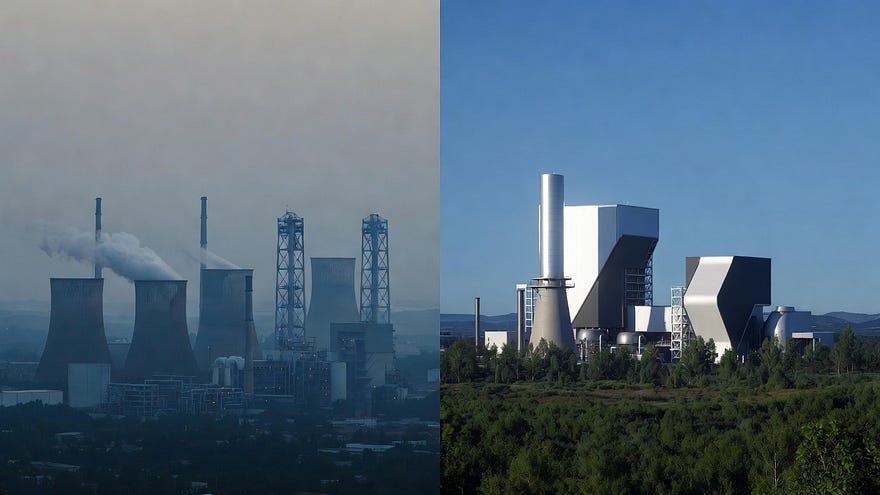
A new turbine at a steel plant in Liupanshui, Guizhou Province, southwest China, was launched for the first time on December 20, 2025. And with it, a century of energy technology just came to an end.
This isn’t a lab experiment. The facility is a 30 MW commercial power plant, linked to China’s power grid and already producing income.
Here’s what makes this absolutely wild: this power plant doesn’t use steam. It doesn’t boil water. It runs on something you exhale every second — carbon dioxide. And according to its designers, this technology increases electrical generation efficiency by more than 85% compared to traditional systems.
Since the invention of the steam engine in the 18th century, literally every power plant on Earth has worked on the same principle: heat water, produce steam, spin a turbine. Coal plants, nuclear plants, gas plants — the principle stays identical. For over a century, nobody managed to do better.
Until now.
Why Water Has Been Holding Us Back
To understand why this is revolutionary, you first need to understand what’s wrong with water. Boiling water is an incredibly energy-hungry process. A significant portion of the heat produced by a power plant is literally wasted in this phase change — that transition from liquid to gas.
The most efficient current steam plants operate at approximately 30% to 40% efficiency. That means 60 to 70% of the thermal energy produced is lost. Just gone.
Supercritical CO2 solves this problem elegantly.
When you increase carbon dioxide pressure above 73 atmospheres (the equivalent of being 740 meters below the ocean surface) and exceed 31°C, something strange happens. CO2 enters a hybrid state. It’s not really a gas anymore, but it’s not quite a liquid either.
It has the density of a liquid, allowing it to store massive amounts of energy, but it flows with the fluidity of a gas, drastically reducing friction losses.
Wang Guangping, the chief scientist of the Chaotan One project, compares it to a powerful man pedaling a bicycle coated with lubricating oil — maximum power with minimal effort.
The Chaotan One plant is installed at the Shougang Shuicheng Iron and Steel plant in Liupanshui. The process captures and converts waste heat from steel sintering, which was formerly released into the atmosphere, into electricity.

Two 15 MW units were developed by China’s Nuclear Power Institute under the China National Nuclear Corporation. The announced numbers are impressive:
Over 70 million kilowatt-hours of electricity per year, generating about 30 million yuan in revenue (roughly $4.26 million).
To put that in perspective, that’s the annual consumption of a mid-sized city. All in a space 50% smaller than an equivalent steam installation.
Keep that in mind, because it’s about to make perfect sense.
While China Commercializes, America Experiments
So while China is commercializing this technology, what are the Americans doing? Experimenting.
