Did Musk Manipulate His Own Employees on Camera?
The 30-minute meeting he posted publicly contains something far more revealing than his scripted answers — and it’s not what the press reported.

Elon Musk published a 30-minute meeting with SpaceX employees last Tuesday, and the internet spent most of the week discussing it. In the meantime, the document that actually matters to anyone following the program went almost entirely unnoticed. It is not a video. It is a regulatory filing with about as much charisma as a form letter. But if you want to understand why the next Starship flight is the highest-stakes test in the program’s history, that filing is where the story actually lives.
What’s Happening on the Ground at Starbase
Two weeks out from a test of this magnitude, the infrastructure work at Boca Chica tells you something about what SpaceX believes is going to happen.
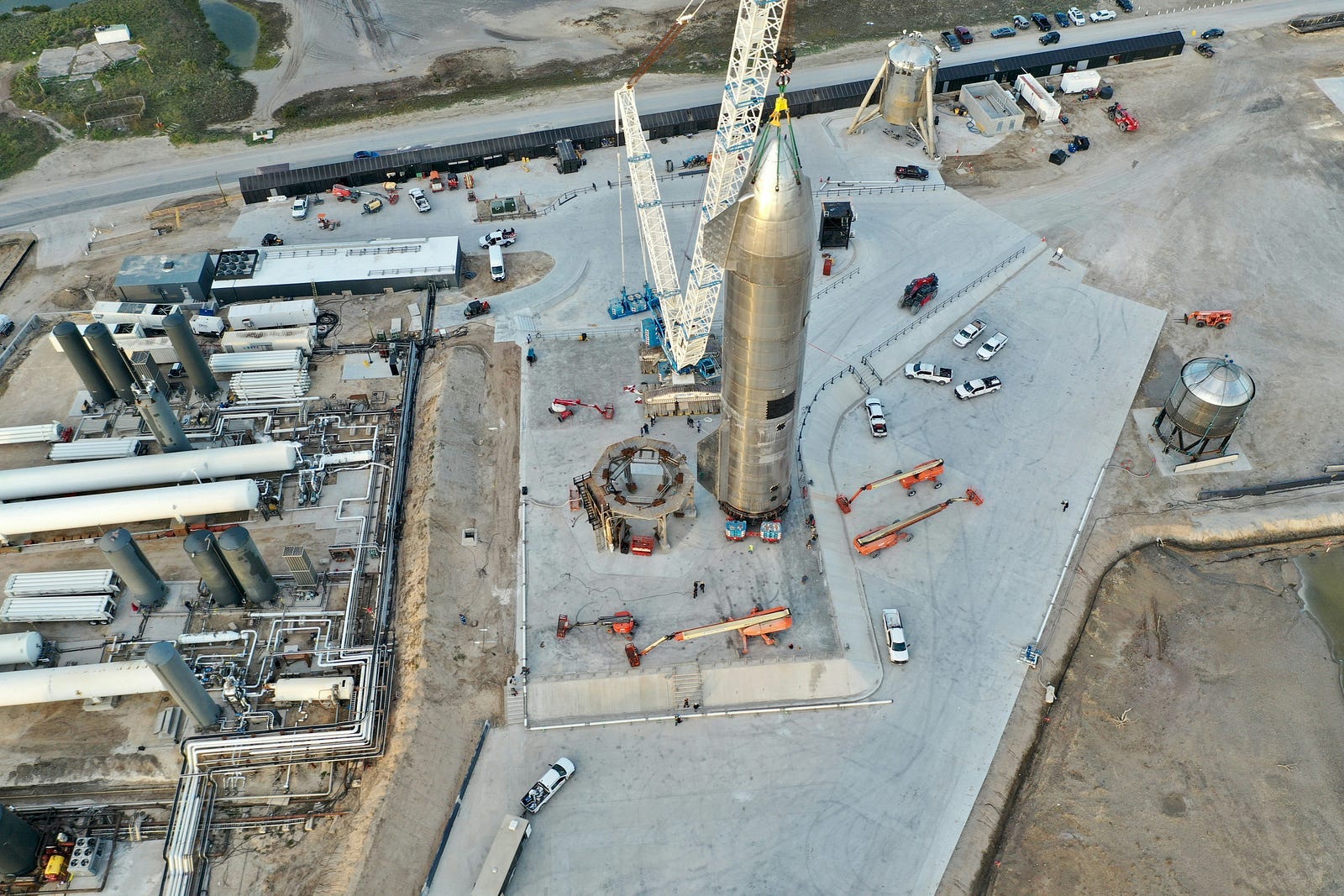
Pad A has been in a state of continuous upgrade since late 2025. The work currently underway includes a doubled water deluge system, a reinforced orbital launch table, modifications to the QD (quick disconnect) arm that fuels the Ship, protective improvements to the tower’s electrical and support networks, and a new maintenance platform that will eventually replace the scaffold systems engineers currently used to access the hold-down clamps between flights.
Those clamps are worth a closer look. Twenty are in place, ready to grip Super Heavy until the launch. On the night of August 12, the team retracted each one individually and ran their first dedicated test of the system. This is not a detail to skip past. The hold-down clamps must release precisely at ignition and fully clear the path of 33 Raptor engines in the fraction of a second before the booster moves — then retract fast enough not to not to be damaged by the exhaust.
Zack Golden, reporting from the CSI Starbase channel, noted that the new maintenance platform will allow individual access to each clamp far more efficiently than the current scaffolding arrangement, potentially cutting days from the turnaround time between flights.
Community creators Niall Anderson and Sean Gissler, working with the Marcus House channel, flagged an important change to Mechazilla’s arms. New sections of steel have been cut from the outer ends of the Chopsticks, extending modifications that SpaceX began when it found that the genuinely useful catch window is much closer to the tower than the original arm design expected.
To handle both current and future vehicle stages, the previous arms were reconfigured to discard lifting hardware exclusive to V1 and V2 vehicles, incorporating a new, singular system instead. Every cut and every weld is pointing toward the same objective: faster operations, fewer days between catches, higher cadence.
A separate site at Massey’s is running its own parallel program. Booster 18.3, a structural test article that arrived in late September 2025, has now completed over ten cryogenic pressure cycles, testing the structural limits of the V3 Super Heavy. After a dome section collapsed on January 21, 2026, still officially unexplained as either deliberate or accidental, the hardware is now on a new platform and may be repurposed as a water storage vessel.
Ship 43.1, which drew attention through the factory windows for its unusual hull cutouts, moved to Massey’s around August 7 and has been set up in a new test stand. Those cutouts appear to be mounting points for load-applying actuators designed to simulate the forces the V3 Starlink dispenser and the new forward dome attachment points will experience in flight, including a simulated Mechazilla catch. Valuable data gathered before anyone has to learn from a failure.
SpaceX is also extending its test infrastructure eastward. The company filed an environmental assessment request for Project Ignition, a new facility covering approximately 41 hectares near the operational W Road area of Kennedy Space Center, south of Schwartz Road near the Indian River Lagoon. The design mirrors Massey’s layout: a static fire test stand for Starship articles, structural test capability, and the supporting infrastructure for evaluation before vehicles are transferred to LC-39A or SLC-37 for launch.
With first Starship flights from Kennedy Space Center targeted before the end of 2026, this facility prepares the East Coast for the same cadence the Texas site is already building toward.
The Meeting Nobody Was Watching For
All of this physical preparation converges on what SpaceX’s CEO said to his employees on August 11.
The meeting was posted in full on X and runs about 29 minutes. The first half covers ground most followers of SpaceX already know: the early Falcon failures, the Falcon 9’s dominance and reusability, Dragon’s 78 astronauts flown, Starlink’s reach across 167 countries with approximately 22 million mobile users, and Starship’s trajectory toward full reusability. This section has the structure of a progress review delivered before a difficult mission; a reminder of how far the company has come from the moments when it could have ended.
The second half is where the meeting’s real purpose comes into focus.
Musk’s central claim: AI revenue will surpass all other SpaceX revenue combined Starlink and launches included, by September. In Q2 2026, AI generated $2.56 billion while Connectivity and Space combined for $5.25 billion. For Musk’s September claim to hold, AI revenue needs to more than double in a single quarter while the other divisions hold steady. When one of his staff offered him a hedge, he corrected himself mid-sentence: “Not probably, definitely.” He then said AI would significantly exceed all other revenue in Q4.
The hardware roadmap behind that claim: SpaceX currently operates approximately 1.4 GW of AI computing capacity, which it describes as the world’s most powerful AI training cluster. The target is 10 GW by the end of 2027. Musk stated that at that scale, the potential annual revenue sits between $300 billion and $500 billion. He also said that in four to five years, AI would represent 99 percent of SpaceX’s total enterprise value.
Then came the statement that has generated the most friction since the meeting was published. SpaceX plans to train Grok, its AI model family, on the entire company’s internal information — including the work produced by its employees. “So in a way, it will be trained on you,” Musk told the room, framing it as a legacy rather than a data extraction: the employees would be “the parents of the AI,” and Grok would inherit their thoughts, ideas, and professional values.
He argued this was a safeguard because he believes the people who work at SpaceX represent some of the strongest engineering talent in the world; their embedded knowledge will give Grok more grounded values than a model trained purely on internet text.
Whether you find that framing inspiring or unsettling depends on where you sit. What’s not debatable is the economic logic: AI developers have largely exhausted openly available web data as a training source and are now seeking proprietary datasets. SpaceX’s operational knowledge — covering rocket design, materials science, orbital mechanics, manufacturing at scale, and satellite communications — is one of the most domain-specific bodies of institutional knowledge in the private sector.
Training Grok on it is a competitive move, regardless of how it’s presented to employees. The privacy and consent questions it raises are real; the company has not publicly clarified what data will be used or how employees can opt out.
The Timing That Is Worth Noting
Here are the dates, in order, without commentary.
June 12: SpaceX IPO at $135. Stock opens at $150, runs to the low $200s, then spends weeks declining.
August 5: Stock hits its historic low at $105.11.
August 6: 911.5 million insider shares exit their lock-up period, more than doubling the float. The expected collapse does not materialize. Stock closes up 2.6 percent.
August 11: The employee meeting is published publicly on X.
August 12: Stock jumps 11 percent. Short interest, which had peaked at approximately 34 percent of shares, drops to around 11 percent.
August 20: A further 319 million shares exit lock-up. Additional tranches are expected in September and October.
The meeting contained projections large enough to reframe the entire investment thesis for anyone who had concluded that SpaceX was primarily a launch company with a satellite internet business attached. Musk is not saying that. He is saying SpaceX is an AI infrastructure company that also operates the best launch and satellite systems in the world, and that the financial center of gravity is about to shift in roughly five weeks.
Interpret the timing as you choose.
What the FCC Filing Actually Revealed
The document that should have been the story of the week is a Special Temporary Authority application SpaceX filed with the FCC — the American agency that manages radio frequencies — requesting permission to communicate with Starship during the fourteenth test flight.
On every previous filing, including the one for Flight 13, the language governing the Super Heavy booster’s landing was consistent: “The 1st stage booster will either return to the launch site or perform a water landing.” The Flight 14 filing drops the fallback. It reads: “The 1st stage booster will return to the launch site.”
That is not a minor wording change. Previous flights caught V2-generation Super Heavy boosters. Flights 12 and 13 used the new V3 Super Heavy booster, which attempted water landings that ended badly. SpaceX’s FCC filing for Flight 14 shows its intention to have the V3 booster brought back to the tower so the Mechazilla arms can catch it. This is a first, separate from the confirmed first-ever attempt to catch the ship with that same tower on this mission.
To understand what that means, consider what the Ship is. It is a 50-meter steel vehicle that has just completed approximately a full orbit of Earth at orbital velocity, survived reentry — temperatures approaching 1,400 degrees Celsius on the heat shield — and must then conduct a precisely controlled flip maneuver, reignite engines, and arrive at the tower arms at the correct speed, angle, and horizontal position.
This Super Heavy catch, first shown in October 2024 on Flight 5, was already considered one of the more remarkable things a rocket had done. The booster is large; it moves relatively slowly at catch, and it does not have to survive the full thermal violence of orbital reentry. The Ship catch is a different class of problem.
No orbital-class upper stage has ever been caught this way. No upper stage of any kind has been caught this way. SpaceX is planning to do both on the same mission.
The window is not just technical. Musk stated during the earnings call that Flight 14 is tentatively scheduled for the end of August — the FCC filing references August 28 as a net date. The FAA must issue its launch license before anything happens. The mission timeline, once orbital, may extend to 48 hours or more, depending on the window used. And unlike any previous Starship test, this one will deploy approximately 20 operational Starlink V3 satellites — not demonstration units, but production hardware that feeds directly into the company’s revenue stream.
The stakes in the event of a catch failure are of a different kind from those in a mid-flight loss. If the Ship or booster misses the arms and hits the tower, the launch infrastructure itself is at risk — months of reconstruction, a schedule that collapses, and a company that has made $300 to $500 billion revenue projections to investors suddenly unable to explain why its keystone program is offline. That is why the engineers have spent weeks on hold-down clamp tests, arm geometry adjustments, and maintenance platform upgrades. Getting the catch right the first time is not optional.
The 14th flight of Starship is not a test of an idea. It is a test of whether the entire business model — the one Musk described to his employees and to investors in the same week — can physically deliver on its promises.
Thanks for reading. I’m curious to know your opinion. Follow me and subscribe for more exciting science and tech innovations. Also, subscribe to my newsletter for early access.

