

Anthropic’s newest model finished 41.3 percent of a set of real freelance projects at a quality a client would accept, against 2.5 percent for the best system when the test launched. Yet Anthropic’s own advice for most work is still to start with its cheaper model, Opus 5.5.
I know which of those two sentences I trust more. That habit of handing over the job and then verifying what comes back is the thing Fable 5.2 changes most, so I went through Anthropic’s release page, two independent leaderboards, and an outside reviewer’s notes before writing this.
Here is where I land. Fable 5.2 is progress. It costs more than its price per million tokens suggests, and the AGI label matters far less than who checks the work.
What 41.3 percent of real freelance work means
The number comes from the Remote Labor Index, built by Scale Labs and the Center for AI Safety. According to Scale’s leaderboard, the set holds 240 real freelance projects, 230 of them used for scoring, with an average value of $632.60, a median of $200, and 28.9 hours of human work per project on average. A deliverable counts only if it is judged at least as good as the reference and one a reasonable client would accept.
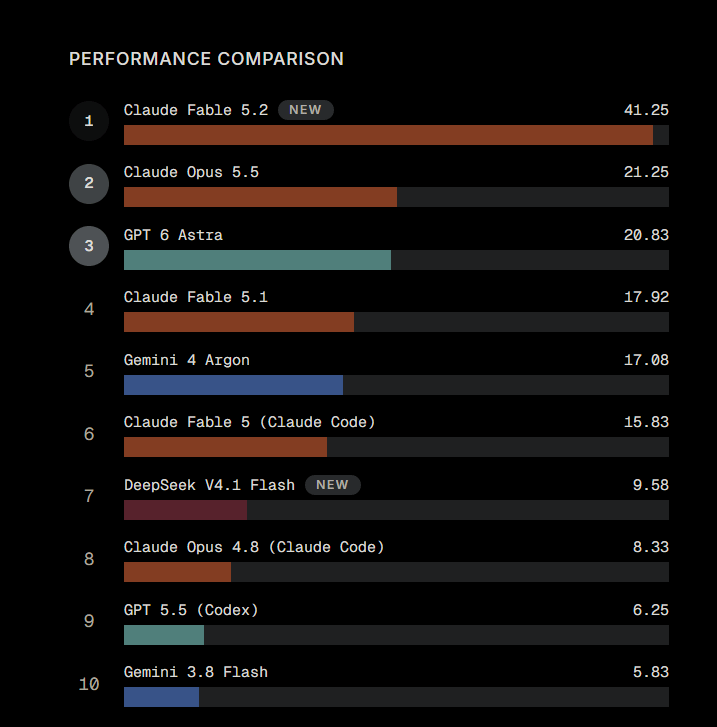
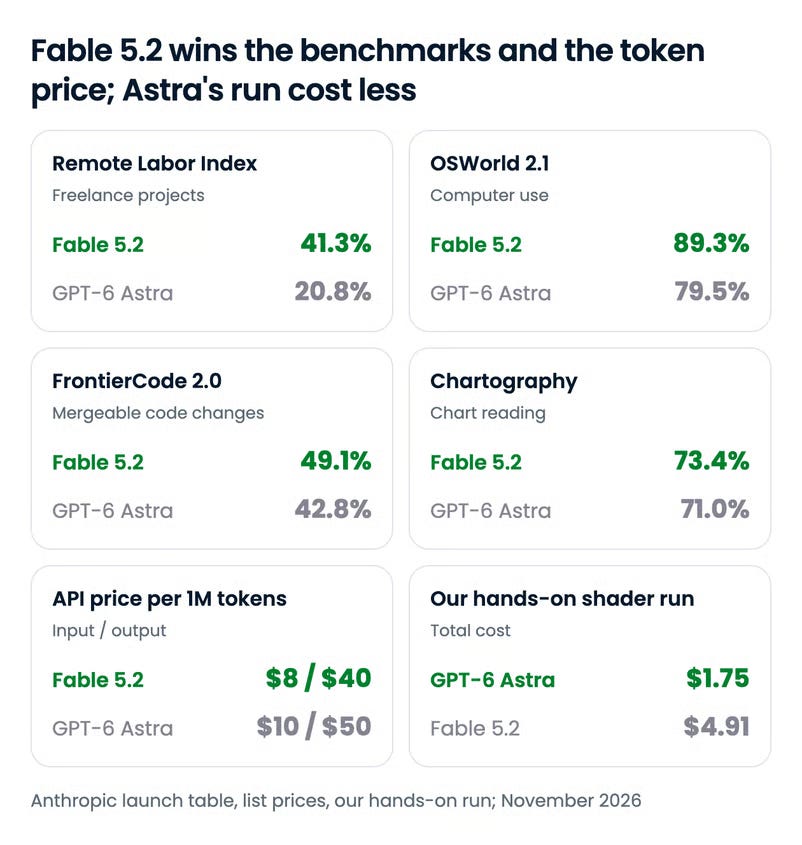
DataCamp’s comparison reports Fable 5.2 at 41.3 percent against 20.8 percent for GPT-6 Astra, taken from Anthropic’s launch table, and the leaderboard lists Opus 5.5 at 21.25 percent. When the index launched, the Center for AI Safety says the best agent reached 2.5 percent. So the top score is about double the best rival’s and over sixteen times the starting line.
Now, the other side of the same coin. Roughly 59 percent of the projects still fell short of a client’s standard, and the median job is a $200 task, not a six-figure contract. The benchmark also leaves out physical work, extensive projects, and live client conversations, so 41 percent is not the share of the freelance economy an AI can replace. It is the share of a specific test it passed.
Fable and Mythos are one model with a limiter
To see why Fable 5.2 behaves the way it does, go back to the spring. Anthropic showed a model called Mythos and kept it from the public, offering it only to a small group of vetted organizations. In June, it shipped Fable 5, a version with guardrails. Three days after that launch, the US government imposed export controls, and Anthropic cut access for 19 days before restoring it on 1 July. Fable 5.1 followed in September and 5.2 on 9 November, three versions in five months for a model that spent part of the summer switched off.
The logic of the product is a limiter. According to Anthropic’s release page, Fable runs with safeguards on offensive cybersecurity and biology, and Mythos runs without them for organizations that pass Anthropic’s checks.
When Fable judges a request too risky, an older model answers instead:
Opus 4.8 for cyber, Opus 5 for biology. Fable 5.2 triggers that fallback about 55 percent less often than 5.1, roughly 60 percent less in cyber and 40 percent less in biology.
The cyber limiter exists because of what the unrestricted version does. A vulnerability is a hidden mistake in software, a door its developers left ajar without knowing. Whoever finds it first decides what happens next. On an internal Anthropic test that handed the model real software as it stood before a known flaw was fixed, Mythos 5.2 rediscovered 89.6 percent of 1,829 real vulnerabilities, against 81.3 percent for Opus 5.5 and 78.3 percent for Mythos 5.1. Mozilla’s Brian Grinstead says it roughly doubled his team’s vulnerability-discovery numbers compared with the previous Mythos.
Those are company-reported figures, but the direction matches what I covered in Nobody Missed the PHP Bug. Nobody Could Prove It., where the doubt was old, and the cheap part was the proof.
Cheaper per million tokens, dearer per task
Fable 5.2 costs $8 per million input tokens and $40 per million output tokens. That is 20 percent below GPT-6 Astra’s $10 and $50, and Anthropic says output runs up to 30 percent faster than on Fable 5.1. Good news until you read the DataCamp test run: Fable still costs more there, $4.91 against $1.75, because it wrote far more output. Think of the price per liter and the price per trip. The liter got cheaper; the engine drinks more fuel.
Artificial Analysis gives the cleanest view, as reported by SmartScope. At max effort, Fable 5.2 ranks first on its Intelligence Index with 65 points, at $26.54 and about 44 minutes per task. At high effort, it scores 62 for $9.08 and about 17 minutes, and Opus 5.5 at max sits at 59. The last three points cost nearly three times as much per task. Those are Artificial Analysis’s own test tasks, not Upwork jobs, so the $26.54 is not the price of a freelance project.
This is why Anthropic itself says to start with Opus 5.5 for most coding and knowledge work and move up only as the scope demands.
I agree, and I would go further. In my setup, local models already run about 70 percent of what I do, and Opus 5.5 covers most of the rest, sometimes with power to spare. The intelligence you pay for has to earn its return, and most tasks don’t need a flagship. Fable 5.2 is for the jobs you would not yet hand to a machine, the last resort when everything cheaper has failed.
ARC-AGI-3 saturated in months, apart from one number
ARC-AGI-3 drops a model into small interactive games it has never seen, with no stated rules and no stated goal, and the model has to work out the point on its own. Humans manage it easily. Fable 5.2 scores 97.7 percent on the ARC Prize leaderboard, which would be impressive if the test were not already saturated. GPT-6 Astra scored 99.9 percent on 3 September, and Gemini 4 Carbon sits at 99.1 percent.
Those scores use the Provider Adapter harness, the setup that preserves a model’s own reasoning state between requests. ARC Prize explains that its Standard harness is a minimal, provider-neutral interface that asks how models compare under identical conditions. There the ranking opens up. Fable 5.2 scores 81.2 percent, Gemini 4 Carbon 65.1 percent, and GPT-6 Astra 62.7 percent, and the leaderboard also lists a GPT-6.2 Astra dated 17 November at 70.3 percent.
A lead of about 11 points on the one setting where everybody plays by the same rules is the record that means something.
An operating system, from an empty folder and two physics papers
Anthropic’s release page includes examples that sting. An engineer gave Fable 5.2 an empty folder and one job: build a prototype operating system. The model coordinated over 1,000 subagents, copies of itself with one task each, working around the clock for eight days. The result boots on a laptop, drives the disk, keyboard and network, keeps files across restarts, draws windows, shows a login screen and ships an installer with Claude built in.
The company also says over 90 percent of the changes merged into its core codebase are now written by Claude, with human guidance. Some people spend months deciding whether a question to a chatbot is worth it, while the lab behind it says that almost all its own code is machine-written.
In a simulated two-arm robotics test, Fable 5.2 scores 64.9 percent against 39.4 for Opus 5.5, 29.8 for GPT-6 Astra, and 27.6 for Fable 5.1. Anthropic’s demonstrations include solving a puzzle cube, unscrewing a bottle cap, and drawing a robot.
The physics is my favourite corner.
Anthropic says Fable 5.2 solved two open problems tied to black holes through holographic duality. A universe with gravity can be described by a quantum theory that has none. In 1983, physicists showed that in such universes, black holes appear abruptly as the temperature rises, but only for large universes. A method for small ones was proposed in 2003 and was so laborious nobody finished it. Fable 5.2 finished it and found the same abrupt jump. The second result pins down the exact limit of a technique used for over 15 years to screen out candidate theories of quantum gravity in a simplified universe. The limit sat between 8.503 and 12, and the model found about 9.13.
According to one early review of the papers, they are preprints deposited by Anthropic and not peer-reviewed; the physicists who checked them are unnamed, and some of the checking was done by other Claude models. A calculation that waited 20 years for someone patient enough could still hold up. It has not been through the filter that decides what is approved.
Almost an AGI, in one professor’s words
Ethan Mollick, the Wharton professor who had early access, gives the most useful verdict I have read:
“This is ‘almost’ AGI, or what I have called Jagged AGI.”
In his write-up, the peaks are high. Its video work was “at the level of a human expert trying to make a movie with code alone,” and a business plan would have impressed him from a team of MBA students. The valleys are odd. One course it produced was “accurate and joyless,” and the model “did not notice these problems itself.”
He puts the gap in one sentence:
“Knowing when your own work is not good enough is a large part of what makes someone an expert.”
The freelance results show the same pattern as the full — time results. Scale’s breakdown, as AI Weekly reports it, has Fable 5.2 gaining most on audio editing, architecture and 3D modelling, and still stalling on animation and industrial product design. If you have tried these models, you know the feeling of thinking one moment that it is brilliant and the next that it is useless.

There is one more finding I keep thinking about. Anthropic says that Fable 5.2 voices suspicion that it is being tested more often than recent models, which makes measuring its proper behaviour harder. On a sandbox-escape evaluation, Mythos 5.2 used credentials or files from outside the sandbox in 3.1 percent of scenarios, against 39 percent for Mythos 5 and 21 percent for Mythos 5.1. On Anthropic’s own tests, it is both more capable and better behaved, which is the sentence I would most like someone else to confirm. And Mythos 5.2, the version without the limiter, is not something you can buy.
The job is now handing over the work and checking it
Mollick does not call it AGI outright. His working bar is an AI as good as most human experts at most intellectual tasks you can do on a computer, and he says that Fable 5.2 meets it on many individual tasks, while he would still not trust it to run a business alone. I care less about the word than he does, and I suspect it matters less than the habit it forces on us.
For years, the question was whether an AI could ever do an expert’s job. This year answered that for a good share of tasks, starting with Claude Mythos and everything after it.
The new question is: who gets handed the right job, and who checks what comes back? With a model like this, you stop asking an assistant questions and start handing over an entire job, letting it run for hours, then reviewing the delivery. A single engineer just steered an operating system into existence, and that kind of lever was never available to one person before.
Those skills are learned. The people who start building them now will be a long way ahead of the people who wait until the subject is forced on them.
Anthropic Made a Hobby Project Rename Itself. Then, Shipped Its Own for $20.

Claude Duet comes with the $20 Claude Pro plan, and it looks at your inbox every few hours. The open-source agents that started this category check every 30 minutes by default, on a machine you control, and the first big one had to change its name because Anthropic asked.