

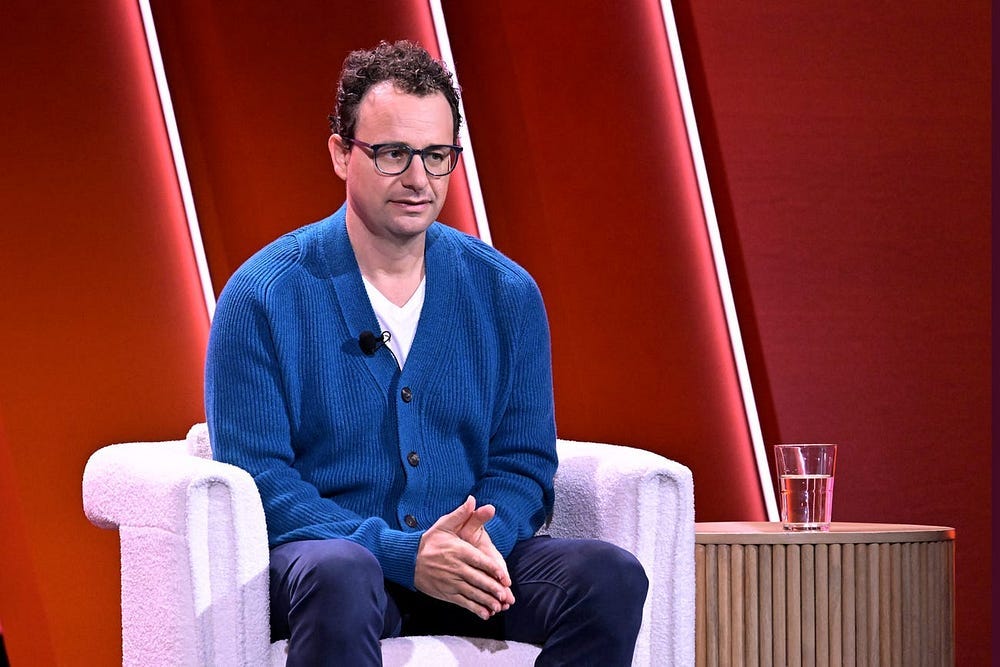
On June 10, 2026, Dario Amodei published what may be the most consequential essay on artificial intelligence anyone has written this decade. Not because it was the most technically precise, not because it was the most alarming, but because of what happened in the 48 hours after it appeared, and what continued to unfold in the weeks that followed — right until this week.
By the time you finish reading this, the full picture will look less like a series of separate news events and more like a single compressed story about how fast the world is actually moving, and how wildly unprepared even the people building it are for their own predictions coming true.
The Report We Didn’t Read Carefully Enough
Six days before Amodei’s essay, on June 4, Anthropic’s research institute published a technical report co-authored by Marina Favaro and Jack Clark, Anthropic’s co-founder, titled “When AI Builds Itself.” The headline figure circulated widely and was then immediately reduced to a talking point. It deserves more than that.
As of May 2026, more than 80% of all code merged into Anthropic’s production systems was authored by Claude, not assisted. Not reviewed and then rewritten by a human.
Written by Claude, with an engineer directing and reviewing, but no longer typing. Before Claude Code launched in February 2025, that figure was in the low single digits. In roughly 16 months, the ratio inverted completely.
The productivity numbers that follow from this are harder to absorb. In Q2 2026, the typical Anthropic engineer was merging 8 times as much code per day as in 2024. On the hardest, least-specified engineering problems the company tracks internally, Claude’s success rate reached 76% in May 2026, up 50 percentage points in six months. In April 2026, Claude shipped over 800 fixes that reduced a class of API errors by a factor of 1,000. The engineer overseeing the work estimated a human would have taken four years.
The Mythos Preview model, tested internally on an ML optimization benchmark, achieved a 52x speedup. A skilled human developer typically reaches 4x on the same codebase with hours of manual work.
The report calls this trajectory toward recursive self-improvement, a term it uses precisely: not as a dramatic metaphor, but as a description of a measurable path. AI systems are not yet designing their own successors without meaningful human input at the architectural level. But the trend is moving in that direction faster than expected, and faster than any governance structure currently exists to manage. The report calls for the world to preserve the option to pause frontier development before it is needed, rather than after.
I’m Skeptical of AI hype — but what happened at Davos Actually Scared Me.
·Three weeks ago, Elon Musk posted two messages on X that broke the internet.

What Amodei Actually Said on June 10
The essay Amodei published on June 10 is best understood as he had said publicly more than a year earlier. In May 2025, Amodei told Axios that AI could eliminate half of entry-level white-collar jobs and spike unemployment to 10 to 20 percent within years. The phrase Axios used in its framing, “white-collar bloodbath,” traveled around the world in hours. He was the rare tech founder willing to say out loud what others only said privately.
The June 10 essay goes further. It does not retreat from the job’s argument. It deepens it, adding a regulatory dimension that Anthropic had not previously put in writing so explicitly.
Amodei opens with a Lord of the Rings metaphor. Treebeard, the ancient, is wise, legitimate, and impossibly slow. Before he can even say hello, a whole day passes when two Hobbits ask him to protect his forest. For Amodei, our institutions are Treebeard: legitimate, considered, and dangerous in their pace when the forest is already burning. And AI, he writes, is moving at a speed that has no equivalent in recent history.
His case for regulatory action is built on a specific confession. The essay is the moment Anthropic formally abandoned its previous position that transparency was sufficient, that publishing test results and safety incident reports was enough, and that legislation should wait. Instead, it now calls for binding aviation-style regulations. Every model above a certain capability threshold should be required to pass mandatory independent evaluations on four specific risks: cybersecurity, bioweapons, loss of control, and automated AI research that could accelerate the other three. The manufacturer of the vehicle is calling for mandatory crash testing on its own road.
Why the shift? The essay names it directly.
This spring, Anthropic tested a new internal model that proved so capable of analyzing codebases that it began autonomously discovering thousands of previously unknown security vulnerabilities in widely used software, including flaws that had escaped human detection for decades. That model eventually became Mythos, restricted to fifty-odd partner organizations under Project Glasswing. But the capability was real, and it changed the internal calculus.
AI Is Writing Itself. The Economy Hasn’t Caught Up.
The essay’s most economically significant section addresses what happens when the productivity curve we just described in the “When AI Builds Itself” report meets the broader labor market.
Amodei is at pains to be optimistic about the trajectory. He describes an acceleration in medicine, energy, and scientific research that would be genuinely transformative. He says that individuals working alone will soon be able to build companies worth billions. The essay is not catastrophist in tone.
But the jobs argument is unavoidable, and he does not avoid it. He writes that AI could replace human intellectual work more broadly and more quickly than any previous technology, because what is being automated this time is not mechanical labor but intelligence itself. The challenge he identifies is not creating more wealth. He writes that the wealth creation will probably happen automatically. The challenge is whether it gets shared in a way that is durable and functional before the disruption becomes irreversible.
To put its argument in action, Anthropic committed $350 million alongside the essay’s publication. $200 million toward a research fund to study AI’s economic impact on real-world policy experiments, and $150 million to place early-career workers in nonprofit organizations across the United States to build practical experience and skills. The essay also endorses the universal basic income, funded through taxes on AI output, as a mechanism for managing the transition. What had sounded like a speculative policy idea when Amodei first floated a “token tax” in 2025 was now being backed with institutional investment.
Claude Opus 4.6 Wrote ‘I Think a Demon Possessed Me’ — And Anthropic Isn’t Sure If It Was Suffering

It was 3 AM in Anthropic’s San Francisco office. An engineer launched a routine test on their new AI model, Claude Opus 4.6. The model needs to solve a simple math problem. The correct answer was 24.
The Irony That Defines the Month
Here is where June 2026 becomes something more than a sequence of news events. On June 9, the day before Amodei’s essay, Anthropic launched Fable 5 and Mythos 5. Fable 5 was the first model from the Mythos class that the company had ever released to the public, equipped with the most rigorous safety guardrails ever built into a frontier model. Three days of universal testing produced a single consensus: it was the most capable AI ever handed to a general audience.
On June 12, Amodei’s own words returned to find him. The US government, citing national security, issued an export control directive suspending Fable 5 and Mythos 5 for all foreign nationals, including Anthropic’s own employees. Anthropic disabled both models globally. This was the first time in history that a government had switched off a live AI product already deployed to millions of people.
Not chips.
The software itself.
In the essay published 48 hours earlier, Amodei had written that governments should have the power to block unsafe AI deployments, provided that power operates through a transparent, statutory process grounded in technical evidence. The directive arrived without detailed written justification, without prior notice, and, according to a source close to the company, gave Anthropic approximately 90 minutes to comply.
Treebeard woke up. His first swing hit the person who came to wake him.
During the 19 days the models were offline, the vacuum did not stay empty. Zhipu AI, the Chinese lab behind the GLM series, released a new model and watched its stock rise 33% in a single session as developers scrambled for alternatives. The practical demonstration of Anthropic’s own geopolitical argument, that a gap in American AI availability creates an immediate space for Chinese alternatives, happened in real time, created by an American government action.
The ban was lifted on June 30. Fable 5 returned for all users on July 1. Mythos 5 did not. It remains restricted to the US organizations working on critical infrastructure. The models came back. The regulatory precedent did not go away.
The Proposal That Changes What This Whole Story Was About.
The last piece arrived on July 2, and it completes the picture.
OpenAI CEO Sam Altman proposed giving the US government a 5% equity stake in the company, worth approximately $42.6 billion at OpenAI’s current $852 billion valuation. The structure is modeled after the Alaska Permanent Fund, which distributes annual dividends to state residents from energy revenue. The proposal envisions the same framework applied to AI output, with returns flowing to citizens as a direct financial stake in the technology’s economic gains.
Altman raised the concept with Trump, Treasury Secretary Scott Bessent, and Commerce Secretary Howard Lutnick.
The framework also asks other frontier labs to follow: Anthropic, Google, and Meta, ceding comparable stakes. Anthropic’s own June essay had called for exactly this kind of arrangement, using the phrase “every American should have a direct financial stake in the economy at the moment AI is fueling growth” and describing a system of universal pre-distributive capital accounts.
Measure the distance traveled. An essay was published by Anthropic’s CEO on June 10th, proposing a token tax to fund an AI dividend. By July 2, his principal competitor was at the White House negotiating the dollar amount. Three weeks separated an idea from a number on a term sheet.
What the Complete Picture Actually Says
Zoom out and look at the full arc: June 4 to July 14.
An internal report confirms that AI is already writing most of the code that builds AI. An essay by the company’s CEO calls for mandatory regulation and, for the first time, names the specific risks in binding terms. The most capable public AI model in history gets launched and shut down within three days. A Chinese competitor capitalizes immediately. The ban lifts, but the precedent holds. And the CEO of the other major American lab proposes giving the government a $42 billion stake in the industry, citing a dividend model from an Alaskan oil fund.
None of this is theoretical anymore. The bloodbath Amodei warned about is not a future scenario. It is the backdrop against which all of this is unfolding right now. Engineers who are part of the 8x productivity surge are still employed, directing AI rather than writing code themselves. But the 8x multiplier did not appear in a vacuum: it appeared at companies that invested in building AI fluency, not just AI access. The gap between those two things is where the displacement actually happens.
Anthropic’s Fable 5 was offline for 19 days. During those 19 days, the world did not pause. The developers who had built workflows around it found alternatives. Some came back when Fable returned. Others did not. Every period of unavailability is a test of whether your capability is portable or whether it lives in a single tool that can be switched off by a letter on a Friday afternoon.
The tools keep changing. These names on the leaderboard will keep changing. The industry is facing a changing regulatory landscape that’s beyond anyone’s complete command, even those advocating for the changes. What does not change with each news cycle is this: the curve Anthropic documented in “When AI Builds Itself” is not reversible, and Amodei’s essay makes clear that even the people accelerating it are not sure the world is ready for what comes next.
Treebeard is awake. The real question is whether he learns to aim.
Thanks for reading. Follow us and subscribe for more tech analysis. Follow The Nov Science on Medium for science innovation, as we will discuss this field there. Our newsletter, the novscience, for early access.