


There’s a particular credibility that only comes from being wrong in public and then being vindicated by history. Yann LeCun has earned it twice.
In the 1980s, he was one of the few researchers in the world still working on neural networks. This was not a popular position. A prolonged period of limited funding, dubbed an “AI winter” by insiders, gripped the field. This was attributed to the prevailing sentiment that neural networks were a dead-end technology, prohibitively expensive to compute, and improbable to expand. LeCun kept working anyway.
In the 1990s, his architecture was being used by American banks to read handwritten digits on over 20 million cheques every day. By the 2000s, computing power had improved enough that everyone else caught up with what he’d been doing for two decades. In 2012, the models he’d spent years on quietly transformed artificial intelligence. In 2018, he shared the Turing Award, the Nobel Prize of computer science, with Yoshua Bengio and Geoffrey Hinton for their foundational contributions to deep learning.
So when Yann LeCun says the dominant approach in AI is a dead end, the default response is not to roll your eyes. One must at least entertain the idea that he has prior experience with this.
The Argument He’s Been Making Since Before ChatGPT Existed
LeCun’s core critique of large language models — the technology underlying ChatGPT, Claude, and every other major AI assistant — is not that they aren’t useful. They are. He is not calling for them to be abandoned. He says so explicitly.
He presents a more confined and harder-to-dispute case: language models are incapable of achieving artificial general intelligence, and the prevailing industry notion that bigger models and more data will suffice is a fundamental error.
The reasoning starts with what a language model is actually doing. It is predicting the next word in a sequence. That’s it. It has learned extraordinarily sophisticated patterns for doing this, so sophisticated that the output looks like reasoning, like knowledge, like understanding. But the model has touched nothing, never navigated a physical space, never needed to predict the consequence of pushing a cup off a table. It hasn’t learned the world. It has learned the description of the world as humans have written it.
LeCun describes this problem through a comparison that is both simple and uncomfortable. The interaction between a four-year-old and an advanced AI chatbot readily allows the child to comprehend the concept of water spilling when a glass is tilted. The chatbot can write eloquent sentences about fluid dynamics. But ask the chatbot to control a robot arm reaching for that glass, and things fall apart quickly. The child has what engineers call physical intuition — a compressed internal model of how the world behaves. The chatbot has none of it.
His illustration of the gap is memorable: “The best AI systems aren’t as intelligent as a cat.” Coming from someone who helped build those systems, this has a different weight than a critic saying it from outside.
He’s also pointed out a simpler version of the problem that circulated widely online. Someone asked a chatbot: “The car wash is 100 metres away. Should I walk there to wash my car?” The chatbot said yes.
LeCun doesn’t see that as a bug. He sees it as evidence of a ceiling.
What He Wants to Build Instead
LeCun isn’t proposing a tabula rasa. World models have been a research area in AI for decades. He proposes to make this the major objective, not a side venture, and he’s backing it with a billion-dollar bet this shift will be impactful.
A world model, in LeCun’s framing, is an AI that learns to represent and predict the physical world rather than generating plausible text about it. The analogy he uses is a baby. In the first months of life, a baby is running experiments. Push this, what happens? Drop that. What happens? Reach for this. What does it feel like? Through millions of physical interactions, a child constructs an internal model — not a set of rules someone taught them, but a dynamic, continuously updating representation of how objects behave, how forces work, and what consequences to expect from different actions.
He wants AI to do this.
Not by reading more text, but by watching the world, interacting with it, and building an internal model can predict what happens next. The test of whether the model has genuinely understood something is whether it can anticipate consequences it hasn’t been explicitly trained on.
The application he cares about most is robotics. A robot running on a world model can transfer knowledge from one physical environment to another. It doesn’t need to be retrained every time it encounters a new object. It has a physics intuition, an intuitive physics engine running underneath, the same way a human can figure out how to handle an unfamiliar tool without ever having touched it.
He uses the example of autonomous vehicles. For fifteen years, the industry promised that self-driving cars were a decade away. They kept being a decade away. A 17-year-old can learn to drive in ten to twenty hours of practice. Even with vast amounts of training data for autonomous systems, cars that can reliably navigate any terrain under uncertain conditions are not yet a reality. LeCun’s diagnosis is that the current approach is missing something structural, not just something quantitative. More data won’t solve it. More computation won’t solve it. A different architecture might.
What’s striking is that his first proof of concept — a model that can abstract away irrelevant visual information and focus on what matters for the task at hand — runs on a single graphics card. To compete, the models need tens of thousands of computational units housed in huge data centers. If the approach scales the way he thinks it can, the efficiency advantage compounds dramatically as capability grows.
The Conflict That Ended Twelve Years at Meta
LeCun’s decision to join Facebook in 2013 resulted from Mark Zuckerberg’s personal recruitment efforts. The Facebook AI Research lab, including its Paris branch, was his creation, and it subsequently became a major hub for cultivating exceptional AI talent in France. For over a decade, he had Zuckerberg’s ear and the autonomy to pursue fundamental research.
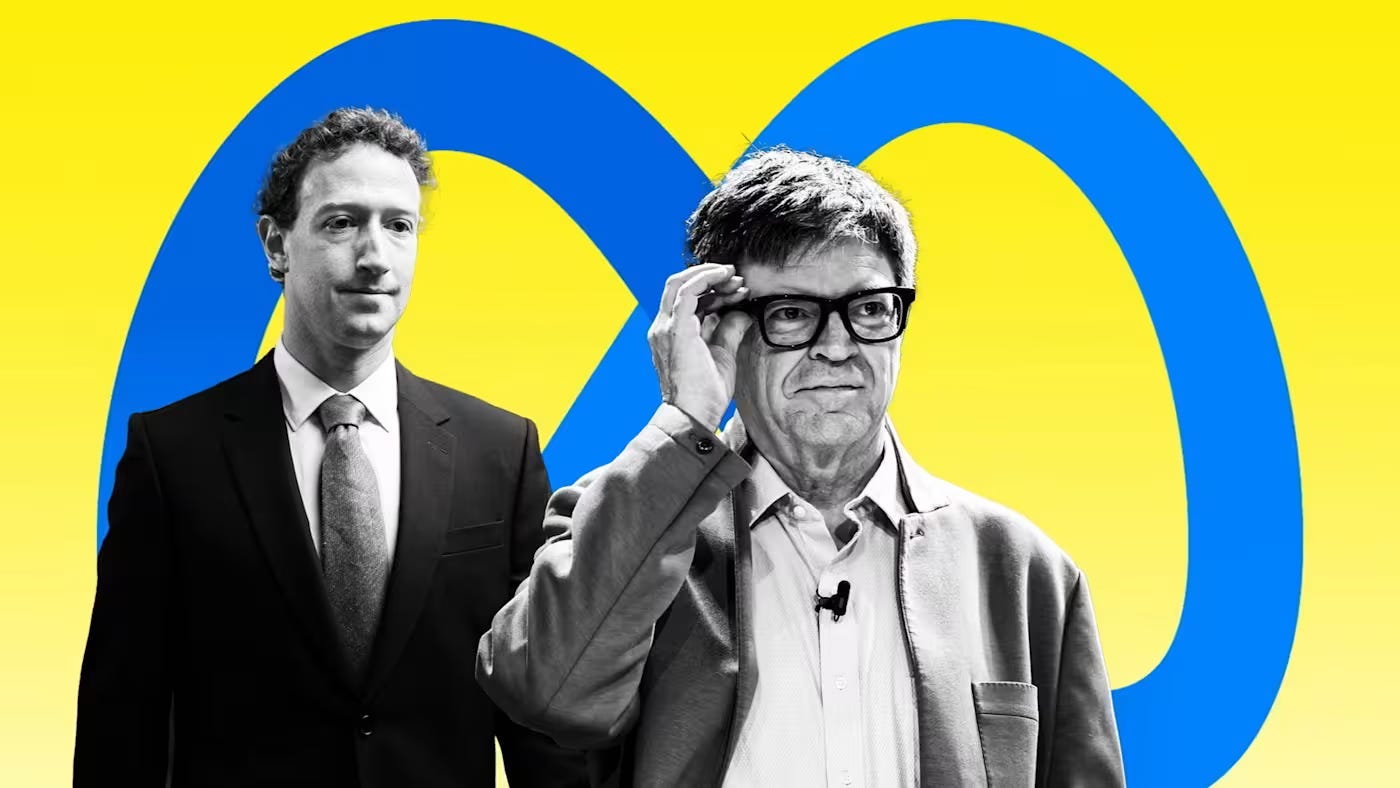
Mark Zuckerberg, left, has pivoted away from the longer-term research lab, which Yann LeCun, right, has headed since 2013, to focus on the rapid rollout of AI models and products © FT montage/AFP/Getty Images
The arrangement changed in June 2025, when Meta paid $14.3 billion for a 49% stake in Scale AI and, along with it, brought in Scale AI’s co-founder and CEO, Alexandr Wang, as Chief AI Officer. LeCun was overlooked for the appointment, which went to Wang, a 29-year-old who briefly held the title of the world’s youngest self-made billionaire. LeCun, who had been chief AI scientist, now reported to him.
The scientific disagreement between the two men hardened quickly into a public rupture. LeCun told the Financial Times that Wang was “inexperienced” and lacked sufficient research background. Wang’s methodology prioritised execution over exploration, large language models over world models, short-term commercial milestones over long-horizon scientific bets. The new Meta AI strategy was, in LeCun’s description, “completely LLM-pilled.”
LeCun’s quote about the dynamic has been widely shared: “You don’t tell a researcher what to do. You certainly don’t tell a researcher like me what to do.”

He announced his departure in November 2025, was 65, and had spent twelve years at Meta. He had nothing left to prove.
He promptly set about proving something, anyway.
AMI Labs: The Billion-Dollar Bet
In December 2025, news broke that LeCun was in discussions to raise €500 million at a €3 billion pre-launch valuation for a new startup. Advanced Machine Intelligence Labs, AMI Labs, officially launched in January 2026 and began operations in March.
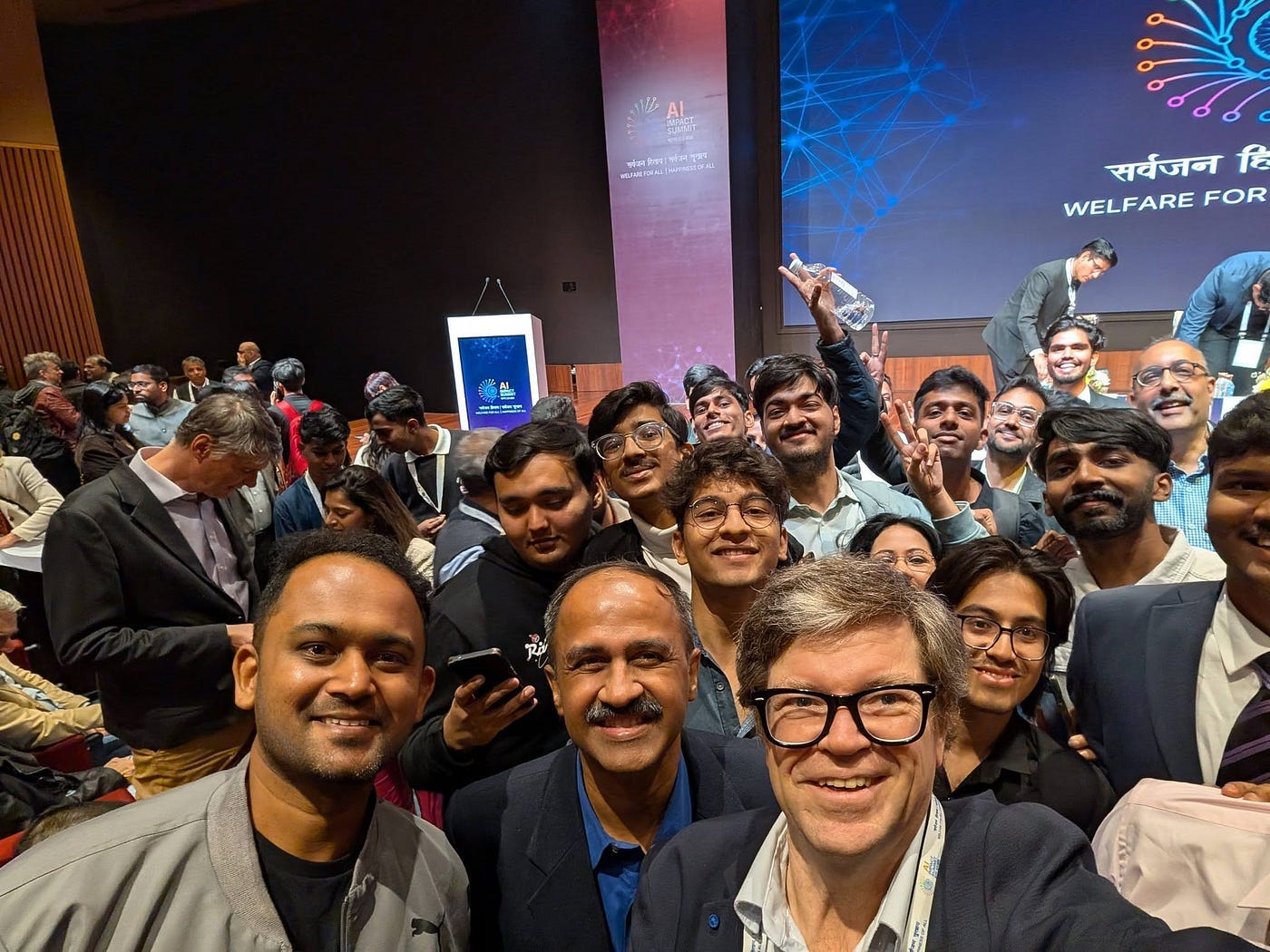
By the time the dust settled, he had raised $1.03 billion — more than double his original target. The investors who moved fast to get in included Xavier Niel and Jeff Bezos, both of whom presumably decided that LeCun being right twice in his career made a third time worth underwriting.
His role at AMI Labs is Executive Chairman. The CEO is Alex LeBrun, who previously co-founded Nabla, a medical AI company, and worked under LeCun at Meta’s research lab after Facebook acquired his prior startup, Wit.ai. Several directors and engineers from Meta’s research teams followed LeCun to the new company.
He expects that in three to five years, world model technology will power domestic robots and autonomous vehicles that are capable of genuine autonomy. Not vehicles with a safety driver. Not robots that only function in controlled environments. Genuinely autonomous systems that understand the physical world they’re operating in.
He put it plainly: “The best way to predict the future is to invent it.”
Why the Critics Deserve a Response
The counterargument to LeCun’s position is not trivial. Large language models have produced genuine scientific results. They have contributed to drug discovery, mathematical proofs, and chip design in ways that he predicted they couldn’t. OpenAI’s recent claim that GPT-6 Astra “invents new things in a way that matters” — however much we should treat it with appropriate scepticism — would, if true, directly contradict his thesis.
There is also the question whether world models face their own ceiling problems. Predicting physical repercussions with a model demands a massive corpus of annotated physical information, which isn’t as abundant as text data. The internet is full of languages. It is not equally full of labelled 3D environments with annotated physical properties.
LeCun’s own admission that the first ten years of his world model research produced “pretty terrible results” before progress accelerated is worth noting. He’s asking for patient capital and a long horizon. The investors who gave him that capital are betting he’s built up enough track record to deserve it.
The stronger version of the criticism is that the entire history of AI has been a series of people confidently predicting the ceiling of the current approach — and being wrong. Every time someone said neural networks couldn’t scale, they did. Every time someone said the current generation had hit its limit, the next generation proved them wrong. LeCun himself was on the receiving end of that critique in the 1980s.
His answer, implicit in everything he says, is that he’s not predicting a ceiling for language models. He’s arguing they’re pointed in the wrong direction. The difference matters.
ChatGPT Recites the World. World Models Understand It.
That’s LeCun’s line, and it’s the cleanest summary of what he’s building toward.
Whether he’s right is genuinely unknown. He was right before, on a timeline that looked absurd from the outside. He was also wrong about the specific prediction — he thought, when he was first working on neural networks, that they’d solve vision before language. Language turned out to go first.
Being directionally correct and wrong on specifics is the normal condition of ambitious scientific bets. What remains uncertain is the accuracy of his hypothesis: that a grasp of the physical world is the vital component for AI to achieve genuine capabilities.
The industry is mostly not waiting to find out. OpenAI, Anthropic, Google, DeepSeek — they’re all building in a direction LeCun says is a dead end. They have market incentives, investor pressure, and competitive dynamics all pointing toward more LLMs, bigger LLMs, better LLMs.
LeCun has $1 billion, a proof of concept running on a single graphics card, a track record that demands seriousness, and the freedom that comes from having already won everything the industry thought was worth winning.
The story of whether he’s right again is just beginning.
Do you think world models are the missing piece for genuine AI capability, or is the scaling argument still stronger than LeCun gives it credit for? The gap between what he’s claiming and what the rest of the industry is doing is now one of the most interesting scientific questions I follow. I’d like to know where you land.
Always wondered how LLMs would jump from predicting the next word to true AGI as quickly as people are calling for.... This all makes perfect sense. If I had a few million to spare, I'd be backing LeCun too!
Just compare the development of other technologies, such as TV sets (tube versus flat-screen), light sources (bulb versus LED), and chip design.
It was and is always a total shift, and we will see it here the same way