

The machine that could one day open your bank’s lock and design tomorrow’s drugs has been stuck on one problem for two decades: it makes mistakes, and the ingredient that fixes the biggest ones was eating most of the machine. On October 15, Google Quantum AI published a paper in Science showing that this ingredient can be made on a real chip with 40 times fewer errors.
Why quantum computers matter for fertilizer, drugs and your bank
Start with what the machine is for because that’s what makes the 40x worth caring about. Meanwhile, bacteria in the soil do the same job at room temperature, with a molecule whose shape we know and whose behavior we can’t compute. Studying a molecule requires tracking interactions among all electrons, and with each extra electron, the calculation becomes exponentially more complicated. No computer on Earth can do it for that molecule, now or in 100 years. I couldn’t verify it myself, but it’s a fair picture of how much guessing the industry still does.
In the early 1980s, Richard Feynman boiled the problem down to nature obeying quantum rules, so to calculate it, you need a machine that obeys the same ones. A quantum computer isn’t a faster computer. It speaks the molecules’ language.
The darker use came in 1994, when mathematician Peter Shor showed that such a machine could also pick apart the locks that protect online payments and encrypted messages. Those locks rest on several numbers with over 600 digits, each the product of two secret primes.
It’s easy to multiply.
In May 2025, Google’s Craig Gidney estimated that fewer than a million noisy qubits could break a 2048-bit RSA key in under a week, down from his own 2019 figure of 20 million. That isn’t even the lowest estimate anymore. A 2026 update on the same topic notes that a start-up called Iceberg Quantum has since claimed under 100,000 physical qubits under the same assumptions. And spy agencies don’t need the machine to exist today. They can store encrypted messages now and open them in 10 or 15 years.
What a qubit is, and why the double-slit experiment matters
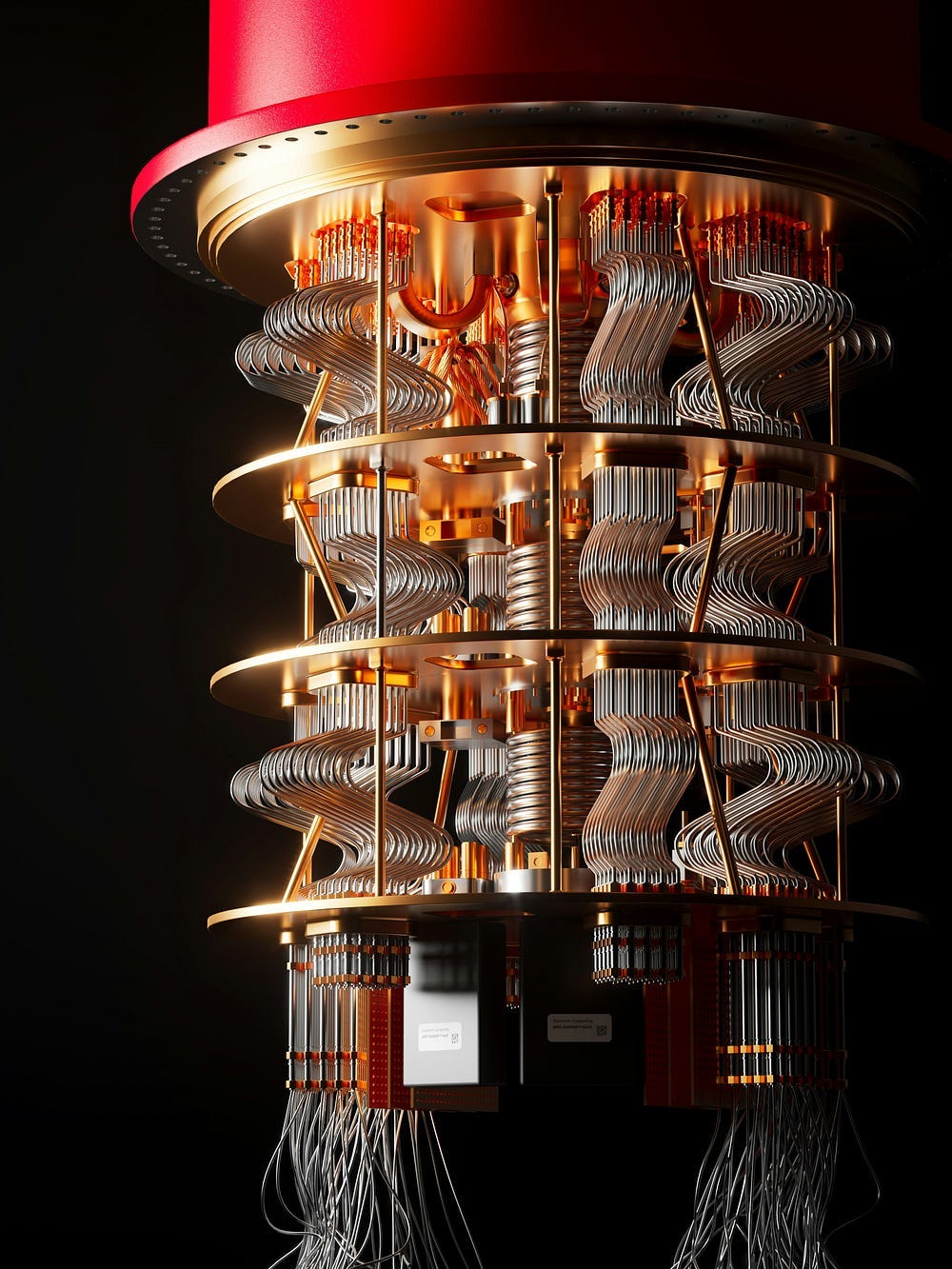
Your computer runs on bits, tiny switches that are off (0) or on (1). A photo, a song, and a video are all long strings of them. A quantum computer swaps those switches for qubits. Qubits are tiny electrical circuits etched on a chip with the same techniques as regular processors, and the Willow chip holds 105 of them. Cool it down to a fraction of a degree above absolute zero, colder than outer space, and the circuit obeys quantum rules like one giant atom. The golden chandelier in every photo isn’t the computer; it’s the fridge. The chip sits at the bottom. Other companies, like the French start-ups Pasqal and Quandela, use real atoms or grains of light instead.
The first is the double-slit experiment. Fire marbles at a wall with two slits, and you get two bands on the wall behind it. Fire electrons one at a time, and a pattern of dozens of stripes builds up, the signature of two waves crossing, even though each electron is alone. The only explanation is that each one goes through both slits at once and interferes with itself. Put a detector at the slits to see which way it goes, and the stripes vanish.
Two bands again.
Looking changed the results. I went through the century-long fight over this in “Einstein’s Biggest Mistake Just Got Proven Wrong — Here’s Why Quantum Computers Depend On It”, and the lesson there carries straight over: until you look, a particle keeps several paths open, and you only get one look.
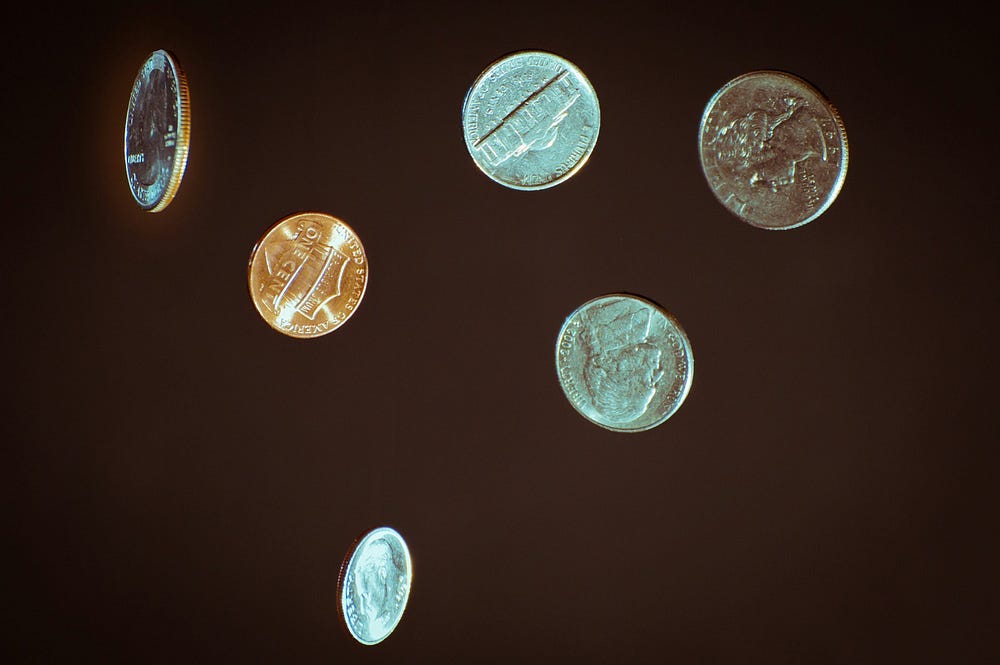
That is a qubit. A bit is a coin lying on a table, heads or tails up. A qubit is a coin that’s still spinning, holding both options with different odds. Measuring means slamming your hand on it, and it falls one way and never spins like before. Computing means nudging the spinning coin with ultra-precise electrical pulses so it leans more to one side.
Entanglement: the second ingredient, proven 44 years ago
The second story is the one that split Einstein and Bohr for half a century. In 1935, Einstein pictured two particles made together and sent far apart.
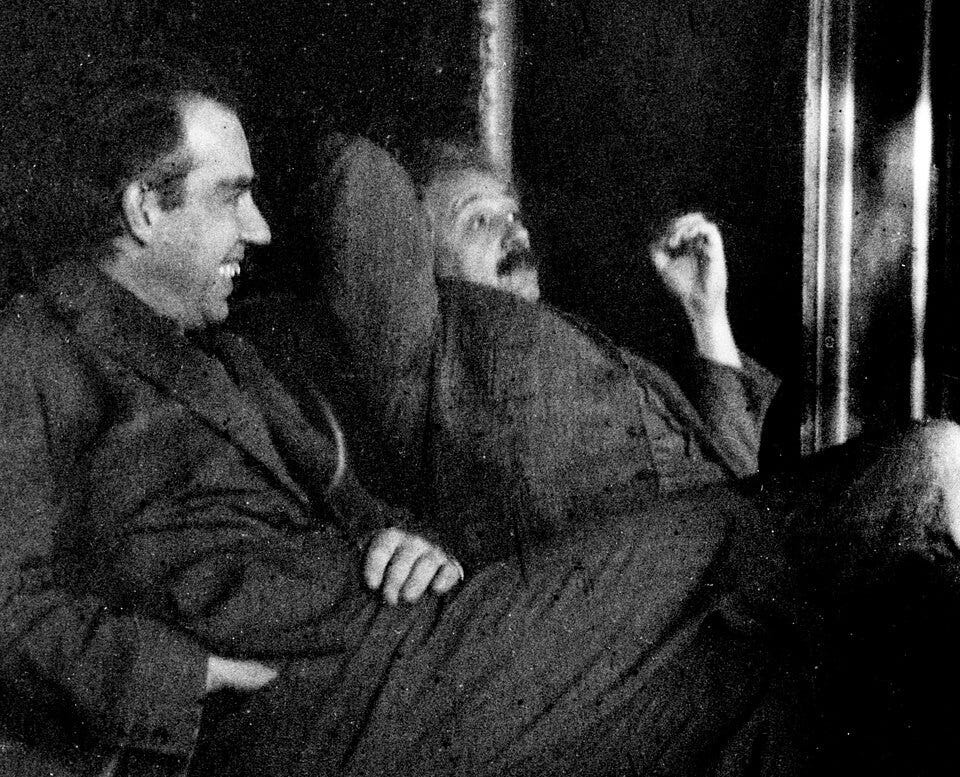
According to the theory, measuring one instantly fixes the answer for the other, whatever the distance. He found that absurd, a spooky action at a distance. For him, the twins carried their answers from the start, like a pair of gloves split into two boxes: open yours. It’s the left one, so the other must be the right. Bohr said no. Before you look, the answer doesn’t exist.
No one could settle it until John Bell found a test in 1964, and in 1982, at Orsay, near Paris, Alain Aspect ran it with pairs of twin photons. Einstein lost. The twins don’t carry their answer in a box; it appears when you look, linked on both sides. Aspect shared the 2022 Nobel Prize in Physics for it. You still can’t send a message this way since each side alone sees only randomness, and the link shows up only when you compare results afterward.
That link is called entanglement, and it’s the second ingredient in the machine.
Link qubits, and they stop spinning in their own corners and form one whole. Two coins mean 4 combinations in play at once, three coins 8, and every qubit you add doubles the number. At 300 qubits, you pass the number of atoms in the observable universe, which is exactly the explosion that makes the fertilizer molecule impossible to compute.
The machine doesn’t calculate it. It lives it.
How a quantum computer gives you an answer
There’s a catch because you get one look. At the end of the calculation, every coin is stopped at once; a tiny readout circuit next to each qubit picks up a radio signal that changes slightly depending on whether it fell on 0 or 1, and you get a single string out of millions of billions of possibilities.
So how do you know it’s the right one?
Back to the stripes. The electrons never landed in the dark zones. A quantum algorithm is the skill of creating those patterns: you adjust the computation so that incorrect answers cancel each other out, while the correct one is amplified, and upon measurement, it appears almost always. Then, you repeat it thousands of times to be sure. One last point matters here. The quantum computer never works alone. A regular computer prepares the questions. The quantum one does the impossible part, and the regular one checks.
Take the lock: the machine returns a number; the regular computer derives the two hidden primes, multiplies them, and confirms it gets the giant number back. Finding is impossible for the regular computer; checking is instantaneous.
From Willow to Quantum Echoes: The machine answers factual questions.
In December 2024, nearly two years ago, Google’s Willow finished a benchmark in under five minutes that it said would take a supercomputer 10 septillion years, and in the same announcement showed error correction working below the threshold where adding qubits helps instead of hurts. The first number was a pure power test with no practical use, and no one could check it.
A year ago, in October 2025, Google took another step with an algorithm called Quantum Echoes, 13,000 times faster than the best classical algorithm on one of the world’s fastest supercomputers, and this time the result could be repeated and verified on other machines.
So why aren’t we making fertilizer and drugs with it yet?
Because a spinning coin is fragile. A bit of heat, a radio wave, or a particle from space, and it tips on its own. Currently, roughly one out of every thousand operations fails, and a valuable calculation involves millions of consecutive operations. At that rate, the results mean nothing.
The magic state bottleneck that eats 95% of a quantum computer
Your computer fixes errors by writing every digit three times, so if one flips, two against one wins. A qubit cannot be duplicated, and inspecting it involves observing it, which causes it to collapse. The workaround is to group qubits into teams that hold the information together while checking that they still agree, without ever looking at the information itself. If one slips, you spot it and set it straight. The price is hundreds of physical qubits for each reliable one.
This is the least talked-about aspect in the news: a secure team can execute only simple functions that a standard computer can replicate.
The move that gives the machine its power, the T gate, can’t be done without breaking the protection. So you prepare it in advance on a special qubit and plug it in at the right moment. Physicists call that special qubit a magic state, and I’d call it a spare part that’s used up every time. A real calculation burns through millions of them, all nearly perfect, and they come off the line imperfect. The standard fix, distillation, melts several flawed ones into a better one. It works, but Rosenfeld told Scientific American that up to 95 percent of a quantum computer’s resources can end up spent just generating them. Google’s own blog says researchers have seen this bottleneck coming since 2004.
That’s the wall. The focus was never on sheer strength.
What magic state cultivation does on the Willow chip
The idea comes from three Google researchers, Craig Gidney, Noah Shutty, and Cody Jones, who proposed it in 2024 under a title that promised T states “as cheap as CNOT gates”. It rests on an asymmetry.

You can’t abandon a calculation in progress; it needs to be repaired. A spare part with any doubt on it can be tossed and remade, and spotting a flaw is far easier than fixing one. Starting with one part, you inspect it repeatedly and discard it immediately if any trouble arises, instead of melting many parts.
Like a gardener who keeps only the perfectly healthy shoots, which is where the name comes from.
On Willow, the team used 54 of the chip’s 105 qubits, and the paper’s abstract reports a 40-fold drop in error with a state fidelity of 0.9999, keeping only 8 percent of attempts. In plain numbers, about 4 states in 1,000 came out faulty without cultivation, and at most about 1 in 10,000 with it. Kenneth Brown of Duke University, who wasn’t involved, said, “The Google experiment shows that cultivation works in practice,” and he pointed out the cost: the quality check discards 92 percent of attempts. The survivors were also moved into a bigger code, a distance-5 surface code, as a first proof that a purified state can leave the small workshop and survive in the larger machine.
The path was less smooth than the headlines suggested. Google’s blog says that Rosenfeld first saw data that seemed to defy the laws of physics, and after months of simulations and consistency checks, she traced it to lab noise from drifting electrical equipment and temperature changes that had quietly broken the team’s measuring method. They added extra control and invented a new benchmark that uses cultivation to measure itself.
One more detail I liked: right before the main run, a reinforcement learning system trained for about four hours to tune the chip, and it cut the error detection rate by about 30 percent on average. An AI helping to build a quantum computer. In 2026.
What the 40x does not mean: Bitcoin and the “40 times cheaper” claim
Now, the part that went around social media. Some posts said the cost of quantum computing had dropped 40 times, or that Bitcoin was in danger. Neither follows from the paper. The 40 is about the error rate of one prepared ingredient. As TechRepublic put it, the result doesn’t establish a 40-fold reduction in the total cost, size, or execution time of a useful quantum computer.
The experiment is also not new in the way the date suggests since the preprint has been public on arXiv since December 2025, and October brings peer review.
And the gap is still wide. Per Scientific American, breaking RSA-2048 would need magic states that fail only once in 10 billion tries, and simulating molecules, the nearer goal, would need one error in a million to one in 100 million. Today, the team is at roughly 1 in 10,000. Google itself says cultivation still has to be shown at a larger scale, and Rosenfeld says her team is “more galvanized than ever” to get to near-term scientific uses. Fair. It doesn’t read like a countdown to your savings account.
Is useful quantum computing closer after Google’s October result?
Look at the puzzle as the video lays it out. For decades, three questions blocked everything. Can you protect qubits without creating more errors? December 2024, yes. Can the machine give a useful, checkable answer? October 2025, yes. Can you make the spare parts without turning the whole machine into a factory? October 2026, yes, at proof-of-principle scale. None of those answers is enough alone, but for the first time, no piece of the plan exists only on paper.
It’s no longer a matter of possibility.
I’d keep that last sentence at its correct size. Proof of principle on 54 qubits is not a quantum computer that designs a drug, and the 92 percent you throw away is a throughput bill someone still has to pay. But I trust this result more than most quantum headlines because the paper counts what it threw out, and the people who wrote it say what’s left to do. In 1935, Einstein thought quantum physics was too strange to be true, and in 1982, Aspect showed it was. Feynman was already dreaming of a machine that would use that strangeness to calculate nature. Google didn’t knock the wall down on October 15, but it opened a gap in it.
If the part about encrypted data being collected today to be opened later is what stuck with you, my piece on “harvest now, decrypt later” goes further into it, including what actually changed in quantum error correction since the start of 2026.
They’re Already Stealing Your Encrypted Data. They Just Can’t Read It Yet.

For the first time in the history of quantum computing, independent researchers proved that quantum error correction actually works at scale. What has been unfolding since the start of 2026 should worry or excite anyone working in tech, finance, cybersecurity, or healthcare.
If you’d rather have a quantum headline checked against the paper before you decide whether to worry about your savings, follow Nov Tech and subscribe for more analysis. Don’t forget to support the newsletter.