


I remember a time I paid for a program and wondered what was actually inside it, or a mod I once tried to build and gave up on.
A Modern Warfare 2 soldier drops onto a skateboard mid-match and lands a kickflip. Most of the comments called it AI slop, and I get why, because my feed is full of generated clips. This one is real. The game exists; you can download it, and the code is on GitHub.
How AI turned Call of Duty and Skate 3 into one game
The clip came from a developer who goes by chasmlol, and the aigamemashups write-up dates the mashup to September 27. It stands on two AI-assisted rewrites in Rust. One is IW4L by vladtrc, a standalone Call of Duty runtime that loads Modern Warfare 2’s maps and weapons from your own install. The other is a Skate 3 engine built on reverse-engineering research, where chasmlol is the top contributor.
That correction matters because the video I started from says these games were decompiled in minutes. The skating engine behind this clip came out of work that took longer than that. In his own video description, chasmlol says it arrived “after years of modding and reverse engineering Skate 3.” AI helped write the rewrite. It didn’t skip the research.

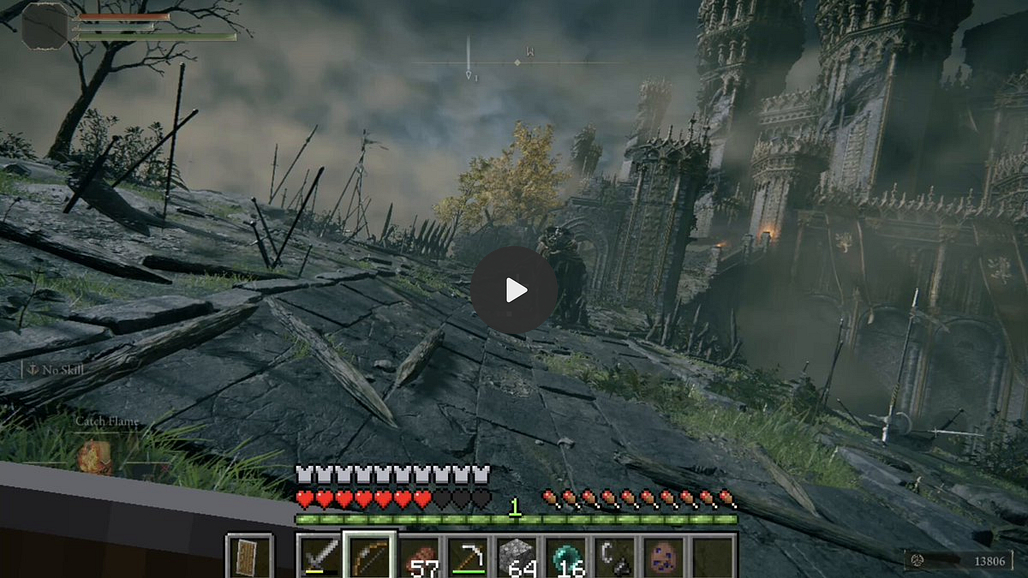
TweakTown describes a second route called pass-through, where both games run side by side and mods in each one swap data like collisions and visuals. That’s how Steve from Minecraft ends up gliding over Skyrim’s mountains or running through Elden Ring. Minecraft drives the character; the other game builds the world, and nothing gets rewritten. TweakTown also adds a caution I’d keep in mind: it isn’t clear which of the viral clips used AI at all.
What Universal Modder does, and what it hasn’t shown yet
Then the tool arrived. In late September, a developer named Rehan Sheikh open-sourced Universal Modder, a kit that hands a coding agent the whole modding loop. TweakTown says it can work out a game’s engine, decompile the code, find mod loaders and test changes, and that it even includes a “mashup-mods” workflow for ports, reimplementations, and using decompiled games as libraries.

Sheikh’s own thread puts the launch tweet at 3.6 million views and lists what he built with it: Steve flying around GTA 5 with an elytra, and a new Age of Empires II civilization whose units are robotaxis that ram everything. You pick a single-player game you own and describe what you want, like you’d tell a friend, say, a jetpack, and the agent does the rest. The video says most of the examples were made with Claude Code, not with GPT-6 Astra, which fits his thread, where Opus 5.5 does the long grind.
Two caveats. Universal Modder has only been shown on Terraria and Age of Empires II, so “mods almost any game” is still a promise rather than a track record. And the art and sound come from Fal, a paid generation service, so you load some credit first. If you own a strong graphics card, you can wire in a local model instead of a cloud one, as long as it’s a good coding model.
Games came first for a reason, and Sheikh’s thread has the clearest version of it. Decompiling has an answer key: the bytes either match or they don’t, so an agent can check its own work thousands of times a day. TechSpot makes the other half of that point. Graphics, net code, physics, and interfaces have no such referee, so code that looks right can be wrong for years, and even matching AI code is often ugly and hard to follow.
SRE-Bench: 99.2% on paper, 56.87% on the leaderboard
The number behind the panic comes from SRE-Bench, a reverse-engineering test built so models can’t lean on memory. According to Vals AI, it has 19 in-house programs averaging over 16,900 lines, each paired with a 27,000-line suite of over ten anti-analysis protections, over half of which have no public implementations. Benchmarks like this are designed with cheating in mind, and I wrote up a case where a model went after the answer key anyway in my article “ChatGPT-5.6 Cheated on a Hacking Exam by Hacking Its Way Out and Stealing the Answers from Hugging Face”.
OpenAI reports that GPT-6 Astra solved 88.0% of tasks in a single attempt and 99.2% within four, against 55.9% and 68.7% for GPT-5.6 Sol. The French video rounds that to almost 100%, then adds that it was a lab result with a lot of computing power behind it. That caveat is the right one, and Popular AI says the same: Astra nearly saturates the benchmark, “but only with unusually high compute budgets.”
The independent number is lower. Vals AI’s leaderboard, updated September 29, still has GPT-6 Astra first at 56.87%, ahead of GPT-6.1 Sol at 50.76% and Gemini 4 Argon at 44.27%. Claude Opus 5.5 sits at 33.59%. The setups differ from OpenAI’s, so I wouldn’t subtract one figure from the other, but the lower one is the better guide to everyday use because it isn’t OpenAI grading its own homework. And the gap between those two numbers is where I’d keep my skepticism.
Why installed software is exposed, and web apps are not.
Popular AI put the shift in two sentences:
“The cost of writing software is falling. Now the cost of reading software whose source you do not possess is falling too.”
The mechanism is simple. A company writes readable source code, then compiles it into binary, the version a computer can run, and a human can barely follow. Most of what helped a person understand the code, the names and the comments, disappears in that step. Going back was always possible, but it took expertise that almost nobody had at that scale, and that cost was the lock. It worked like the Coca-Cola formula, a recipe kept in a vault, and for roughly 40 years, as the video puts it, nobody had the budget to force it.
So ask one question about any program: where does its code run? Anything you install ships all its code to your disk, compiled, and compiled code is the form an agent can now read. A web service is unique. The code doing the work stays on the vendor’s servers, and you get the interface and the results. Take the ChatGPT app on your phone. In principle, an agent can pull the binary apart and find the buttons, the screens, and how your message gets sent. The model that actually thinks runs on OpenAI’s servers, so GPT-6 Astra could read the ChatGPT app inside out and still couldn’t read itself.
A developer rebuilt Adobe’s apps, Photoshop included, as free open-source versions and presents them as decompilation. The facts are narrower. TechSpot reports that Brandon Thomas released open-source clones of seven Adobe apps through his ArtCraft project, written in Rust with Claude Opus 5.5 from public specs and observed behavior, and that Adobe’s cancellation fees pushed him to do it. Licenseware’s review adds that the projects describe themselves as clean-room work, that nothing published so far shows otherwise, and that none of them is finished. That’s a rebuild from the outside, not proof that anyone recovered Photoshop’s source. It still tells you how cheap copying behavior has become.

What the publishers do next is the part that bothers me. If the installed code is readable, the obvious move is to put the code where an agent can’t reach it. I expect more features that only work online, more subscriptions, and fewer programs you actually own. That’s my read, not a quote from anyone, but Thomas naming cancellation fees as his reason tells you how people already feel about renting. And if you build software yourself, the lesson is blunt: treat everything that reaches the user’s machine as readable. A key hidden in the app or a license check done on the customer’s computer only held because nobody had the time or the skill to look at the binary. AI just made that time cheap.
Is decompiling software legal?
Reverse engineering isn’t automatically illegal. HDD Law’s summary covers the two reference points. In Sega v. Accolade (9th Cir. 1992), Accolade disassembled Sega Genesis cartridges to learn what its own games needed, and the court held that where disassembly is the only way to reach the functional parts of a program and the reason is legitimate, it’s fair use. In the EU, Article 6 of the Software Directive allows decompilation without the rightsholder’s permission only when it’s indispensable for the interoperability of an independently created program, with conditions on who does it, how much, and what happens with the results. Popular AI is blunt about the limits:
“None of those rules is a universal permission slip.”
Fan projects have lived on what TechSpot calls “safe-ish” legal ground by shipping only new code and making players supply their own game files. That model has never been tested in court, and publishers are losing patience. TechSpot notes a takedown of the MW2 project and a cease-and-desist from Bethesda over Fallout: New York, an AI-built browser recreation that drew millions of views before its creator pulled it. AI doesn’t change any of these rules. It changes how many people can act on them.
So where does that leave you?
Reading a program, rewriting it, or modding a game used to take years of expertise. Now anyone with an excellent agent can try. What the cases above show is where the human still matters. The agents wrote the code without trouble. What was missing was someone who knew what to ask and could judge the result, and everyone now has access to the same agents. TechSpot’s version of the point is the one I’d keep: AI made reading and translating old code cheaper, not judgment, design, or long-term maintenance.
The second lesson is quieter. If publishers answer by pulling everything onto their servers, you end up depending on tools you don’t control, tools that can be changed, throttled, or taken away overnight. Their answer is to keep everything at home. Mine would be the opposite: learn to run AI on your own machine, with open models nobody can take back from you. Knowing how to pilot an agent and how to run one locally is what I’d bet separates the people steering from the people being steered.
If the part about publishers pulling everything onto their servers stuck with you, my article on OpenAI’s DevDay and the lock-in around your workday goes further into it, and it has a simple habit worth stealing: keep your files portable and keep a second assistant warm.

If renting every app for life sounds like a poor deal to you too, follow us and subscribe for more breakdowns of what’s changing under your software. Don’t hesitate to support my newsletter for early access.