

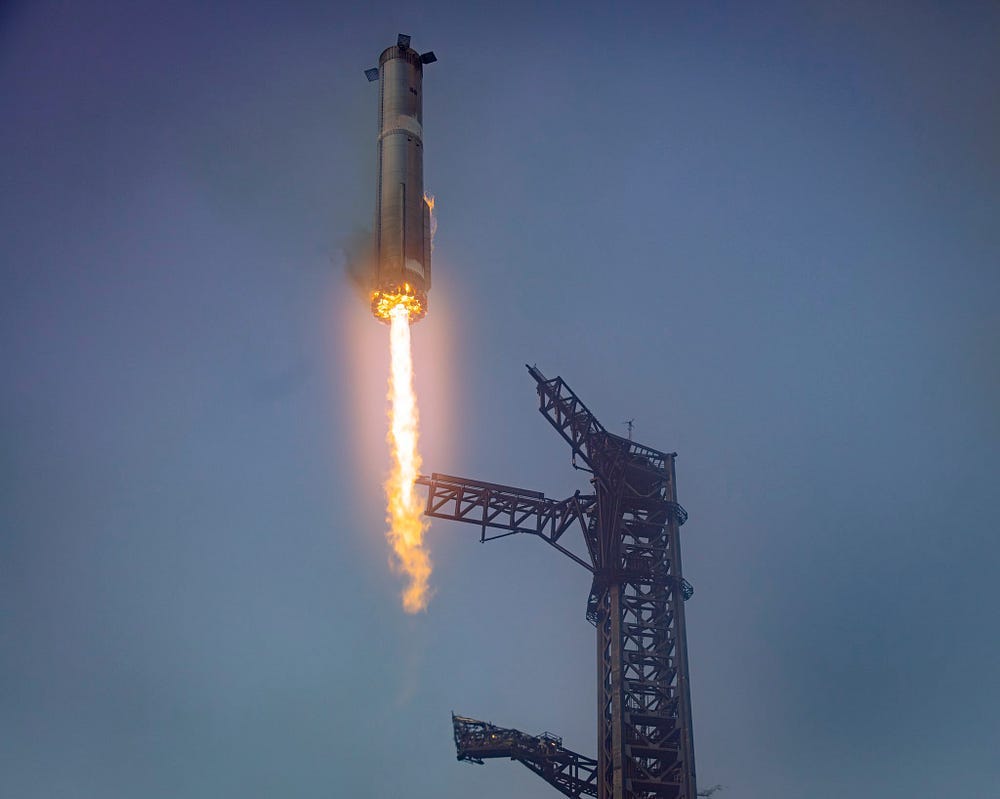
The simplest version of the question is: why not just land the booster the way Falcon 9 does? Legs, engine relight, ground landing, or drone ship. SpaceX has been doing that since 2015. It works.
The answer is weight. Super Heavy is roughly 70 meters tall and, when empty, weighs around 200 metric tons — just the structure, the engines, and the residual propellant you need for landing. If you add landing legs to something that size, you’re adding several tons of hardware that does nothing during ascent, does nothing during the orbital phase, and only earns its mass budget for about 30 seconds at the end of the flight. Then you have to fold them back up, refuel, restack, and do it again.
The math that makes Starship interesting — launch costs low enough that you can afford to put Starlink satellites in orbit at scale — depends on not carrying that dead weight. Mechazilla exists to solve the problem of landing without legs.
How the Tower Actually Works
The Orbital Launch Tower at Starbase is about 146 meters tall. Most of that height is structure for stacking and servicing the rocket. But near the top, roughly at the level where the booster’s grid fins sit when it’s fully stacked, there are two arms: hydraulically actuated, able to swing inward and catch something moving at low speed from below.

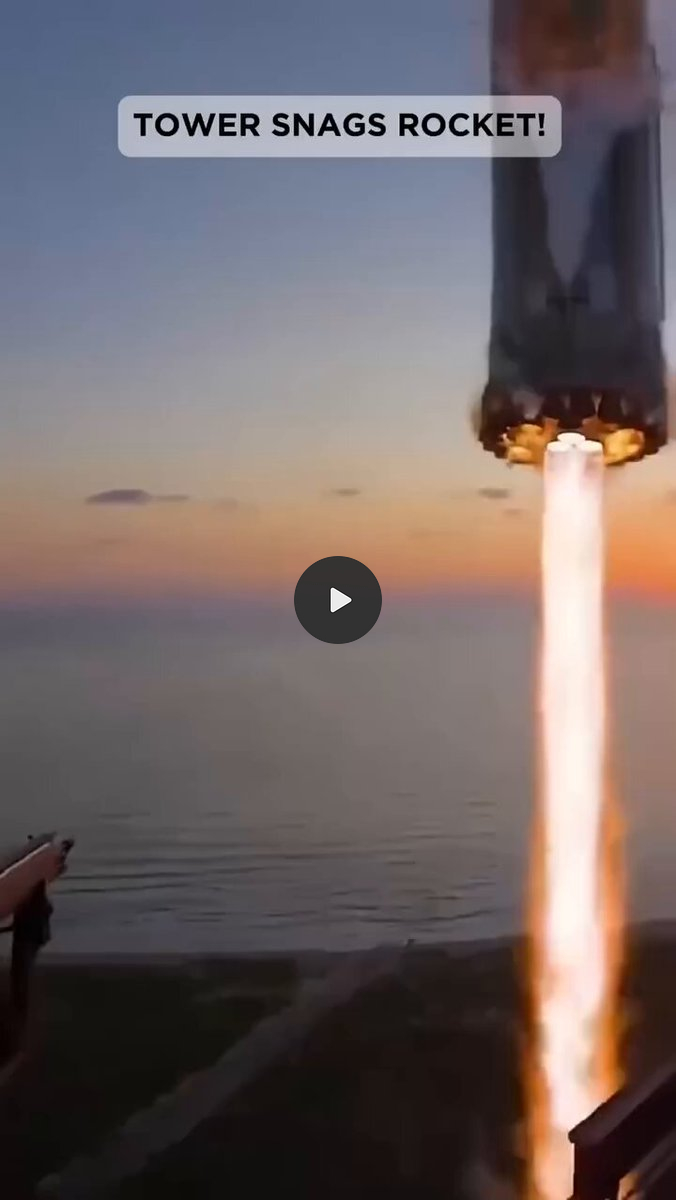
Those are the chopsticks. Or Mechazilla, depending on which name you prefer. The tower itself is sometimes called Mechazilla, the arms are sometimes called the chopsticks, and people use both names for both things. I’ll use chopsticks for the arms and the tower for the structure, and move on.
The catch sequence works like this. The booster separates from Ship at Max-Q on the way up, then does a flip and burn to come back down toward the launch site. As it approaches the tower, it’s flying on its six inner Raptor engines — the ones clustered at the center of the engine section. This outer ring of engines shuts down after separation. The booster slows, stabilizes, and the arms close around the section of the vehicle just below the grid fins. The grid fins themselves act as the final positioning reference: the arms target that structural area, and the catch happens in a window measured in fractions of a second.
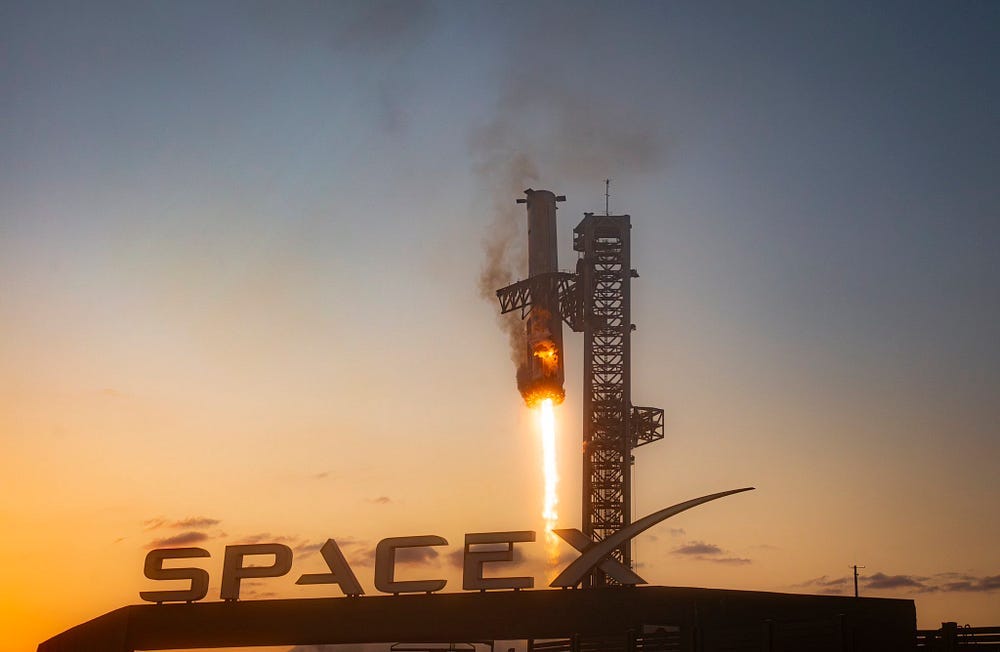
What’s not intuitive is where exactly the arms grip.
On the first generation of Super Heavy boosters — what SpaceX calls V1 and V1.5 — there are structural hooks built into the vehicle just under the grid fins. Those hooks are the catch points. The arms engage those hooks, the rocket stops, and the system holds it suspended until the ground crew can stabilize it.
The V2 booster generation uses the same catch point location, but the hooks themselves are integrated differently into the methane tank structure near the base of the grid fin assembly. V3, which is still in development, moves the catch point integration deeper into that methane tank zone. The structural logic is the same across all three generations: the grid fin area absorbs the landing loads, and the arms catch from below.
The Sequence, Beat by Beat
Three catches have happened. B12 on Flight 5, in October 2024, was the first time the system was tested on a live vehicle returning from an actual flight. B14 followed on Flight 7. B15 on Flight 8. All three worked.
What that means mechanically is more significant than the number sounds. Each catch requires the booster to fly back to within a few meters of its launch position, having traveled to the edge of space and back, burning through roughly 3,400 tons of propellant on the way up. The arms have to close at the right moment, absorb the landing loads without structural failure, and hold several hundred tons of vehicle. That this worked on the first attempt, and then two more times in a row, is not something I would have bet on in 2022.
The tower also serves the stacking function. When a new booster or Ship arrives at the pad, the arms lift it into position. So the same hardware that catches a returning booster also builds the next rocket. That’s the operational logic: one structure for both directions of the vehicle’s life cycle.
The Ship Catch Is a Different Category of Problem
Everything above is about the booster. The Ship Catch — catching the upper stage, the actual spacecraft, on its way back from orbit — has not happened yet. And it’s a fresh problem.
The Ship is roughly 50 meters tall, carries passengers and payload, and on the orbital trajectory it needs to shed enormous kinetic energy from orbital velocity before it can return to the launch site. This booster is a point-to-point return from a suborbital trajectory. The Ship is coming back from orbit. The heat shield has to work, the reentry has to go exactly right, and then it still has to hit a window at the tower.
SpaceX has been working toward this, and the arms at Pad A — the tower that’s been running operations longer — have been exercised in what the team has described as practice runs. But no Ship catch has been attempted on a live flight yet.
Flight 14, which is scheduled NET September 28, 2026, will not attempt a catch on either vehicle. Booster B21 will splash down in the Gulf of Mexico. Ship S41 will splash down in the Indian Ocean. The mission profile for Flight 14 is an orbital trajectory — the first one for Starship — and the priority is getting to orbit and deploying approximately 26 Starlink V3 satellites. Recovery can wait. This is the right call: you don’t run a new catch attempt on the same flight where you’re attempting a new trajectory for the first time.
What’s Happening at Boca Chica Right Now

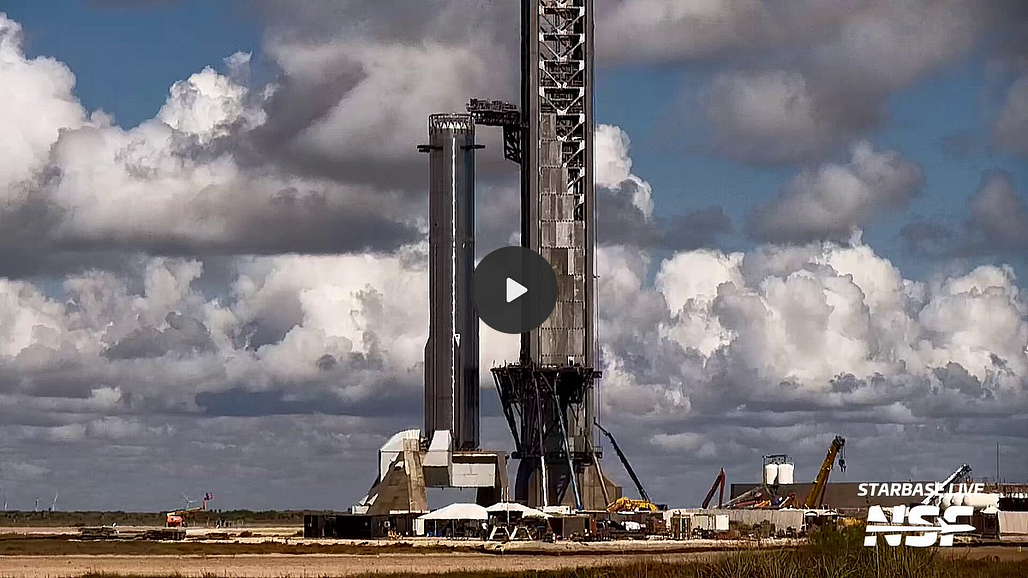
The episode was recorded during a dense period of ground activity at Starbase, and it’s worth walking through what’s actually happening site by site.
Pad B, which is the newer launch mount, has been running arm movement tests — what the crew on the episode called a “fitness session” for the chopsticks. This is systematic: each arm movement, each hold-down clamp, is tested individually before the full sequence is locked in. The hold-down clamps that secure the vehicle on the pad before launch were tested one by one. This kind of sequential individual testing is how SpaceX validates new hardware before committing to a full static fire or launch attempt.
Pad A is undergoing a significant overhaul. A new orbital table has been installed — the platform on which the vehicle sits before and during launch. This suggests Pad A is being reconfigured for the next generation of operations, likely in parallel with Pad B taking the immediate launch cadence.
The Sanchez site, which is SpaceX’s logistics and processing area near the port, continues to handle vehicle parts movement and integration work between the production facility and the pads.
Gigabay Texas — the large enclosed assembly and processing building on the Starbase site — recently completed its outer wall, giving SpaceX a fully enclosed high-bay workspace for integration work. Gigabay Florida, the equivalent facility at Cape Canaveral, received its first equipment transfer, delivered by sea from Texas. Both facilities are part of SpaceX’s plan to run Starship operations from two launch sites, which is a prerequisite for any serious launch cadence.
Ship 40 is still at sea
Ship 40 is currently aboard the semi-submersible vessel FORTE. It completed Flight 13 on July 24, 2026 — two months ago now — and it’s been at sea since then. Based on what was said on the episode, it was less than 20 days from returning to Brownsville at the time of recording, which puts its expected arrival on October 8, 2026.
What happens when it gets back matters. S40 will be inspected, and the condition of the heat shield after an orbital reentry and splashdown will feed directly into how SpaceX approaches the next-generation heat shield design. Every Ship that completes a flight and returns to port is a data point in the system that eventually makes the Ship catch viable.
The Port of Brownsville Is Being Transformed
This part doesn’t get covered much, but it matters operationally. The Port of Brownsville has been undergoing a dredging campaign specifically tied to Starship logistics. Docks 15 and 16 — the closest berthing positions to the Starbase site — have been dredged to their design depth of 13.7 meters. The main maritime channel has been deepened to 15.8 meters, and the entrance channel to 16.5 meters.
Those aren’t abstract numbers. The FORTE, the semi-submersible that carries Ship hardware, needs deep-water access to berth safely. As the Starship vehicles get heavier and as SpaceX moves larger structural components between Texas and Florida by sea, the channel depth directly limits what can transit. Dredging to those specs is infrastructure investment for a production rate that doesn’t exist yet, but that SpaceX is clearly building toward.

The equipment is already moving between Gigabay Texas and Gigabay Florida by sea — the first transfer happened recently, which means this isn’t hypothetical. The maritime logistics chain is operational.
What the Arms Actually Decide
I keep coming back to why the chopsticks decide whether Starship works commercially, and I want to be specific about it.
Falcon 9’s reuse model is already remarkable. The booster lands, gets inspected, gets refueled, and flies again. But it still carries legs. It still needs a landing zone or a drone ship. And it still takes days to turn around because the legs, the landing system, and the servicing all add steps.
Starship without Mechazilla would be a rocket that splashes down in the ocean after every flight. You’d be recovering hardware from the water, shipping it back to port, draining it, inspecting it for saltwater damage, and deciding whether it’s worth refurbishing.
That is not a 24-hour turnaround.
That is not a 100-flight booster.
That is not a $10 per kilogram to orbit price point.
With Mechazilla working, the booster lands on the tower. The same arms that caught it can hold it while the ground crew connects the propellant lines. The arms can lift it back onto the orbital table. In principle — not yet, but in principle — you restack, refuel, and relaunch. The infrastructure for that loop is what’s being built at Boca Chica right now.
Three catches out of three attempts is a small sample. But it’s enough to say that the system works in the mechanical sense. What remains is the operational question: how fast can you run the loop?
The next flight won’t answer that. But the work happening at Starbase right now — the Pad B fitness sessions, the Pad A overhaul, the port dredging, the Gigabay completions, the Ship 40 return — is all aimed at the same answer.
Two arms, one tower, and the whole commercial logic of the world’s largest rocket hanging on whether the sequence holds. That’s what I think about every time a catch happens.