

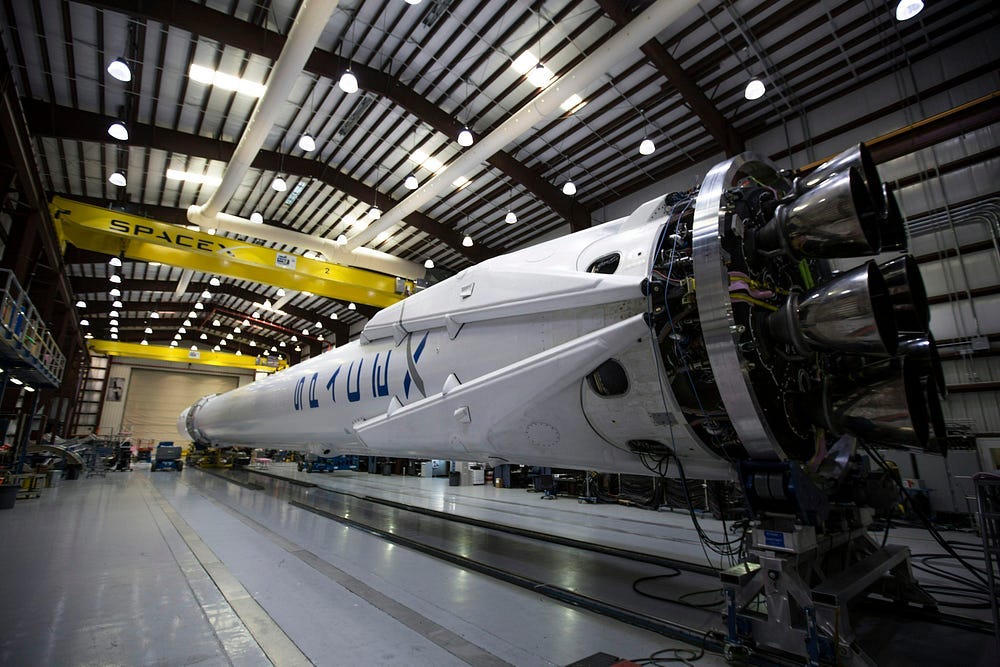
On October 13, 2024, I watched a 71-meter rocket booster fall back toward a Texas launchpad and get caught by two mechanical arms.
Not land.
Caught. Like a ball.
I genuinely had to stop and sit with that for a second — not because it was spectacular content, which it absolutely was, but because something in my gut said: this isn’t just a cool engineering stunt. This is the moment the price of everything changes.
And almost no one noticed what that meant.
The Price Drop That Changes Everything
There’s a principle in industrial economics called Wright’s Law. Every time cumulative production of a manufactured object doubles, its cost falls by a fixed percentage — typically between 15 and 25 percent. It’s why solar panels that cost $76 per watt in 1977 now cost around 20 cents. The sun hasn’t changed. The physics hasn’t changed. A few billion units of production happened in between.
Apply that same logic to rockets, and the numbers get genuinely uncomfortable.
For decades, sending a single kilogram to orbit cost around $54,500 aboard the Space Shuttle. At that specific price range, only government entities such as NASA, the Pentagon, the ESA, and Roscosmos were purchasers. If you were a startup with a brilliant idea that required orbit, it didn’t matter. The door was locked, and only nation-states had the key. Falcon 9 broke that price down to roughly $2,720 per kilogram, a 95-percent reduction that was enough, on its own, to create the entire modern satellite industry. Starlink, Planet Labs, OneWeb — none of those companies could have mathematically existed at Shuttle prices.
But Starship, the vehicle whose booster was caught that October morning, is targeting somewhere between $78 and $94 per kilogram in the near term with partial reusability. Elon Musk’s stated long-term aspiration is $10 to $20 per kilogram at full cadence.
From $54,500 to $10. We have seen this movie before.
The Shipping Container Moment
In 1956, a trucking entrepreneur named Malcolm McLean loaded a converted oil tanker with standardized metal boxes in Newark, New Jersey. Before that moment, loading cargo onto a ship cost about $5.86 per ton and required days of manual labor by longshoremen. The container dropped the cost to roughly 16 cents per ton. This result wasn’t just cheaper shipping. The result was globalization. South Korea, China, Vietnam — entire industrial revolutions were made possible because a metal box made transoceanic trade economically negligible.

The same pattern played out with internet bandwidth costs, which fell by a factor of roughly 1,000 between the mid-1990s and 2015. Netflix, YouTube, and cloud computing were mathematically impossible at dial-up prices. They became inevitable once bandwidth became cheap.
The orbital economy is following the same curve. And the companies already building inside it are not the ones anyone predicted.
Mirrors, Medicine, and What Nobody Saw Coming
Reflect Orbital has raised $35.2 million with backing from Sequoia Capital and Lux Capital. Their plan involves launching a constellation of 4,000 satellites, each carrying an 18-by-18-meter reflective mirror — lighter than the overweight bag your airline charges you for, at just 16 kilograms — into sun-synchronous orbit. These mirrors enhance the energy production capabilities of current solar farms by reflecting sunlight onto them after sunset. With the former economic price of $54,500 per kilogram to orbit, the cost of launching those 4,000 mirrors would have been around $3.5 billion just for the launches.
At Starship’s near-term target of $78 per kilogram, the same bill comes to around $5 million. That’s the difference between a government program and a Series B.
Then there’s Varda Space Industries, which manufactures pharmaceutical compounds in microgravity. Not slightly better versions of existing drugs — molecules that are physically impossible to produce in Earth’s gravitational field, because gravity disrupts the crystalline structure during formation. The company has completed multiple successful missions, each time returning a capsule from orbit carrying crystals that couldn’t exist any other way. They’ve raised $329 million, have a new laboratory in El Segundo, and are exploring the production of semiconductors in microgravity as a longer-term direction, where the absence of gravity allows for crystals with fewer structural defects than anything achievable in any terrestrial cleanroom.
These are not science fiction startups pitching slides. They are operational companies making things that didn’t exist before.
Nvidia Goes to Orbit
In March 2026, Jensen Huang announced the Vera Rubin Space-1 Module during his GTC keynote in San Jose. This is an AI chip system specifically engineered to operate in orbit, claiming up to 25 times the AI compute of an H100 for orbital inference workloads.
For context: the computers aboard the International Space Station have less processing power than your phone. Decades of stagnation in space computing performance, reminiscent of the Stone Age, can be attributed to the fact that radiation-hardened chips have historically been a generation behind their terrestrial counterparts. The partners for this platform include Axiom Space, Kepler Communications, Starcloud, and Planet Labs. The hardware isn’t shipping yet, but Nvidia has planted a flag nobody expected it to plant.
The obvious question is: why put AI chips in orbit when you can build data centers on Earth?
Because terrestrial data centers are hitting three walls at once: energy availability, thermal dissipation, and community opposition. On Earth, you need massive cooling systems, proximity to power plants, permits, real estate, and years of regulatory patience. In orbit, solar panels generate continuous power in many orbital configurations, with no electricity bill, no grid dependency, and no neighbors.
The cooling problem is real — space is a vacuum, which means heat can only escape through radiation, requiring large radiator arrays — but the engineering consensus is increasingly that the sum of Earth’s constraints is becoming worse than the challenge of thermal management in orbit. When the price to send a kilogram into orbit drops to $10, the physics of space access begins to make sense.
Starcloud and the First LLM Trained in Space
Starcloud is the most instructive example of how fast this is moving. Founded in January 2024, the company launched its first satellite in November 2025, carrying an Nvidia H100 GPU — the first time a data-center-class GPU had ever been to orbit.

In December 2025, they became the first company to train a large language model in space, running nanoGPT (designed by Andrej Karpathy) on the complete works of Shakespeare while orbiting Earth. They subsequently ran inference using Google DeepMind’s Gemma model on the same hardware.
In March 2026, Starcloud announced a $170 million Series A, reaching a $1.1 billion valuation — making them the fastest company in Y Combinator’s history to reach unicorn status, just 17 months after their demo day. Their second satellite, already in development, will carry 100 times the power generation capacity of the first. Google has a parallel project called Project Suncatcher with Planet Labs targeting prototype cluster satellites in the 2027 timeframe. And SpaceX has filed a request with the FCC for authorization to launch up to one million data center satellites. One million. Starlink today operates roughly 10,000.
I’ll say that again so it registers: Starlink has around 10,000 satellites and is considered one of the largest satellite constellations in history. The company SpaceX is requesting authorization to develop a constellation of AI computing capabilities, scaled up by a factor of one hundred.
Who Builds All of This?
A human body in orbit requires oxygen, food, water, radiation shielding, two hours of daily exercise to prevent bone loss, and a reentry vehicle. The cost of maintaining a single astronaut aboard the International Space Station runs to approximately $1.5 million per day. At any meaningful scale, the orbital economy cannot be built by people.
The answer is robots. Tesla’s Optimus, Boston Dynamics, and a growing field of Chinese humanoid companies are all iterating at an accelerating quarterly pace. NASA is independently developing humanoid robots for lunar operations. China has announced plans to land humanoid robots on the Moon by 2028. These machines need no oxygen, no food, no sleep, no HR department. They work continuously in conditions that would kill a human in minutes.
Tesla’s stated cost target for Optimus implies an effective labor rate of a few dollars per operating hour. The robots being developed for space will inevitably find their way into homes and factories on Earth — that’s historically how these things work. The aerospace industry has always been the most productive innovation launchpad in industrial history.
The IPO That Prices the Infrastructure
On April 1, 2026, SpaceX confidentially filed for an initial public offering with the SEC. The initial target valuation was $1.75 trillion. By early April, Bloomberg reported that it had already been revised above $2 trillion in preliminary investor conversations. The company is seeking to raise to $75 billion, which would make it the largest IPO in recorded history, surpassing Saudi Aramco by a significant margin. Musk has reportedly reserved 30 percent of the offering for retail investors, three to six times the typical allocation — the same playbook he ran with Tesla.
The entity going public is not a rocket company. It is a platform for space, communications, and AI infrastructure. The February 2026 merger between SpaceX and xAI — valued at a combined $1.25 trillion at the time of the transaction, with SpaceX absorbing xAI in an all-stock deal — means that what’s being priced is the combination of the world’s dominant launch provider, a global satellite internet service with roughly 10,000 spacecraft, and one of the world’s most capable large language model stacks. Reuters reported that the company’s 2025 revenue was in the range of $15 to $16 billion, while its EBITDA was approximately $8 billion.
SpaceX is the railroad of orbit. It’s the shipping container for space. The market is pricing the infrastructure layer of a new economy, and the size of that bet is $2 trillion and climbing.
The Layer We Don’t Talk About
The following points set this apart from a typical business story.
Every company mentioned above is built on AI. Starcloud trains language models in orbit. Nvidia is designing space chips specifically to run inference above our heads. Varda uses AI to control its crystallization processes in weightlessness. The orbital economy and the AI economy aren’t two separate trends — they are the same trend at different altitudes.
The Internet wasn’t built for people to share cat videos. The iPhone wasn’t designed for Uber. This shipping container wasn’t invented so you could buy a Bangladeshi-made shirt at a mall in Brussels. The second and third-order effects — the ones that create the real wealth, measured in trillions — are by definition the ones nobody predicted. In 20 years, there will be trillion-dollar industries that no one at SpaceX, at NASA, or at any Wall Street firm has yet imagined. These cost curves guarantee it.
The capital is already flowing.
The hardware is being built.
The question isn’t whether this happens. The question is whether you’re in the room when it does — or whether you read about it five years later and wonder when exactly you missed the turn.
Thanks for reading. Sometimes I wonder if we’re in a transition period or just watching an entire industry figure out in real time that nobody actually knows what they’re doing. Let me know your thoughts in the comments.