

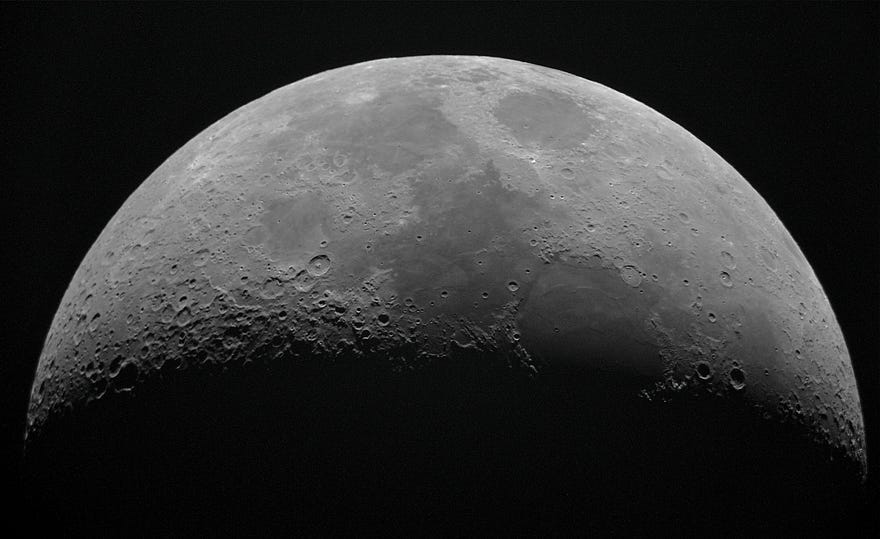
Thirteen months ago, Elon Musk wrote on X that the Moon was a distraction, that SpaceX would go straight to Mars without detours.

But on February 9th, the same man announced exactly the opposite. SpaceX is refocusing its entire strategy on building an autonomous city on the Moon.
A 180-degree turn that nobody saw coming, and the consequences go way beyond just space exploration.
This reversal isn’t a whim. It’s part of a much larger mechanism involving Starlink, Tesla, and even a French automotive ranking that’s making the entire industry nervous. But to understand why everything is connected, we first need to understand what actually changed at SpaceX and why this time it’s not just another promise.
Musk’s declaration triggered a shockwave in the space community. His post racked up over 46 million views in just a few hours. And here’s what nobody’s connecting: this isn’t about choosing the Moon over Mars. It’s about building the infrastructure that makes both possible, and it’s happening faster than anyone realizes.
The Math That Changed Everything
Musk now claims he can build what he calls “a self-growing city on the Moon” in less than 10 years, whereas Mars would require more than 20. The reasoning is based on a concrete logistical reality that honestly makes Mars look like the slow route.
A launch window to the Moon opens every 10 days with a two-day trip. For Mars, you have to wait for planetary alignment every 26 months, then count on six to eight months of travel. The difference in iteration speed is colossal.
On the Moon, SpaceX can fail, correct, and relaunch all within a few weeks. On Mars, every mistake costs you two years. When you’re trying to establish a civilization backup, two-year feedback loops are a luxury you can’t afford.
But that’s not the most revealing part of this announcement. Musk specified that the deep motivation for this change is fear. Not an irrational fear, but the conviction that a natural catastrophe or human-caused disaster could one day threaten Earth’s civilization. The Moon offers a refuge that is accessible quickly. Mars remains too distant to play that role in the short term.
He believes the foremost aim is to guarantee the survival of civilization, and the Moon is a more expedient option.
It’s the difference between having a lifeboat 10 feet away versus one that’s two miles offshore.
Moonbase Alpha Isn’t Science Fiction Anymore
The project already has a name that sci-fi fans will recognize: Moonbase Alpha, a reference to the 1970s series Space: 1999. Musk has been talking about this project since the BFR era, which was Starship’s ancestor. SpaceX envisions using Starship’s gigantic pressurized volume as a lunar habitat, basically an improved Skylab sitting on the lunar surface.
What makes this scenario credible is Starship version 3.
The 12th test flight, which will also be the first of this new version, is scheduled for early March 2026. Booster 19 has already passed several cryogenic tests. This iteration integrates Raptor 3 engines capable of generating 280 tons of thrust each, 50 more than the previous generation.
The long-term objective is to reduce space access costs to less than $220 per kilogram, down from several thousand today. At that rate, sending dozens of tons of equipment to the Moon every 10 days becomes economically viable. And when you can iterate every 10 days instead of every 26 months, you’re not just moving faster. You’re learning exponentially faster.
Building a lunar base doesn’t just require rockets. You need autonomous machines. Robots. Vehicles capable of functioning in hostile environments. And that’s where Musk’s vision takes on a completely different dimension.
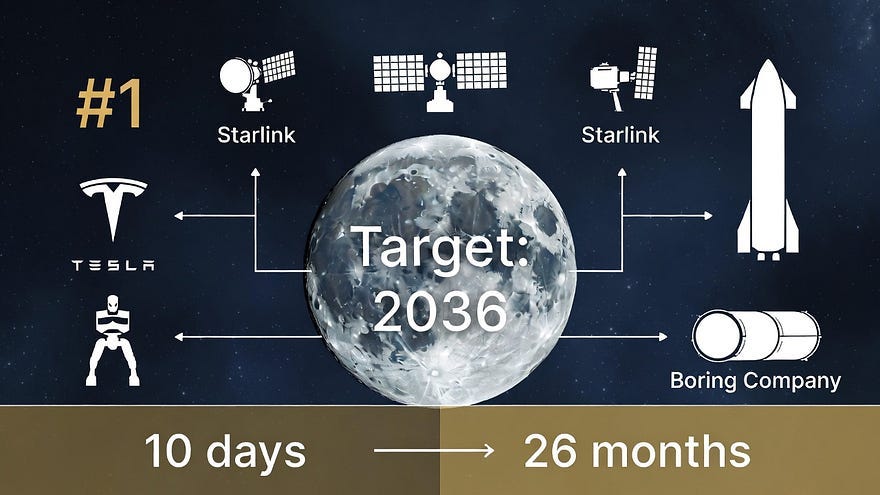
Tesla is developing Optimus robots in parallel for autonomous construction and maintenance. We can also imagine that Boring Company’s drilling technology would serve to dig underground habitats, protected from radiation and micrometeorites on the Moon.
If this convergence is confirmed, Musk’s ecosystem wouldn’t be converging by chance but by design. And that’s precisely why Tesla’s timing isn’t random.
We’re bringing two long-postponed programs back to the forefront, starting with the Semi. Musk confirmed on February 8th that the Class 8 electric truck will enter high-volume production this year. By the end of 2026, Tesla’s goal is to manufacture 50,000 vehicles per year, available in two variants: the standard range providing 525 km of autonomy and the long-range model extending this to 800 km.
Both consume about 1.7 kWh per km, roughly equivalent to what an average French household uses in half a day, but to move 40 tons nearly 2 km. They can recover 60% of their charge in 30 minutes thanks to Tesla’s Mega-chargers. The first units were delivered to PepsiCo and DHL for pilot tests. This time, it’s the shift to industrial scale.
Keep that in mind because it’s going to make total sense in a moment.
