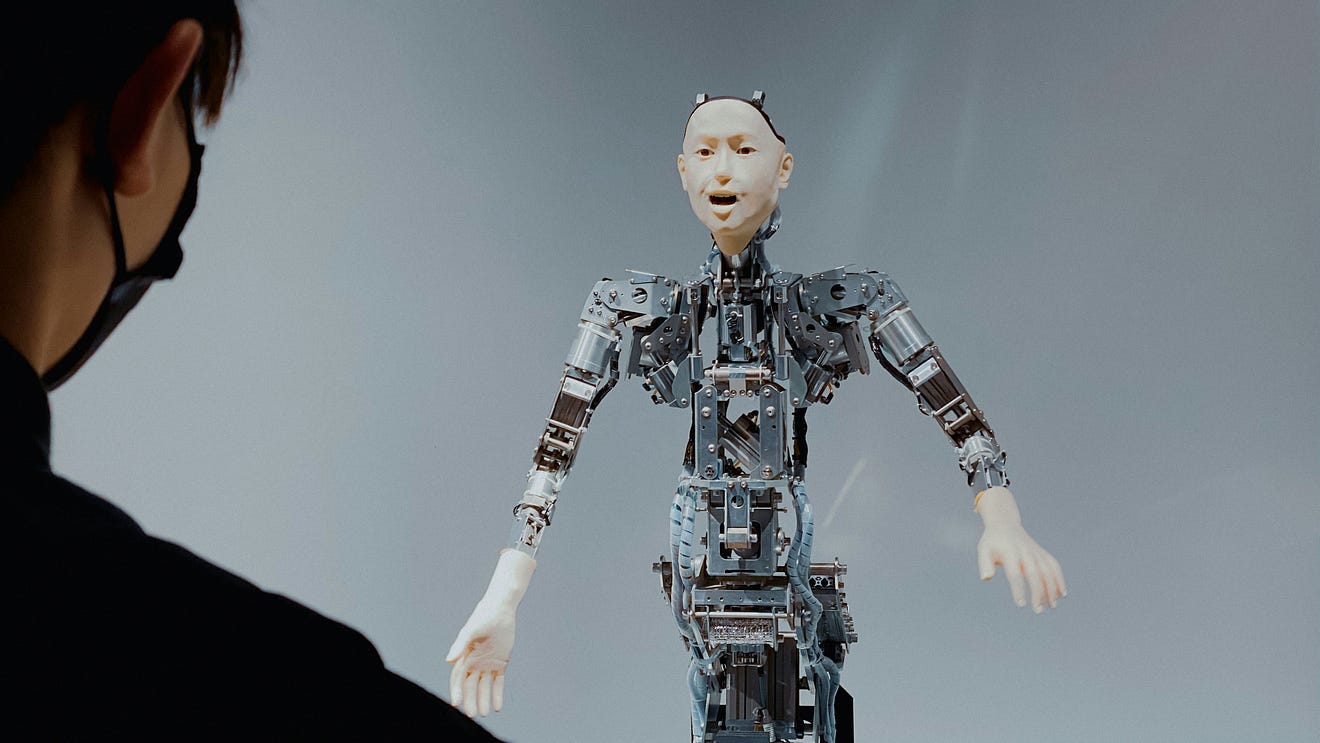
The $2 Robot Workday Is Coming. And History Says It Won’t Kill Your Job.
A 160-year-old economic paradox explains why a 96% drop in labor costs might create more work than it destroys.
$46.
Salary, payroll taxes, health insurance, retirement contributions — all of it. $46 for one hour, for one person, at one position. That number is the invisible price tag on almost everything you buy: every product on a supermarket shelf, every restaurant meal, every car, and every house.
As of March 2026, several companies are driving that number down to under $2.
Not $20. Not $10. Two dollars.
I did not expect to see this happen this fast. And the way it is being done is about to redraw entire sections of the global economy.
Why the World Needs This, Whether It Wants It or Not
Before getting to the robots, there is a problem almost nobody is taking seriously enough.
From a purely economic standpoint, the world is running out of workers. Not in absolute terms, not yet, but in the places and sectors where it counts most. South Korea now has a fertility rate of 0.7 children per woman. For context, a population needs 2.1 to stay flat. 0.7 is not a decline. It is a collapse without precedent in modern human history (World Bank, 2024).
China’s working-age population peaked in 2011 and has been shrinking for over a decade. The country has lost population for three consecutive years. In the United States, the fertility rate has dropped to 1.58 children per woman according to recent Congressional Budget Office projections, and the CBO estimates that by 2030, the number of deaths will exceed the number of births on American soil. The OECD’s working-age population began declining in mid-2025. And according to a study published in The Lancet by the Institute for Health Metrics and Evaluation, more than 97% of countries will fall below replacement fertility by 2100 (Vollset et al., The Lancet, 2020). No pro-natalist policy anywhere in the world has managed to reverse this trend durably. Parental leave, subsidies, tax credits: the data consistently show these slow the decline but do not stop it.

The workers who were supposed to become the logistics handlers, care workers, and assembly line operators of 2040 were never born. That is the context in which the most consequential industrial race of the decade is being run.
Tesla’s Bet That Changes Everything
In January 2026, Tesla made a decision that almost nobody measured at its proper scale.
The company announced it was ending production of the Model S and the Model X, two vehicles that literally built the Tesla brand, to convert the production lines at its Fremont, California factory to the manufacturing of humanoid robots (CNBC, January 2026). The robot is called Optimus. Its third generation, the first designed from scratch for mass production, features a hand with 50 actuators and 22 degrees of freedom. Elon Musk himself acknowledged that the hand and forearm assembly represents most of the entire robot’s engineering challenge. When considering the Model X as a whole, this is more intricate. More complex than the Cybertruck. Musk has stated that only the SpaceX Starship presents greater engineering difficulties than Optimus.
When you sacrifice two of your most iconic products, you only do that if you are convinced that what comes next is incomparably larger.
Tesla plans to deploy robots in its own factories as early as the second quarter of 2026 to collect operational data, with a commercial target of selling to businesses by the end of 2026 and to the public in 2027. The company’s investment budget for 2026 exceeds $20 billion, up from $8.5 billion in 2025 (Global China EV, January 2026). The signal is unambiguous.
The Math Behind the $2 Hour
The hourly cost calculation for a humanoid robot rests on four variables.
First, unit price. Tesla is targeting $20,000 to $25,000 per unit at scale. To put that in perspective, Unitree, the Chinese manufacturer that already delivered its G1 humanoid robot starting from $16,000 at launch, confirms that Tesla’s price target is not a fantasy (Unitree Robotics, 2024).
Second, operating hours. A human worker logs roughly 2,000 hours per year. A robot does not sleep, eat, or take a vacation. At 20 hours of activity per day with 4 hours reserved for charging and maintenance, annual operating time reaches approximately 7,000 hours.
Third, lifespan. Even on a conservative estimate of three years, that is 21,000 total operating hours. A $25,000 robot amortized over 21,000 hours comes to approximately $1.20 per hour in depreciation alone.
Add electricity, a few hundred watts during operation, roughly $0.10 to $0.15 per hour at industrial rates. Add maintenance, joint replacements, updates, roughly $0.20 to $0.30 per hour. Then account for everything you are not paying: health insurance, recruitment costs, payroll taxes, turnover, absenteeism, workers’ compensation litigation, and training. The total is between $1.50 and $2.00 per hour.
Against $46 for a human. A reduction of 96%.
Why This Is Not the Disaster Everyone Assumes
The instinctive reaction to these numbers is fear. 3.5 million Americans drive trucks for a living. In warehouses, nearly 2 million people are employed, with millions more working in manufacturing, food service, and retail. If a robot does the same work 25 times less, the conclusion can seem obvious.
It is not. There is an economic principle, well-established and counterintuitive, that has been right about this exact situation for 160 years.
In 1865, the British economist William Stanley Jevons observed something that should not have been possible. James Watt’s steam engines had just become dramatically more efficient. The expectation was that coal consumption would drop, given that less was needed to produce the same energy output. The opposite happened. Coal consumption exploded because cheaper energy made profitable dozens of activities that had previously been economically absurd.
More factories.
More trains.
More ships.
Efficiency did not reduce demand. It created an entirely new one (Jevons, “The Coal Question,” 1865).
This is the Jevons Paradox.
It has replicated itself at every major technological rupture since. Cheaper transistors did not reduce spending on computing. It put processors in cars, phones, refrigerators, and watches. Cheaper data storage did not reduce the volume of data stored. It made YouTube, TikTok, and billions of videos possible that nobody would have created when a megabyte cost a fortune. Every time, a massive drop in cost did not produce a proportional drop in usage. It produced an exponential explosion.
Apply that principle to physical labor. If the cost of an hour of work drops from $46 to $2, the Jevons Paradox predicts that the total volume of work performed in the economy will not shrink. It will grow. Services and industries that were economically absurd at $46 per hour will suddenly become viable. Personalized 24-hour in-home care for every elderly person who needs it, in a sector already struggling to fill hundreds of thousands of care worker positions. Local micro-factories that manufacture on demand. Every piece of aging infrastructure requires preventive maintenance. These are not hypotheticals. They are the logical consequence of a 96% cost reduction.
The parallel with the Luddites of the 19th century is striking. When the mechanical loom appeared in the 1810s, a single operator could produce as much fabric as ten skilled hand-weavers combined. The weavers panicked. They destroyed the machines. They were certain it meant the end. Then the price of cloth collapsed. Demand exploded. People who owned two shirts could suddenly afford ten. Entirely new industries emerged around mass-produced fashion and textile exports. Fifty years later, more people were employed in the textile sector than before the mechanical loom existed. Not fewer.
The race is already underway
Tesla is not alone, and the competition is accelerating everything.
Figure AI deployed its Figure 02 robot at BMW’s Spartanburg, South Carolina, plant over a ten-month pilot. During that period, the robot contributed to the production of more than 30,000 BMW X3s, moving over 90,000 components with millimeter-level precision (BMW Group, 2025). Figure’s next model, Figure 03, runs on Helix, an internally developed vision-language-action system that allows the robot to parse natural language instructions. You say, “I spilled my coffee.” It understands that it needs to find a cloth and clean the floor.
Agility Robotics just signed a commercial agreement with Toyota Motor Manufacturing Canada to deploy Digit robots at the Woodstock, Ontario, plant building the RAV4, in a robots-as-a-service deal that converts what used to be capital expenditure into a monthly subscription (Agility Robotics, February 2026). Unitree is targeting between 10,000 and 20,000 units sold in 2026, up from the 4,200 delivered in 2025. The production volume of humanoid robots worldwide is dominated by China, at 85 to 90%. A week before this article was written, Xiaomi was testing its own humanoid robots on electric vehicle assembly lines.
This is no longer a laboratory prototype. It is a global industry organized at scale.
What distinguishes Tesla within this field is vertical integration. Tesla designs its own AI training chips. It writes its own software. It manufactures its own motors and actuators. This owns those factories to produce at an automotive scale. Every competitor depends on external suppliers somewhere in their chain. Figure AI does not have its own chips. Unitree does not have its own AI training infrastructure. Boston Dynamics does not manufacture at an automotive scale. Every link you control is a link where your competitor must negotiate, wait, and pay a margin to an intermediary. That structural advantage compounds over time.
What the Honest Picture Actually Looks Like
Clarity requires acknowledging what is not yet true.
Musk himself confirmed on Tesla’s Q4 2025 earnings call that no Optimus robot is currently performing productive work inside Tesla’s factories. They are in research and data collection mode. A December 2025 demonstration in Miami raised doubts among observers who noted that the robots appeared to be remotely operated rather than fully autonomous. Rodney Brooks, co-founder of iRobot, has publicly described the idea of a truly general-purpose domestic humanoid robot as pure fantasy at this stage. And Musk had previously promised 5,000 units by the end of 2025. That number never materialized. The third generation, the first version genuinely designed for mass production, will only be unveiled in the coming weeks.
Short-term timelines deserve skepticism. The direction does not.
The economic and demographic trajectory makes this technology not optional but inevitable. The global labor market represents more than $40 trillion per year in value. Even capturing a fraction of that market makes humanoid robots the largest industrial product category in modern history. The global labor market’s structural deficit will only deepen as populations age.
This transition will be painful for many people, exactly as it was for the weavers of the 19th century. This difference is that this technology moves incomparably faster. The adaptation window will be shorter. The retraining is more urgent. Governments that do not invest massively in workforce transitions will create social crises, not just economic ones.
But on the other side of that disruption, the Jevons Paradox also tells us there will be an explosion of economic activity that nobody can fully imagine yet. Entire industries, services, and job categories that do not exist today are impossible because the cost of labor has made them impossible.
2026 is not the year robots will take your job. It is the year the question became unavoidable.
Thanks for reading. Are you preparing for this shift or hoping it slows down? Let me know in the comments.


