

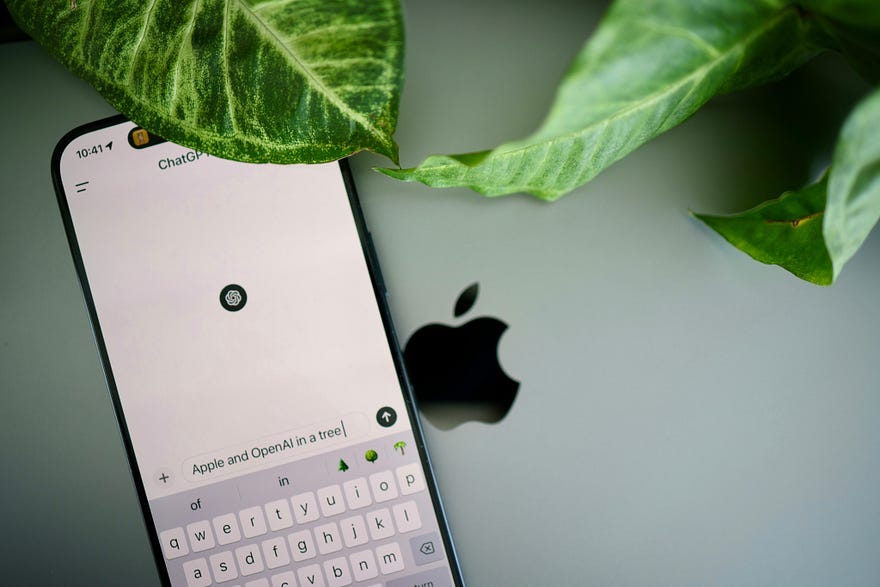
OpenAI is quietly backing away from Apple’s ecosystem. Not dramatically, not with press releases, but with the type of strategic retreat that tells you everything about where the AI wars are actually headed.
Simultaneously, Apple’s multi-billion dollar collaborations with Google and Anthropic communicate an obvious message to the AI industry:
They are avoiding over-reliance on one provider and will not be held captive by any single company.
Let me explain why this matters more than you think.
The ChatGPT Integration That Never Really Worked
Can you remember Apple’s announcement about bringing ChatGPT into Siri? It shocked everyone, myself included. When I discussed it with friends and colleagues, we all agreed the integration felt clumsy, almost embarrassingly so.
Here’s how it actually works:
When Siri can’t answer your question, it suggests asking ChatGPT instead. It’s like having two assistants where one constantly admits incompetence and defers to their smarter colleague. Not exactly the seamless AI experience Apple promised.
This wasn’t Siri enhanced by AI. This was Siri admitting defeat and outsourcing to OpenAI’s chatbot.
The partnership was announced with fanfare at WWDC 2024, positioning OpenAI as integrated across Apple’s ecosystem. OpenAI was signing partnerships with everyone: Apple, Microsoft, NVIDIA, and countless software platforms. They were establishing something close to a monopoly, the only serious AI player deeply embedded in major operating systems.
But something fundamental shifted in late 2025.
Google arrived almost quietly with Gemini 3, and it absolutely took the AI world by storm. Within months, Gemini’s usage numbers approached OpenAI’s ChatGPT, an unprecedented rise that caught everyone off guard.
The agreement represents a significant setback for OpenAI. Since 2024, the company has integrated ChatGPT into Apple Intelligence features and hopes to reach millions of iPhone users through this partnership.
The announcement followed:
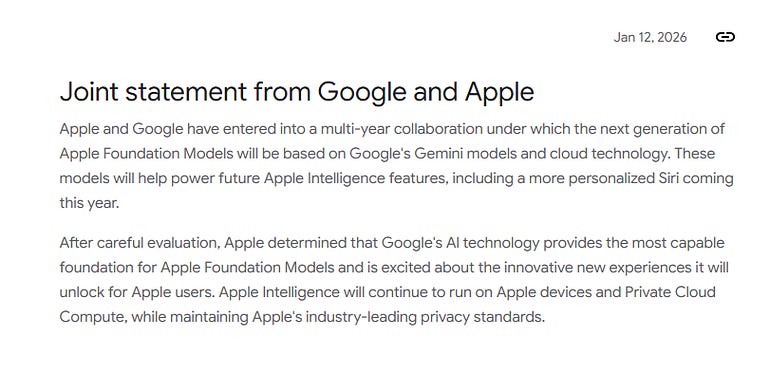
Translation: Google just became the brain powering Siri, not OpenAI.
According to reports, Apple is paying around $1 billion per year for the deal, though the companies haven’t confirmed exact figures. What we know for certain is that Gemini, not ChatGPT, will power the redesigned Siri launching in 2026.
For OpenAI, this is devastating. OpenAI’s ChatGPT still holds the lead when compared to Google’s Gemini app in terms of usage, though analysts say that lead is rapidly narrowing.
Why OpenAI Walked Away (And Yes, They Did)
Here’s where it gets interesting. OpenAI didn’t just lose the Apple deal.
According to multiple reports, OpenAI made a conscious decision to refrain from partnering with Apple… a person close to the company said it had taken “a conscious decision to not become the custom model provider for Apple” in the autumn of last year.
Why would OpenAI voluntarily walk away from billions of iPhone users?
The answer is a $6.5 billion conflict of interest.
The full acquisition of IO by OpenAI, along with the merger of both companies, was announced in May 2025. The deal valued the company at $6.5 billion, making it OpenAI’s largest acquisition to date.
IO is the AI hardware startup founded by Jony Ive, Apple’s legendary former design chief. The same Jony Ive who designed the iPhone, iPad, and iPod. Ive is taking on “deep creative and design responsibilities across OpenAI and io,” while his design collective LoveFrom stays independent but manages design for all OpenAI projects.
Think about the implications:
OpenAI is building consumer AI hardware with Apple’s former design genius, directly competing with Apple’s ecosystem, while simultaneously providing AI models for powerful Siri.
That’s not a partnership. That’s corporate espionage waiting to happen.
What exactly is OpenAI building with Jony Ive?
Details remain scarce, but the vision is clear. The device is expected to be pocket-sized, screenless, and contextually aware, gathering information from its surroundings and experiences through built-in cameras and microphones.
Altman described the goal as creating devices with a calmer “vibe” than smartphones. “You can then go for a vibe that is not like walking through Times Square and getting bumped into and having all this stuff compete for your attention, but, like, sitting in the most beautiful cabin by a lake and in the mountains and sort of just enjoying the peace and calm.”
Translation: They’re building an alternative to the iPhone.
Ive said he expects OpenAI to reveal its hardware device in two years or fewer. Prototypes are apparently complete, and Altman was quoted as expressing an ambition to make a big launch in 2026, with the intention of selling 100 million units during the initial rollout.
You don’t sell 100 million AI devices while providing the intelligence layer for your competitors’ products. You pick a lane. OpenAI picked hardware, which meant walking away from Apple.
Enter Anthropic: The Developer’s Choice
While Google grabbed Siri and OpenAI pursued hardware, Anthropic (maker of Claude) quietly secured perhaps the most strategic position of all: Xcode integration.
Apple revealed this month that it would incorporate agentic coding into Xcode, its main coding software, aligning with a significant emerging trend in Silicon Valley. Apple said its tool will support Anthropic’s Claude Agent and OpenAI’s Codex.
For context, Xcode is where essentially every iOS and macOS app gets built. With the Claude Agent SDK, Claude can now work autonomously on much more sophisticated, long-running coding tasks inside Xcode.
This gives Anthropic direct access to millions of iOS developers. Claude can now explore project structures, understand app architecture, search Apple’s documentation, build interfaces, test code, and iterate autonomously, all without leaving the development environment.
“At Apple, our goal is to make tools that put industry-leading technologies directly into developers’ hands so they can build the very best apps,” said Susan Prescott, Apple’s vice president of Worldwide Developer Relations.
For Anthropic, this is an enormous win. They’re a smaller player compared to Google and OpenAI, but suddenly, they’re embedded in the workflow of every serious Apple platform developer. For Google, who thought they’d have Apple’s AI ecosystem to themselves? This is an annoying little brother tagging along.
To celebrate our 10K followers on Medium, I got a 10% discount from CleanMyMac for y’all. Click below to enjoy it or use NOVTECH until Mars 2026.
Apple’s Genius Strategy: Never Get Held Hostage
Here’s what makes Apple’s approach brilliant: they’re not betting everything on one AI provider.
