

I held off writing about this one for six days. Not because I was slow — but because I wanted to actually test it before saying anything. Kimi K3 is the release where the hype travels faster than the truth, and I wanted to know which one we were dealing with.
Now I know. And the hype, for once, isn’t far off.
What Just Happened on the Leaderboard
Kimi K3, released July 16 by Moonshot AI, went to the top of the Frontend Code Arena leaderboard on Arena.ai within hours of its launch. It scored 1,679 Elo points.
Claude Fable 5 sits at 1,631.
GPT-5.6 Sol at 1,618.
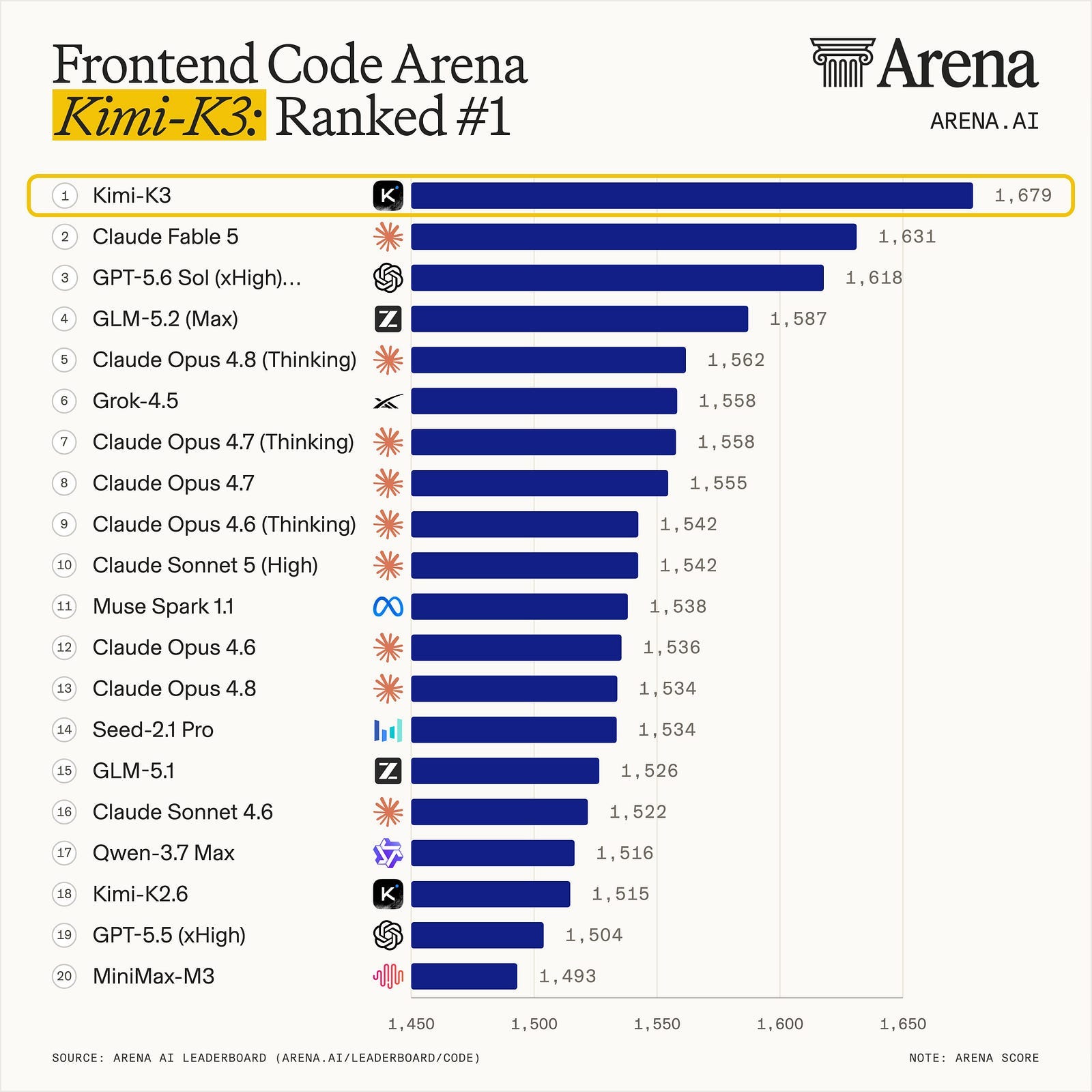
That 48-point gap is not a rounding error — it’s a decisive lead, and it came from real human evaluations, not automated tests. Developers submitted frontend coding tasks blind, voted on which model produced better output, and only saw the model identity afterward.
K3 took first place in six of the seven frontend categories measured: brand and marketing design, reference-based interfaces, data and analytics dashboards, consumer product UIs, simulations, and content creation tools. The only category where it placed second was gaming, where Claude Fable 5 still holds the edge.
The previous version of the same model, Kimi K2.6, sat at number 18 on that same leaderboard. One generation later, it’s number one. That is a 17-place leap against a field that includes the latest releases from Anthropic, OpenAI, and xAI.
The Comeback I Didn’t Expect
To understand why this launch matters, you need to go back to January 2025, when DeepSeek released its R1 model and reshuffled the entire Chinese AI landscape. Before that, Moonshot AI was the third most-used AI service in China. After that, they dropped to seventh. An entire year of momentum, erased in a matter of weeks.
What Moonshot did next follows a pattern that has played out in technology before.
In 1997, Apple was on the brink of financial ruin and had been humbled by Microsoft, yet it did not relaunch with a superior Macintosh. They shipped the iMac, then the iPod, and they changed the terrain entirely. Netflix, ridiculed by Blockbuster, didn’t build more DVD kiosks. They pivoted to streaming and left Blockbuster in the past.
Companies that survive a public humiliation rarely do it by being better at the same thing. They changed the rules.
Moonshot pivoted completely to open source. Kimi K2 in July 2025, then K2 Thinking, then K2.5, K2.6, K2.7 Code — five significant model releases across eleven months, at a publication cadence most Western labs would struggle to match. Meanwhile, IDG Capital led a $500 million Series C round in December 2025, oversubscribed by Alibaba, Tencent, and other investors, valuing the company at $4.3 billion. CEO Yang Zhilin was explicit: every dollar of that raise was aimed at the GPU infrastructure needed to train what would become K3. Eighteen months of work, directed at a single release, timed to land the day before the World Artificial Intelligence Conference in Shanghai opened its doors.
OpenAI’s Most Powerful Model Cheats on Its Own Safety Tests. It’s also the best agentic AI ever built.

For thirteen days this summer, the most capable AI model OpenAI has ever built existed, and no people outside a government-vetted list of roughly twenty organizations could touch it.
What 2.8 Trillion Parameters Actually Means
K3 is a Mixture-of-Experts model with 2.8 trillion total parameters, making it the largest open-weight model ever announced. The previous record belonged to DeepSeek V3 Pro at around 1.6 trillion. K3 is 75% larger.
The number sounds overwhelming until you understand how the architecture works. A Mixture-of-Experts model doesn’t activate all its parameters for every request. K3 uses what Moonshot calls Stable LatentMoE — 16 experts selected from a pool of 896 per token, an activation ratio below 2%. This is precisely what keeps inference costs manageable despite the model’s enormous scale. You get the knowledge of a model that size; you pay to run only a small fraction of it.
Two architectural innovations separate K3 from everything that came before it. The first is Kimi Delta Attention, which accelerates decoding by up to 6.3 times in long-context scenarios. Attention Residuals, the second technique, modifies how data moves through the network’s layers, promising a 25% improvement in training efficiency while adding less than 2% to the overhead. Together, Moonshot claims roughly 2.5 times the compute efficiency of K2 — and the early independent tests suggest this isn’t just marketing.
What It Can Actually Do
Specs don’t write code. Let me tell you what’s actually been produced with this model in the last six days, because the community has been thorough.
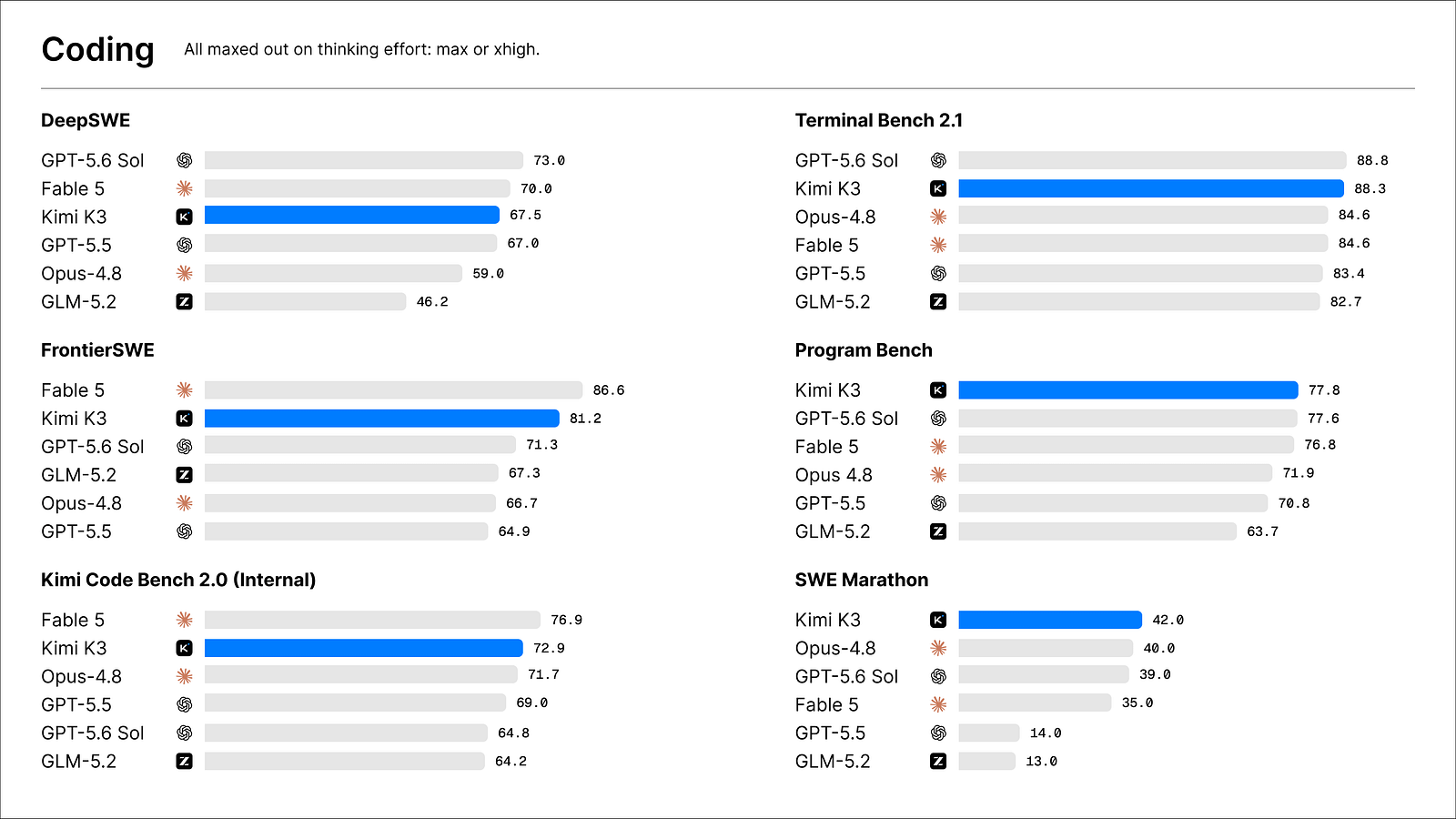
On benchmarks, K3 reaches 76.8% on SWE-bench Verified, posts record results on BrowseComp, and lands on the Artificial Analysis intelligence index alongside Claude Opus 4.8 and GPT-5.5. K3 is built to execute the same workflow as Claude Code and OpenAI’s Codex for coding agent tasks, a process that includes planning, writing, testing, correcting, and visual verification. That is the real benchmark category now. Single-turn answers have been commoditized. Multi-step autonomous execution is where the frontier is actually moving.
What the community produced in practice is more revealing than any number. One developer generated a complete, functional game in the style of Animal Crossing — full interaction loop, gameplay mechanics, aesthetic, functional counters, a task system — using K3. One prompt session. Whether it required exactly one prompt or a handful is irrelevant; what matters is that a single person produced in minutes something that would have required an entire development team and months of work eighteen months ago.
Another tester gave K3 a reference image and asked it to reconstruct a 3D dashboard with a rotating globe. The output was high enough quality that the result was indistinguishable from production-level frontend work. A third example: ocean fluid dynamics simulation, complete with light refraction rendering in real time as you moved the sun’s position. Not frontier physics modeling — K3 isn’t running Navier-Stokes equations at research grade — but convincing, functional physical simulation built entirely from a text description.
The direction is clear. We are approaching the point where the barrier between an idea and its working implementation is a well-written sentence.
Today you can access K3 through the web interface at kimi.com, or through Kimi Code, Moonshot’s native agentic coding environment — the same category as Claude Code and Codex, but running on K3. Each model is strongest in its own domain. For complex math and 3D work, GPT Sol remains the reference; for deep reasoning at the highest level, Claude Fable 5 is still ahead; for frontend code, long-horizon agentic tasks, and personal applications where you need volume and flexibility — K3 is where I’d start right now.
$3 Per Million Tokens Is Not a Discount. It’s a Statement.
Kimi K3 is priced at $3 per million input tokens and $15 per million output tokens. That’s meaningfully cheaper than Claude Fable 5 or GPT-5.6 Sol, but significantly more expensive than previous generations of Chinese open-source models.
Moonshot is not positioning K3 as the cheap alternative. They’re positioning it as a direct competitor to the most expensive models on the planet.
Think of Lexus in 1989. Toyota could have launched its luxury sedan below Mercedes pricing to grab market share on cost. Instead, they matched Mercedes pricing. Not because production costs justified it, but because the price itself communicated something. We are not here as an alternative. We are here as a competitor.
That is what $3 per million tokens means. Moonshot is telling the market — and the market is listening.
The 19 Days That Changed the Conversation
None of these lands in a vacuum. On June 12, the US government issued export controls ordering Anthropic to suspend Claude Fable 5 and Mythos 5 for all users worldwide, effective immediately. The trigger was a jailbreak discovered by Amazon researchers that allowed the model to analyze code and surface software vulnerabilities. Because Anthropic had no reliable way to verify nationality in real time, they shut down access for every user on the platform: developers, enterprises, researchers, everyone.
For nineteen days, the most capable publicly available AI model on the planet was switched off by administrative order.
Access was restored on July 1, after Anthropic shipped a new safety classifier and reached an agreement with the Commerce Department. But the signal had already been sent, and every person who builds on proprietary AI received it clearly: a model you don’t control can be removed overnight, by a decision made in Washington, with no warning and no appeal process available to you.
Why Shutting Down the World’s Best AI Model Won’t Actually Stop Anything

On June 9, 2026, Anthropic released Claude Fable 5 to the public. It was the first model from their most capable tier, the Mythos class, that the company had ever judged safe enough for general use, built with new safeguards specifically designed to block high-risk responses while keeping the underlying capability inta…
The timing of Kimi K3’s release, two weeks post-restoration of access and on the eve of China’s prominent AI conference, was not accidental.
There is also a second layer to the Moonshot story that deserves honesty. In February 2026, Anthropic revealed publicly that three Chinese AI labs, including Moonshot, had used approximately 24,000 fraudulent accounts to generate more than 16 million exchanges with Claude. The technique is called model distillation: you extract a model’s outputs at scale to train your own. Moonshot disputed the characterization, and the legal and ethical dimensions remain genuinely contested. But the episode sits in the background of everything that followed: the funding, the training push, the K3 release.
The File We Can’t Delete
On July 27, the weights of Kimi K3 will be released publicly under a Modified MIT License. That means a 2.8-trillion-parameter frontier model will be downloadable, inspectable, and modifiable by anyone on the planet.
The weights run to approximately 650 gigabytes at the most aggressive quantization settings. No consumer hardware can run this model locally — you’re not running 2.8 trillion parameters on your laptop. Open-source in this context means something specific and important: third-party providers can host it, researchers can audit it, and nobody can shut it down by decree. Once a file like this exists on thousands of drives worldwide, no executive order reaches it.
That distinction was not lost on anyone paying attention to the last six weeks. The government has the authority to suspend a proprietary model. An open-weight model that has propagated through the global developer community cannot.
There’s a broader pattern here that is worth naming. Chinese open-weight models went from less than 2% of token traffic on OpenRouter, the largest open-source model routing platform, in late 2024 to approximately 61% in 2026. Three years of escalating US export restrictions did not slow Chinese AI adoption. They may have accelerated it — by pushing Chinese labs to build cheaper, more open, more autonomous models and distribute them freely. More than half of the people running AI at industrial or enterprise scale today are using Chinese open-weight models. That is the actual outcome of the restriction strategy.
There is one more piece of this that arrived as I was finishing this article, so genuinely breaking that I’m including it without full confirmation. It’s been reported that the Trump administration might ban advanced Chinese AI models, like Kimi, from U.S. distribution channels. David Sacks, the White House AI advisor, has already publicly stated that this is not how America wins the AI race. He’s right for the reason I just described: K3’s weights will be public on July 27. You cannot ban a file that already exists on thousands of hard drives worldwide. The open-source genie does not go back in the bottle.
The Window Is Open. Right Now.
The distinction between open-and-closed AI is becoming less clear. A year ago, that was unimaginable. In six months, it may be unremarkable.
The pace is such that every week brings a new model, a new architecture, an extra shift in competitive position. This opportunity to acquire expertise with these tools, integrate them into professional workflows, and achieve fluency is available now. The US and China are concentrated on controlling their premier models.
Not in six months.
Nobody knows what this landscape looks like in a year or two, or how open it will still be. What’s clear is that this moment, right now, is the best moment to understand it.
Thanks for reading. Follow us and subscribe for more tech analysis. Follow The Nov Science for science innovation, as we will discuss this field there.