

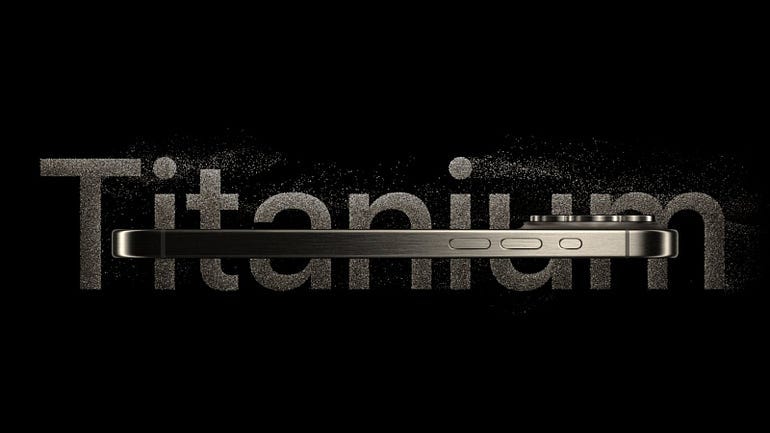
This ad annoyed me so much 2 years ago. What annoyed me about this ad from last year’s Apple?
Let me show you something by comparing this iPhone 15 Pro with something else you might remember.

“1000 songs in your pocket.” That was an ad.
It undeniably resonated with consumers because it hinted at a technological revolution, not just a technical one, with a simple, powerful promise that made the iPod desirable to anyone.
But this ad?
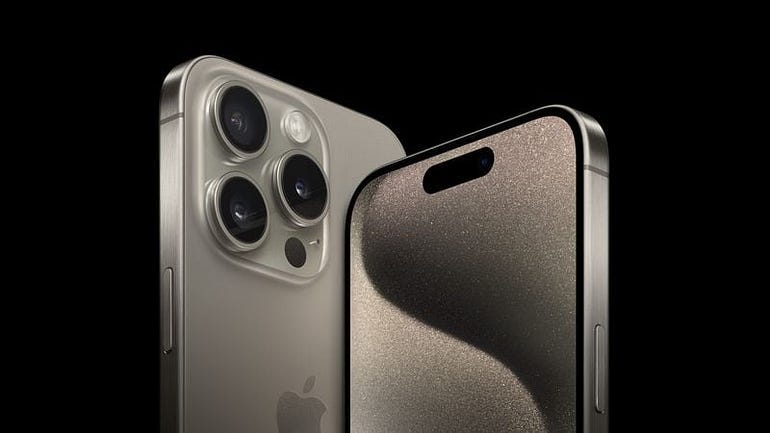
It said nothing. Someone glancing at it while waiting for the bus won’t feel anything. You probably won’t understand the intended sensation or phone benefits unless you’re an aerospace engineer.
All you’re thinking is, “It’s a titanium iPhone.”
By emphasizing titanium, Apple had shifted from ads focusing on the experience to those highlighting a material feature. And what else could they say? The iPhone 17 Pro has improvements, but it’s not dramatically different from other phones, such as the iPhone 15 Pro.
This is reflected in sales.
Consumers see that smartphones have reached maturity. Sales dropped by 8% between 2022 and 2023, and the market is expected to decline another 6% this year, hitting its lowest level in a decade. This is a significant problem for Apple, as the iPhone accounts for over half of its revenue.
The Strategy Behind Titanium
Titanium was a luxury code, a differentiation attempt in a saturated market, allowing Apple to continue gaining market share without reinventing its formula. But this strategy can’t last forever. Each time Apple rises above the rest, the market eventually catches up. When they’ve exhausted all the materials in the world, they’ll need a new plan.
That plan is already in motion. It’s hidden inside the iPhone.
There are still surprises in smartphones, such as the iPhone X, which changed how we navigate interfaces, or the more radical folding phones. But radical changes, like folding phones, come with risks, especially for a product central to daily life. You pick up your phone on average 200 times a day. If it’s a hassle because you impulsively bought a folding phone and hate it every time you unfold it, you’ll regret it. Your curiosity may push you to want change, but in the face of novelty, caution usually makes the final decision. So, you keep buying the same products.
Expectations for new smartphones are technical: battery life, camera quality, processor power, and weight. These don’t focus on usage changes, but on the reliability of existing features. Among these limited improvement areas, some defy physics. Improving batteries, for example, is a complex chemical challenge. The best solution found so far is improving processors for better energy efficiency, but also processor evolution.
The Post-iPhone Era
When the smartphone market exhausts improvement avenues, what will be left for the iPhone to continue developing? In engineering, if something works, you improve it. If you can’t improve it, you create a new product. The best way to create a new product without public rejection is to do it within a product that already sells.
The iPhone X introduced Face ID, a facial recognition technology projecting 30,000 infrared dots on your face to identify features and detect attention. The iPhone 12 Pro added a LiDAR sensor, sending infrared points to see the surrounding environment. Spatial audio, immersive sound that seems to move around you, is presented by the iPhone 12 Pro.
The iPhone 15 Pro was the first model with a Pro processor, offering power that allows video games to render current light and reflection, creating a reality illusion in virtual environments.
Each technology individually made the iPhone better through secondary uses. New features include Face ID, LiDAR for portraits, spatial audio on AirPods, and A17 or A18 Pro-powered games. Yet, their combination elevates them to primary importance. They guarantee immersion in a new product: Apple’s first spatial computer, the Vision Pro.
Years of Face ID development led to the best eye tracking ever seen in a mixed-reality headset, eliminating the need for controllers or a mouse.
Vision Pro is controlled with your eyes, voice, and hands.
LiDAR and Spatial Audio
LiDAR in the iPhone 12 Pro is essential in a mixed-reality headset to understand and interact with your environment, for app development, games, and letting people enter your immersion without cutting you off from the world. Vision Pro also includes spatial audio technology, as immersion isn’t just visual; sounds must surround you.
The A17 Pro or A18 Pro processor’s Ray-tracing technology brought realism to Vision Pro, where light and reflection effects add depth to the environment, making it almost indistinguishable from reality.
The Role of the iPhone Beyond Titanium
With format maturity comes relevance, but this maturity’s relevance may be inseparable from boredom. Apple has sold over 2 billion iPhones. Around the iPhone, there’s an entire ecosystem of products, technologies, users, and apps, making it a remarkable development platform.

What allows Apple to be impressive from the first iteration of Vision Pro is that it has already tested and improved the technologies within its ecosystem products.
In this strategy, the iPhone is no longer serving itself but the future.
Birth of the New Revolution
Change should no longer come from the iPhone itself; it should emerge from within to fuel other revolutions. Apple has good reasons to believe that mixed reality, which it calls spatial computing, is the next big thing. A revolution’s chief characteristic is breaking down barriers between us and technology, knowledge, creativity, or information.
Personal computers removed the coding barrier, the internet removed communication and information barriers, AI removed the language barrier between humans and machines, and the iPhone’s touch interface removed the physical button barrier. Vision Pro is an infinite interface in space that you only need to look at and make micro-gestures to interact with.
It seems impossible not to see its revolutionary potential. And its price doesn’t matter.
Apple understands that to believe in technology, you need to show its full potential — to convince investors, developers, and the public who await a more affordable version that will eventually arrive.
Luxury and Strategy
What was your perception of electric cars before Tesla? In 2008, electric automobiles were already on the market, with a Nissan Leaf costing around $30,000. Tesla launched its vehicle at $100,000. Before Tesla, electric cars were judged as underperforming and not sexy products for radical environmentalists. But they arrived with a high-end, desirable vehicle that changed public perception, making people interested in their proposition before they could access it.
Then came the Tesla Model S at $76,000, and the Model 3 at $35,000.
Today, the VR market leader is a €500 headset that’s great for gaming, but its interface, camera quality, and uses make the entire market seem like a geek gadget because the product was compromised to sell at that price.
The Power of Vision Pro is Premium, Not a Gadget
Vision Pro isn’t designed like a gadget. Everything in this headset is premium and meant to appear real. Vision Pro costs $3500 because its demonstration can’t cost a dollar less — it’s too important.
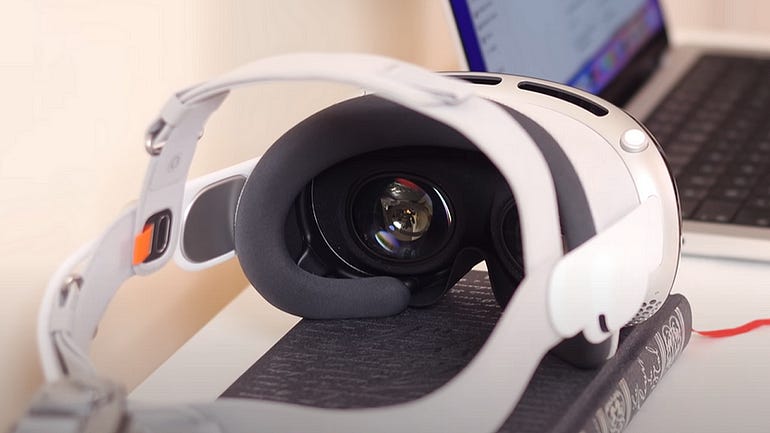
Apple claims it represents the future of Mac, productivity, and entertainment.
Will it be a commercial success? It doesn’t matter. Only Apple can create a product whose high standards make it inaccessible. But that’s what sets leaders apart from the rest.
Vision Pro will be a revolution, even surpassing previous Apple innovations. Unfortunately, nowadays we don’t need it.
Spatial Computing: Convinced Yet?
You’re not convinced? Okay, give me two minutes.

What you’re seeing is a VR ping-pong match between my dad, with a cathead, and me.
The reason we’re playing in VR instead of on a proper table is because it’s 2024, and we’re 10,000 km apart during the Christmas Holidays. We felt so much like we were playing ping-pong that we played ping-pong.
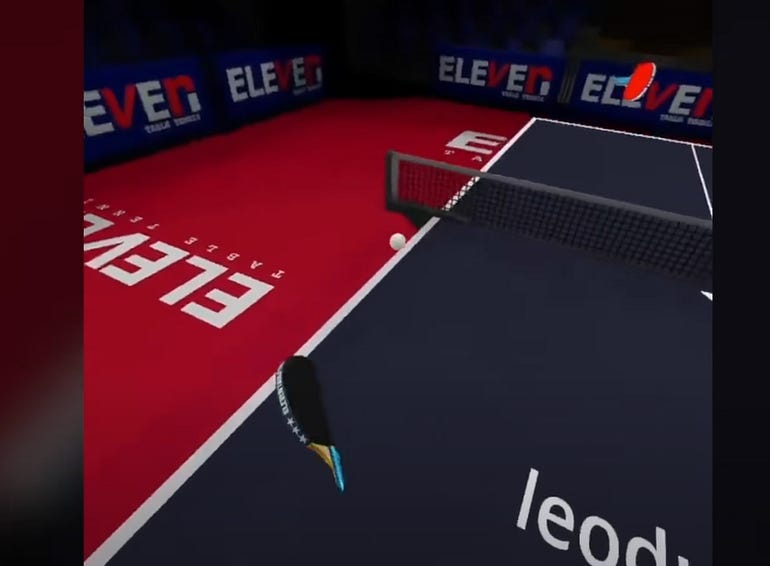
Otherwise, I would have just moved into my living room to catch the ball. But I leaned over the void like an idiot because I felt the table was in front of me and lost the point.
The Las Vegas Sphere & Vision Pro’s Potential
Have you heard of the Las Vegas Sphere? It’s a one-of-a-kind performance hall covered entirely with screens, inside and out.
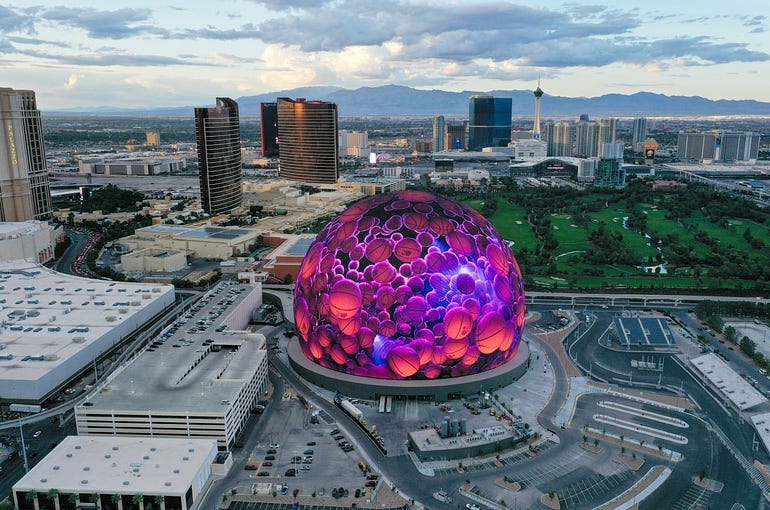
These innovations aim to make you feel you’re elsewhere. Watching a screen meter away versus watching a screen centimeters from your eye makes you feel like it’s meters away — what’s the difference?
Imagine your favorite artist performing at the Sphere, but you can’t attend because of ticket costs, travel, and hotel expenses. Instead, for a few dozen euros, you can watch the concert live, with spatial sound, crowd energy, and giant screens from your couch. Would you do it? If you could watch a basketball game from the bench next to the players in Vision Pro, would you do it? Think about it, because you might do it sooner than you think.
Vision Pro is the technology that suddenly makes sense of the past decade’s innovations. By merging the digital and real worlds and seamlessly integrating digital information into our physical reality, the Era of Spatial Computing is transforming our perception. Apple presented it as a domestic device for work sessions, watching movies, browsing the internet, or playing games.
Vision is the successor to the Mac, and through new versions sold to more people, with innovation comes competition, accessibility, and eventually miniaturization. We will figure out how to put some of this technology into much smaller equipment.
The Future of Digital Integration
Today, Vision doesn’t aim to replace the iPhone, but it will lead to the only product capable of killing the iPhone — connected glasses that constantly augment our reality. Digital content will no longer be confined to a small screen or a big headset; it will become part of our vision.

The dystopian future you fear, where we’re behind screens, is already the present.
Innovation doesn’t make technology more present; it already is. Innovation helps it blend seamlessly into our lives, as we are already accustomed to it. By removing an obstruction layer to live through technology rather than behind it, its omnipresence becomes paradoxically less present.
Final Thoughts
Steve Jobs firmly believed that technology should bring people together, and I believe spatial computing has that potential. You could attend inaccessible events, connect with distant people, capture memories without missing a second, and relive them in three dimensions.
You could feel here and elsewhere without disconnecting from your environment.
Thanks for reading this, Understanding the Hidden Technologies in Your iPhone and Their Implications. Follow me and subscribe for more content like this. Stay safe until next time. Nov Tech.