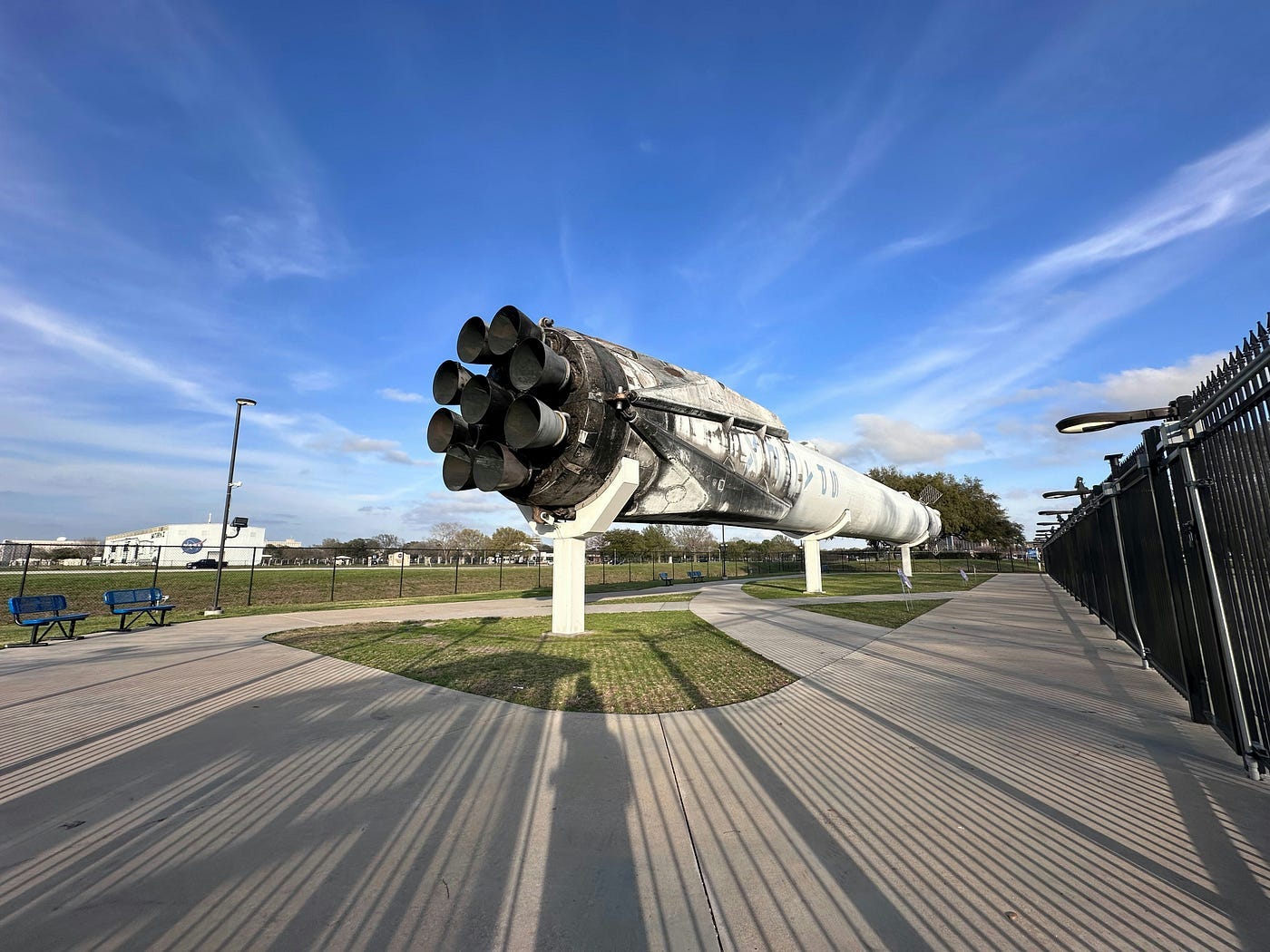
The Soviet Rocket That Looked Exactly Like Starship Failed Four Times. Here’s Why SpaceX Succeeded.
33 Engines, One Abort, One History-Making Flight and the 50-Year-Old Engineering Idea That Finally Has the Technology It Always Needed

On July 16, 2026, four seconds before the planned liftoff of Starship Flight 13, six of the 33 Raptor engines on Booster 20 failed to reach the required oxidiser turbo pump speeds. The onboard computer caught it, cut all engines simultaneously, and aborted the launch at T-minus zero. The vehicle sat there, intact; the launch pad; the crew safe. Nobody was hurt. Nothing exploded.
That date was exactly 57 years after Apollo 11 launched from Kennedy Space Center.
It was also exactly the scenario that destroyed a Soviet rocket half a century ago — minus the part where the computer worked.
The Question Everyone Asks About Those 33 Engines
If you have ever watched a Starship launch and wondered why anyone would put 33 engines under a single rocket when five or six powerful ones would theoretically do the same job, the answer is not hubris. It is economics, redundancy, and a philosophy of engineering that the Soviets pioneered decades before the technology existed to make it viable.
Smaller engines are cheaper to develop and manufacture in volume. They can be produced on an assembly line. If one fails in flight, the others compensate. You can lose several and still complete the mission.
On paper, it is an interesting argument. For decades, it was catastrophic.
The N1: Same Idea, Wrong Decade
The Soviet N1 rocket was Moscow’s answer to Apollo, a hundred-meter-tall colossus designed by Sergei Korolev, the man who had given his country Sputnik and Gagarin. Korolev died in January 1966 without ever seeing his rocket fly. The problem his engineers inherited was blunt: the USSR had no engine comparable to the American F-1, the five massive powerplants that lifted the Saturn V. So instead of building one enormous engine, they built thirty smaller ones: NK-15 engines designed by Nikolai Kuznetsov, arranged in two concentric rings beneath the first stage.
The engineering logic was the same logic SpaceX would revisit fifty years later. Thirty small engines cost less to build than one enormous one. They can be manufactured in series. If one fails, the others compensate. The problem was not the idea. The problem was the tools.
Soviet engineers could not build a test stand capable of firing all thirty NK-15 engines simultaneously. Such a facility would have cost more than the program could afford, especially competing for funding against multiple parallel Soviet lunar projects. Worse, the NK-15 engines could not be tested and reassembled — certain components were single-use. So engineers would test a random sample from each production batch, and if the sample passed, they would mount the remaining engines on the rocket without ever firing them. Then they crossed their fingers.
To manage engine anomalies during flight, the Soviets built a monitoring system called KORD, designed to detect failing engines and shut them down before they could damage their neighbors. The principle was sound, while the execution was not. The KORD system suffered from a lack of speed and precision compared to modern computing capabilities. Its most hazardous characteristic was its tendency to shut down engines incorrectly due to misinterpreting pressure and flow indicators.
The second N1 launch attempt, on July 3, 1969, illustrated the consequences. Seconds after liftoff, a metallic fragment entered the liquid oxygen turbopump of engine number eight and caused it to explode. The shock wave severed nearby propellant lines and triggered a fire at the base of the vehicle. KORD detected abnormal pressure and flow readings and began shutting down engines one after another. In roughly two seconds, 29 of 30 first-stage engines went silent. The one remaining engine pushed the rocket sideways. This N1 climbed to about 200 meters, tilted, and fell back onto its own launch pad.
The explosion that followed is one of the largest non-nuclear explosions in recorded history, with an estimated yield of approximately seven kilotons. Their launch facility was obliterated.
This occurred thirteen days before Apollo 11. Two more N1 attempts followed in 1971 and 1972, both failures. The program was cancelled in 1974, and the remaining rockets were cut apart with torches. Their archives were destroyed, while improved NK-33 engines, which remained in storage, were eventually purchased by an American company decades later and refurbished as AJ26 engines for the Antares rocket — one of which failed six seconds after launch on October 28, 2014, destroying the vehicle and its cargo.
The Right Idea at the Wrong Time
SpaceX’s bet with Starship is that the N1 had a correct architectural intuition fifty years too early. The failure was not the multi-engine concept. It was the absence of computing capable of managing it.
Modern flight computers can monitor 33 simultaneous engine starts, compare 33 independent pressure and temperature signatures, and make an abort decision in milliseconds. What KORD attempted with 1960s electronics, Starship’s onboard systems execute roughly a thousand times faster and with far greater precision. SpaceX also conducts full static fire tests before every flight, with all 33 Raptors burning simultaneously while the vehicle is anchored to the ground. The test capability that the Soviet program could not afford has become standard procedure.
The July 16 abort showed this at T-minus zero. Six engines failed to reach turbopump speeds. The computer intervened and autonomously halted everything, protecting the vehicle and launch pad. The outcome that destroyed the N1 program in 1969 produced a brief scrub and a launch rescheduled for the following week.
Flight 13, July 24: What Changed
Starship Flight 13 lifted off from Starbase, Texas, on July 24, 2026, all 33 Raptor 3 engines igniting successfully on the third launch attempt. It was the second flight of the Block 3 vehicle configuration and the first Starship mission to deploy operational payloads: 20 Starlink V3 satellites, carried inside the ship’s payload bay and released during the flight.
The performance improvement over Flight 12, which had launched on May 22, was visible. Both flights followed similar profiles, but at around 970 kilometers per hour, Flight 13 began pulling ahead of its predecessor. The reason is that SpaceX removed the traditional MaxQ throttle reduction. At the point of maximum aerodynamic pressure during ascent, most rockets briefly reduce engine thrust to protect the vehicle’s structure. On Flight 13, SpaceX maintained full power throughout. The ship handled it without incident — a direct demonstration of confidence in the structural margins and engine performance of the Raptor 3 generation. The mission duration was one hour, five minutes and twenty seconds, a full minute shorter than Flight 12’s one hour, six minutes and twenty-two seconds.
Booster 20s recovery did not go as planned. The boostback burn was completed, but only 10 of the 13 engines designated for the landing burn successfully relit. Subsequent engine shutdowns caused the booster to affect the Gulf of Mexico at speed and be destroyed. Ship 40, however, completed a controlled reentry, deployed its payload, and splashed down in the Indian Ocean west of Australia. It tipped over on impact but remained structurally intact — the first time a Starship upper stage had survived in this configuration — and floated for more than a week, giving SpaceX an unprecedented opportunity to inspect the heat shield and engine bay from water level.
The Turbopump Problem That Remains
On the night of the successful Flight 13 launch, SpaceX confirmed the root cause of the July 16 abort. Six engines on the intermediate ring of Booster 20 failed to start because their liquid oxygen turbopumps did not reach operating speed in time. Propellant is delivered to the combustion chamber by the turbopump, which operates under extreme pressure. If it does not spin up correctly, the engine cannot ignite.
Six turbopumps failing identically and simultaneously is not six independent random failures. It is a systemic issue in the engine startup sequence or the propellant feed system upstream of those engines. SpaceX had also quietly replaced engine E16 on the outer ring before Flight 13 — a motor that had functioned correctly on the July 16 attempt — which pointed toward a broader technical review beyond just the six that misfired. The pattern was systemic, not coincidental.
The same engines that struggled at ignition went on, once running, to push the vehicle harder and faster than any prior Starship launch. Raptor 3 at full throttle through MaxQ is genuinely more capable than its predecessors. Fragile to start, formidable once started — that paradox is where the engineering team’s attention is concentrated.
Ship 40 at Sea: An Operation to Recover in Real Time
Meanwhile, the recovery of Ship 40 from the Indian Ocean has turned into a slow-motion engineering operation. The ship drifted over 170 kilometers from its splashdown point, carried by ocean currents. Elon Musk confirmed recovery vessels would be dispatched on July 29. The support ship Go Australis had been shadowing Ship 40 since splashdown. Two specialized offshore tugs, Normand Ranger and Ski Marchetti, departed port and headed for the coordinates. Normand Ranger arrived on July 31. Recovery operations were completed on Sunday, August 3, with Ship 40 secured for towing.
At five-and-a-half to nine kilometers per hour, the convoy — three vessels towing a 50-meter, roughly 100-tonne steel structure — requires ten to twelve days to reach a port in Western Australia, likely Dampier, with arrival expected around August 11 or 12. The ship is not expected to fly again after days in saltwater, but that was never the aim. The goal is detailed inspection of the heat shield tiles, the structural frame, and the control surfaces after a complete reentry cycle — data that will directly inform the next flight, which aims to catch the upper stage with the Mechazilla tower arms rather than landing in the ocean.
Back at Starbase: The Infrastructure Behind the Launches
To understand what makes Flight 14’s arm-catch objective even plausible, it helps to look at what is happening at Starbase right now.
The Mechazilla tower’s chopstick arms — the massive cantilevered steel structures that caught Booster 14 in September 2024 and have since caught multiple boosters — are undergoing maintenance. Cameras at the site recently filmed the removal and replacement of a torsion bar on the left arm of Launch Pad B’s tower. A torsion bar is a structural element that absorbs rotational forces acting along a beam’s axis. The requirement for these horizontally extending arms, which span tens of meters, is to bear the load of a Super Heavy booster or a full Ship upper stage during catch or assembly operations. Achieving this demands high accuracy, ensuring the vehicle’s connection points align precisely with the arm components to within a few centimeters. Under load, under wind, under the vibrations of nearby engine tests, the arms experience twisting forces that the torsion bar absorbs. Replacing it is standard maintenance or a load-rating upgrade ahead of the additional stresses that catching a ship will impose.
Launch Pad A, where the first 11 flights took off, is being completely rebuilt. The Mechazilla tower there has had its chopstick arms shortened and partially dismantled, the propellant arm (QD arm) removed, and the wiring and propellant lines inside the tower base stripped out. These base columns are being rebuilt using a more modern construction method: steel plates filled with concrete, the same technique used for Pad B, which proved structurally superior under the thermal and acoustic loads of Raptor ignition. Upgraded Pad A is expected to match Pad B’s capabilities over time, including its ability to handle Raptor 3’s increased chamber pressures.
Where This Leaves Things
The N1 program could not proceed because of the absence of technology that could support its sound engineering principles. SpaceX is executing the same concept with tools the Soviet engineers could not have imagined: computers that react in milliseconds, simulation capabilities that let engineers test failure modes digitally before metal burns, static fire infrastructure that fires all 33 engines before every flight, and an iterative development culture that treats anomalies as data rather than disasters.
The July 16 abort and the July 24 success together tell one coherent story.
The architecture works.
The engines, once running, are the most powerful rocket motors SpaceX has ever flown. The startup sequence has a vulnerability that is understood and actively being resolved. And the computer that stopped the launch eight days before it flew saved the program to fly another day — exactly what KORD was supposed to do in 1969 and could not.
Fifty years of computing progress, condensed into one non-event at T-minus zero.
I appreciate your time reading this. Follow me, comment your opinion, and don’t forget to subscribe to or support my newsletter for early access content.

