
This $500/Month Robot Takes 5 minutes to Load the Dishwasher (And Someone in California Is Watching)
Neo is the first ‘affordable’ domestic humanoid, and after two days of research, I’m more terrified than impressed.

My partner walked into the living room last night while I was watching the Neo robot demo before streaming the AFCON. She looked at the screen, at this beige humanoid figure slowly placing dishes into a dishwasher, and said:
“That’s the creepiest thing I’ve ever seen.”
She wasn’t wrong.
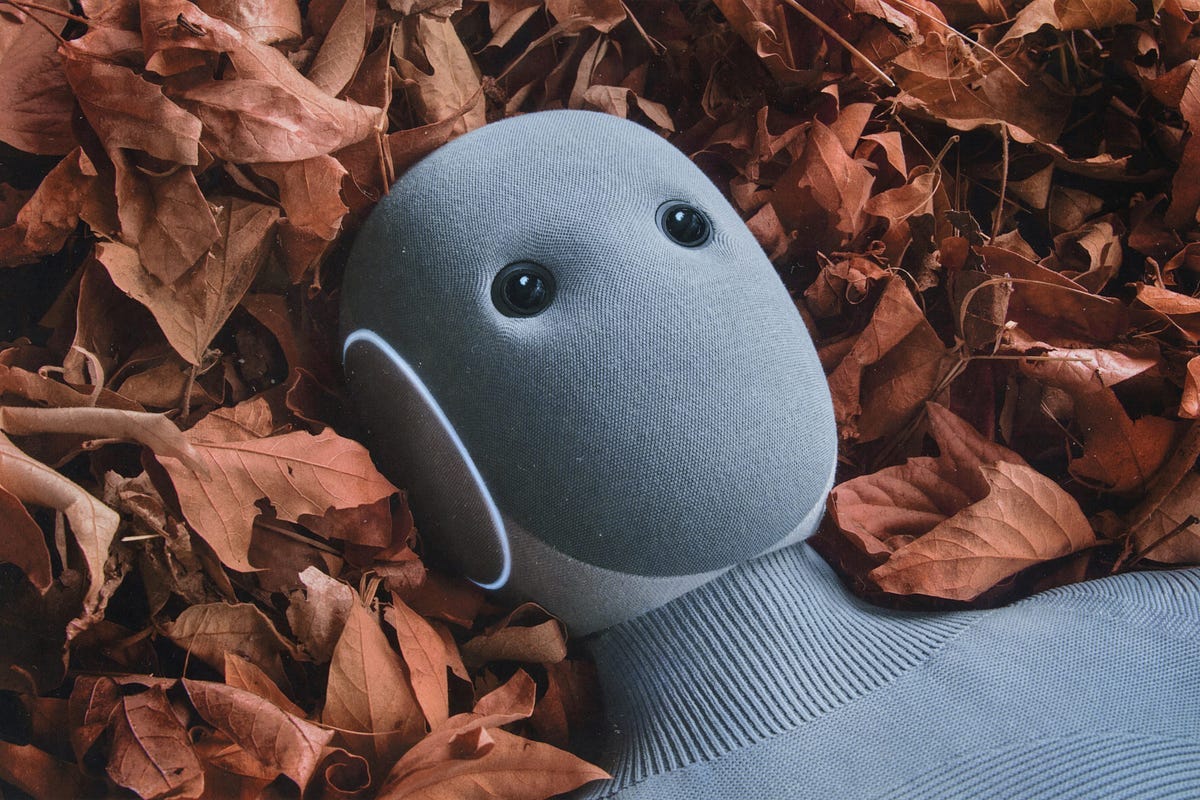
This is Neo, the first “affordable” domestic robot that costs either $20,000 upfront or $500 per month on subscription. Yes, you read that right. Five hundred dollars. Per month. To watch a cotton-faced android with sunken camera eyes shuffle around your house at the speed of a sleepy toddler.
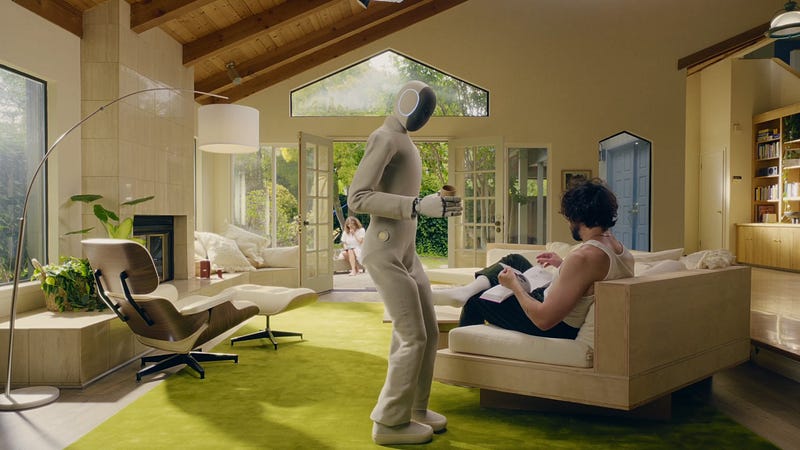
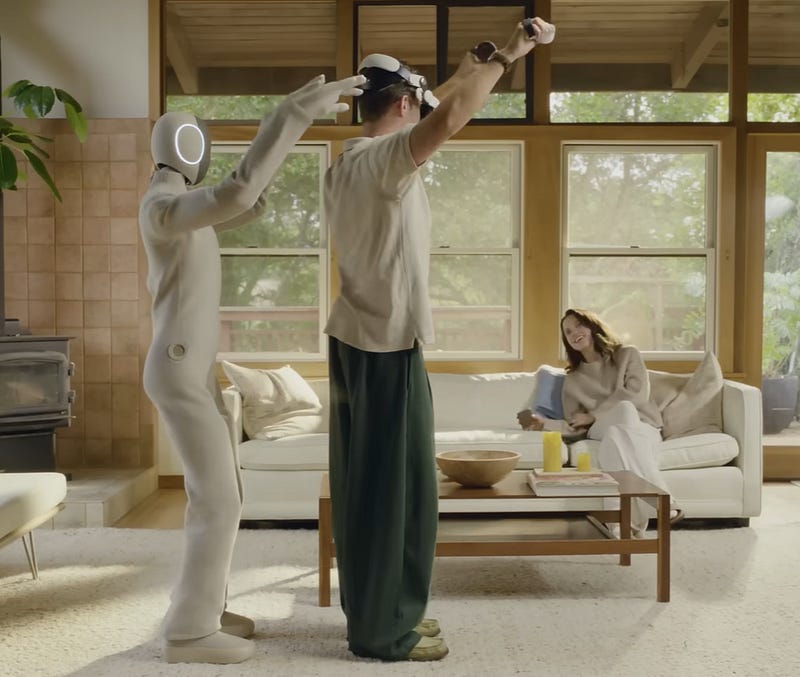
And here’s the kicker: most of the time, it’s not even autonomous. There’s literally a guy in California with a Vision Pro headset controlling your robot while you’re in bed, watching everything in your home through those creepy little cameras.
I spent two days going down the Neo rabbit hole, and what I found raises some uncomfortable questions about where we’re headed with domestic automation.
The Teleoperator Nobody Talks About
Let me get this straight. You pay $500 a month so a robot can do your dishes. Except the robot isn’t ready yet, but that’s fine because the main thing is selling subscriptions. You don’t know when exactly you’re lying in bed and the robot is picking up laundry, whether there’s actually some dude in California seeing everything and just doing household chores 500 miles away from you.
Hire a domestic helper at that point.
So it actually employs a human. I hadn’t seen it that way. Wait, I had tons of takes on this robot, but this perspective is even more terrifying than having cheap immigrant labor in Silicon Valley. You’re literally having them control your robot in countries that cost even less to pay them even less.
Oh no.
The CEO was surprisingly frank about this in that interview. If you buy it, you need to agree to what he calls “the social contract of this product.” Meaning they can take remote control at any moment because they need to teach it tons of things, and if you’re buying it, you’re okay with that.
On one hand, I respect the frankness of the deal. At least it’s stated clearly. But on the other hand, the guy is basically saying, “Right now it’s not entirely autonomous. The goal is for it to become that, but for now, we can remote into your home.”
I hope they give you a heads-up before taking control afar.
The Uncanny Valley Is Real
There’s something deeply unsettling about Neo’s design. They made a robot covered in what looks like carpet or cotton, but gave it two cameras positioned exactly at eye level. I find it terrifying. It’s stronger than me.

Picture this: you run into this thing in your house at night. Are you reassured? Especially knowing it can be piloted remotely and see everything in your home.
That’s pretty creepy.
And the way it moves? Look at the watering can scene. Super terrifying. It shuffles around like something out of Black Mirror right before things go horribly wrong. Everything is bright until the crazy stuff happens.
The absolute worst image? The $20,000 robot holding the Dyson vacuum. Get a robot vacuum, for fuck’s sake.
Here’s what really bothers me: you have this hyper-complex thing with rare materials and expensive technology, and you need to equip every household with it. This super costly thing that consumes massive planetary resources (we barely have enough components for iPhones anymore, or at least it’s getting harder to access them, we can agree on that). There’s a ceiling we’ll hit one day.
And you prefer making a bot that picks up your watering can, slowly grabs the Dyson with a billion batteries inside that itself costs $600, passes the vacuum around, then takes your cup and puts it in the dishwasher, which is another machine. I find this to be an efficiency problem.
But What About Efficiency?
My friend brought up an interesting counter-argument. You could frame the problem differently. Is it better for elderly care to have them share a robot at an assisted living facility level rather than having a home aide who burns fuel driving around to 17 different homes?
What’s more efficient?
I’d still choose the human, but for a different reason than fuel consumption. Especially with older adults care example he raised, I have a pretty clear opinion on this. Old people need someone to clean their dishes because they can’t do it anymore, okay. But I think they need to see other human beings. Unfortunately, that’s what’s most important for old people, that’s my opinion.
When the person comes to help, they chat a bit. It’s not just about bringing groceries. And if a robot brought groceries, they wouldn’t talk to any human. I’m sorry to say it, but that’s what bothers me most.
When you keep wanting to optimize everything, you end up with old people dying of loneliness. Not because they feel like getting their groceries, but because they have zero human contact. I’m exaggerating, but I think it becomes dangerous when you go too far too quickly on something like this.
The Social Shift Nobody Sees Coming
Here’s where my friend made a point I can’t entirely dismiss. The notion of social circles is shifting through time and space. We’re extremely social; we need sociability, but we’re socializing right now, and I’m 8,000 miles away from him. When we’re old, I’m not saying we won’t have that need anymore. We’ll always have it; it’s human. But it’ll be done differently.
Having a domestic robot while you’re on a Discord call with all your friends will be a perfectly acceptable form of socialization.
I see what he means. It’s cool to socialize as a bonus through Discord, but if we only saw each other on Discord, I wouldn’t be happy. I need to see him in person sometimes, see my loved ones in person sometimes. Otherwise, as a human, I wouldn’t be okay if I only socialized through a screen.
Still, it’s a good crutch while waiting for the moment when we actually see each other. Otherwise, it would be unbearable. Some people are introverts level 1000 who only do Discord, and that’s fine. But for me, virtual socialization will never be enough.
We haven’t talked about one subject yet, and it’s going to be a real mess. What happens when police want to equip themselves with these?
Yeah, all the potential abuses. Sexual abuse, police abuse. Honestly, I’d almost say if it’s used as a sex robot, that’s not the biggest problem. Do your thing at home quietly with your robot.
But when your little robot picks up a gun like that in your house, what are you going to do?
That’s why, in reality, you don’t really want to touch this technology. You don’t want to let it into your home. It feels too unpredictable. For me, it’s more the bipedal police robot on rollerblades in the world that’s going to be something else.
The Efficiency Paradox
Let me circle back to something that keeps nagging at me. My friend argued that this is just the logical endpoint of domestic automation. We went from laundromats to washing machines, dryers, dishwashers, and robot vacuums for some households. The ultimate form is a multitasking robot that does multiple household and biological management tasks as a humanoid because it’s simpler to navigate in an environment made for humans when you have a humanoid.
He’s not wrong about the trajectory. The line was drawn on a graph, and the endpoint was always going to be here. It’s fairly certain.
But here’s where I push back: when we replaced telephone operators (the ones where you’d call and say “Give me 506 in my city” and they’d connect you), we didn’t replace them with a robot shaped like an operator mimicking one. We replaced them because it wasn’t efficient.
We’re talking about efficiency, clearly. It wasn’t efficient, so we found a better solution.
The humanoid form makes sense for navigating human spaces, sure. The bipedal model will always be most efficient, or rather most adapted, because the world is created for us. But I think we’re at two extremes of the spectrum here. My friend is in his technological maximalist, and I’m apparently doing a “this time it’s different because…” thing.
But it really is different because it’s in your home, in private, in the physical world of your intimacy.
What Happens When It Actually Works?
Here’s what my friend said that I can’t fully argue against: once the thing is autonomous with its AI model running locally in its brain, what’s the difference between that and having 14 appliances doing the same thing, but now all-in-one and adapting to different contexts? The difference isn’t that huge, and it’s just the logical continuation of these innovations.
I want to clarify something because now you all have the impression I’m against tractors and think we should hand-wash clothes in the river. Not at all. I know automation is something that logically progresses.
But what triggers me is the fact that it’s humanoid. its uncanny valley territory. It’s in your intimacy and possibly piloted remotely (though that’ll develop). Asking for a number in a directory, I don’t need someone to tell me that humanely. But taking care of elderly people at home? I’m more affected because often (and I know this because I have elderly people in my family), what interests them most is when the person comes over, they chat a bit. It’s not just about bringing their groceries.
The Resource Question Nobody Wants to Ask
Do you think the planet will have enough resources eventually for every household to have a robot? That seems tough to me.
My friend is optimistic.
These things get massively optimized. You need less and less metal to do more and more things. It’s always a curve that goes like that. He’s not doomer about it at all. That doesn’t mean it won’t be a problem at distinct moments in different industries where something is missing, or something is more complicated to source. You see, at diverse moments, prices of resources do that because it’s hard to source.
But humans always find a solution. Always.
Unless we don’t.
AI Is Transforming the Internet - But at What Cost to Our Planet’s Water Supply?
In this article, we are Exploring The untold environmental impact of AI-powered data centers and their massive…ai.gopubby.com
The Demo That Says Everything
Let me show you what really sealed my opinion. In the demo video, the robot is delivered in an egg. It’s literally a sarcophagus for the robot. Then you see it doing various tasks, all in this pristine white showroom home that’s 800 square meters. The robot never slips on 3-year-old Timothée’s toy car.
There’s definitely an elite vibe to this whole thing.
One scene particularly stuck with me: the guy is reading in his armchair and says, “Yeah, Neo, take my coffee cup.” The thing arrives at 0.3 miles per hour while the guy holds his arm out for what feels like an hour. Then it finally takes the cup.
Dude, just put it down and pick it up when you leave. Don’t be annoying.
Because it’s the first one, it’s weak, clumsy, and that’s pretty funny. But in a few years, it’ll be much more fluid.
Maybe. I don’t know. Something is going on about it.
Final Thoughts
Look, I’m not a Luddite. I use technology every day. I appreciate automation. My robot vacuum is great. But there’s something about Neo that crosses a line I didn’t know I had.
Maybe it’s the uncanny valley design. It’s knowing someone could be watching through its cameras. It’s a $500 monthly subscription for something that takes five minutes to load a dishwasher. Maybe it’s imagining a future where old people interact only with cotton-faced androids instead of human caregivers.
Or maybe it’s simpler than that. Perhaps I don’t want to wake up at 3 AM to get water and see this thing standing in my hallway with its sunken camera eyes, slowly rotating its head toward me with a barely perceptible whir.
My friend thinks we’re one generation away from people asking, “Wait, you used to wash all your house windows by yourself?” And he might be right. Perhaps this is a turning point. The logical endpoint of the trajectory we’ve been on for decades.
But for now? For now, I’m with my partner on this one. It’s creepy as hell.
Share your thoughts in the comments. I will be pleased to discuss this with you. Interested in more articles like this? Subscribe to my new Substack, where I will share more in-depth economy, geopolitics, and business reviews, and it’s free
Ok, now I’m interested.
Emptying the dishwasher is worth it.
Have the exact same thoughts, and you've summarized everything quite eloquently. But still a little part of me cannot help but imagine a few decades from now, in a more dystopian future where the uber elite all have Neo v118 while the commoners dream of ways to make the robots turn on their masters... 😅