

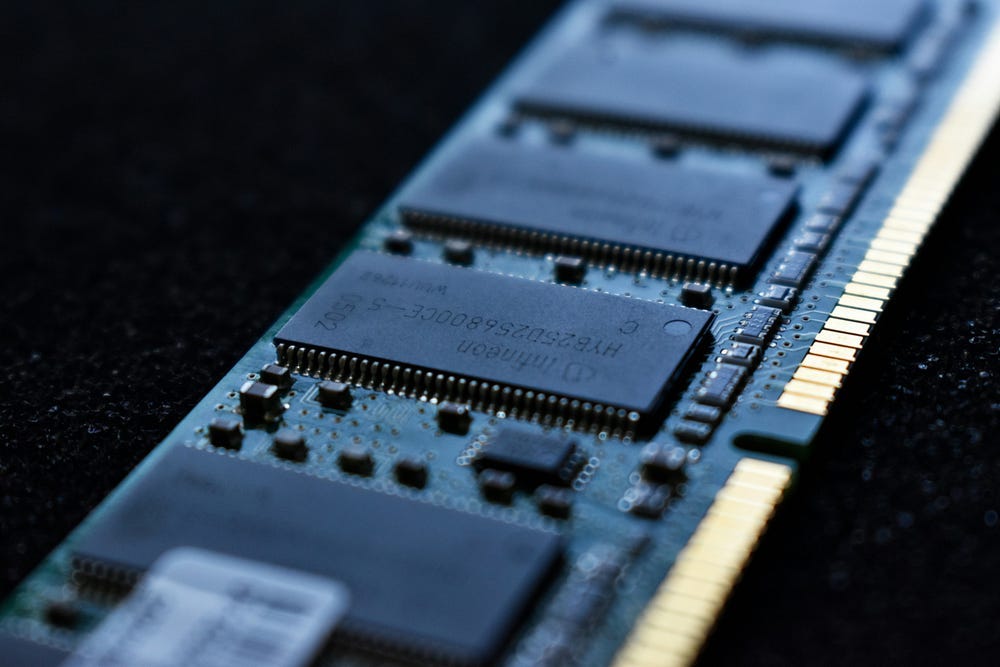
If you’ve recently purchased a computer, phone, tablet, or basically any device with a screen, you’ve experienced this. Prices have climbed everywhere, not just on high-end components but across the board. Memory now represents 30 to 40% of a smartphone’s manufacturing cost, up from a historical 10 to 15%. What’s happening in the RAM industry right now is directly affecting the price of almost everything you use every day.
The paradox is that before AI arrived, the memory industry was already a graveyard. Toshiba, Hitachi, Elpida, Qimonda — all manufactured memory, all disappeared, consumed by the same brutal cycle repeating every few years. Demand would rise. Everyone would build factories. Capacity would explode. Prices would collapse. The weakest would die. Start over. For 40 years, that cycle ground the industry down to three survivors: Samsung, SK Hynix, and Micron. Together, they held over 94% of global DRAM revenue.
Then AI arrived, and the catastrophe reversed. Demand exploded. Supply couldn’t follow. That’s where we’ve been since 2023. But something is finally changing.
Why does memory differ from every other chip?
When Intel designs a processor, the result is unique. Nobody else makes the same thing. When Nvidia designs a GPU, same story; and for that reason, they can decide their own pricing. They’re selling something no one else can build.
Memory is the exact opposite. A Samsung RAM module does the same job as a Micron module. Your computer can’t tell the difference. The only thing that separates manufacturers is cost. Whoever produces the cheapest wins. Whoever can’t keep up disappears. That’s what makes this industry so violent.
Japan dominated it in the 1980s with NEC, Fujitsu, and Hitachi. Almost all were wiped out. Europe tried with Qimonda — brilliant technology, catastrophic timing. One market downturn was enough to bankrupt the company. The technology didn’t vanish, though. It resurfaced years later in China when a company called CXMT acquired thousands of Qimonda patents, including one of the most important in modern DRAM: the buried word line (BWL) architecture.
In traditional DRAM, the transistor controlling each memory cell sits at the silicon surface. For decades, engineers made progress by shrinking everything at each generation. That worked until there was simply no more room on the surface. So they buried the critical component beneath the silicon. Instead of building outward, they built downward. This freed up space above to continue miniaturizing. It was a genuinely elegant solution, except it got more expensive with every generation — bigger factories, more complex tools, billions in investment piling up. Meanwhile, prices kept riding their roller coaster, and at each trough, another company died.
The three survivors learned one lesson: never produce too much. That caution was burned into their DNA. Then AI erased it.
The Shortage Nobody Could Have Predicted
The scale of demand is worth pausing on. A smartphone today carries about 12 GB of RAM. A high-end PC runs 32, 64, or 128 GB. Nvidia’s Ampere GPU in 2021 contained 40 GB. The Hopper generation: 80 GB. Blackwell: 192 GB. The latest Vera Rubin architecture: 288 GB per chip. Nine times the memory of a high-end PC, concentrated on a single component.
Companies don’t buy one GPU. They buy hundreds of thousands. Elon Musk wants to put over a million people in a single facility. OpenAI, Google, Amazon — everyone wants more. Every new generation of AI hardware multiplies the total memory the industry must produce.
This memory, called High Bandwidth Memory (HBM), is arguably the most difficult product ever put into mass production in the semiconductor industry. You stack 12 to 16 layers of silicon, each thinner than a human hair, without cracking a single one. If one layer is defective, the entire stack goes to waste. Even Samsung struggled for months to achieve acceptable yields. SK Hynix learned fastest. It secured its position as Nvidia’s primary HBM supplier in Q2 2026, with roughly a 50% share of the global HBM market. Samsung climbed back to about 33% after its yield crisis. Both Korean giants envisioned the future and agreed on one thing: move rapidly or fail to stay competitive.
SK Hynix’s M15X facility in Cheongju gives you a sense of the scale.
Three fabrication facilities under one roof. The main cleanroom exceeds 100,000 square meters. The most expensive machines inside aren’t the ASML EUV systems. They’re the thermocompressive bonders that stack HBM layers with micron-level precision. Each one costs up to $200 million, and a single factory needs roughly a hundred of them.

