


Your retirement account is more exposed to this than you probably think. Americans for Financial Reform put 34% of US household wealth in equities as of the second quarter of 2026, against 26.7% at the dot-com peak, and the AI complex is the part of that index doing the work. So when the Nasdaq Composite dropped 4.48% in the week to Friday 16 October, its worst week since June, whether something is breaking is not an abstract question.
I spent two days putting the week’s numbers back against the filings and the primary sources. Most of the alarming ones point at something other than what people assume. One points at something worse than the headline. The layer everyone is watching is not the layer that moved.
What actually fell in the week to 16 October was
From 9 to 16 October, the Nasdaq Composite fell 4.48%, and the PHLX Semiconductor Index fell 11.41%.
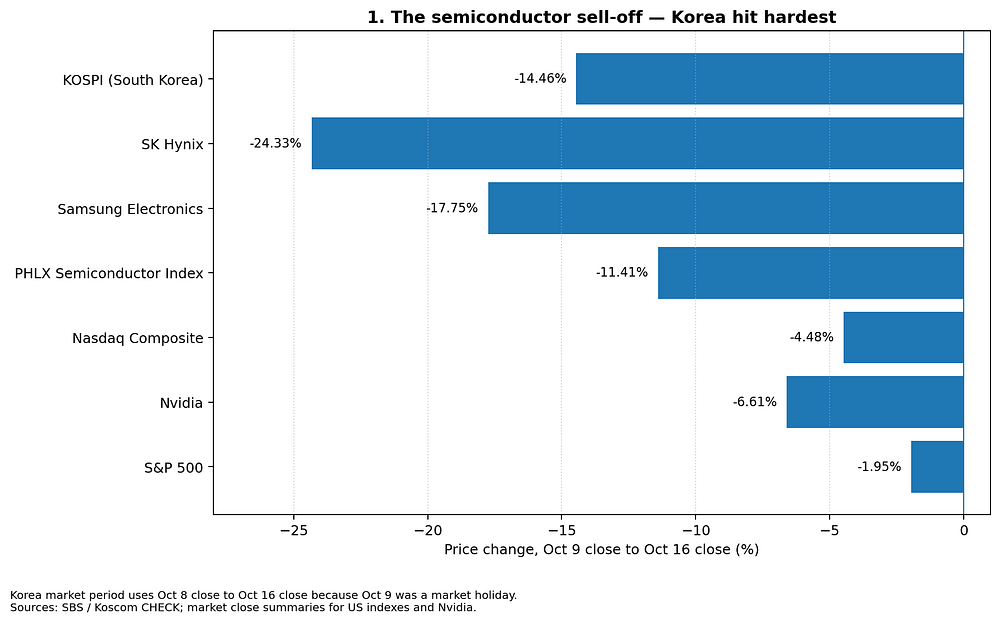
Korea took the worst of it. The KOSPI fell 14.46%, its steepest week since October 2008. SK Hynix fell 24.3%, and Samsung Electronics fell 17.8%, less than the 26% and 22% doing the rounds, but still each company’s worst week since 2008. Foreign investors net sold 11.2 trillion won of Korean stocks that week, about $7.8 billion, and those two names accounted for 78.8% of it. I went through why memory became the pressure point of this buildout in “AI Broke the Memory Market. A Chinese Company Nobody Heard Of Just Forced Its Way In.”, and the short version is that the Korean duopoly bet its capacity on AI, which makes it the highest-beta way to own this trade.
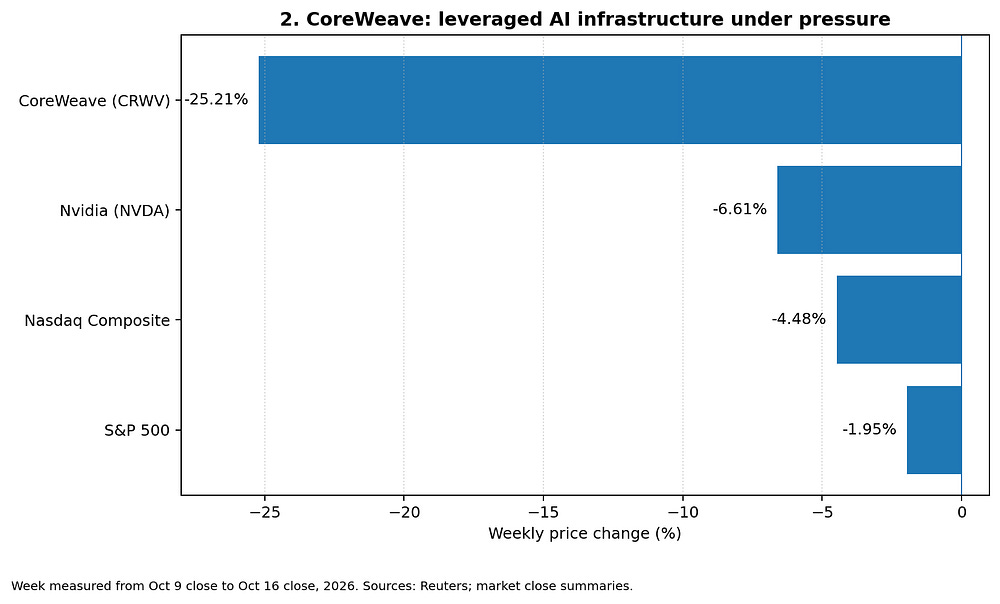
CoreWeave, the largest of the GPU landlords, fell 25.21%.
Now the core.
Nvidia fell 6.61%, a terrible week that still beat the index it anchors by almost five points. The S&P 500 sat about 0.8% below its record and was up 11.9% on the year. The semiconductor index, after an 11% week, was still up nearly 60% year to date.
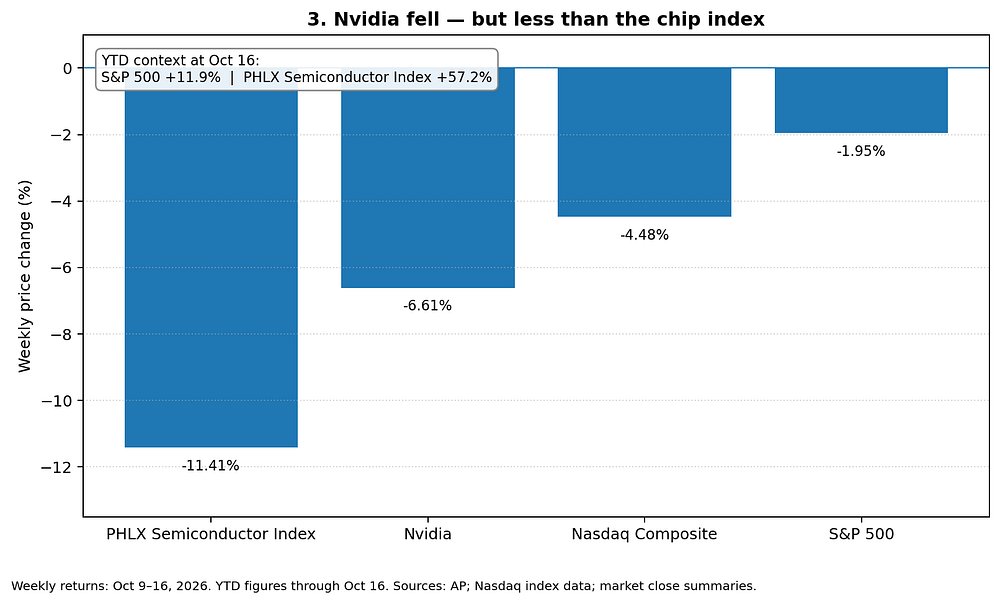
So the shape is real: a violent repricing at the periphery, a shrug at the centre. The periphery here means memory, Korea, and the companies that rent out graphics cards.
The equities layer: estimates up 25%, the multiple down 22%
This is the figure that reframed the week for me. Citadel Securities’ Scott Rubner published an October update on 14 October, giving, for the AI infrastructure group, forward twelve-month EPS estimates up 25% and the forward price-to-earnings multiple down 22% since the end of June.
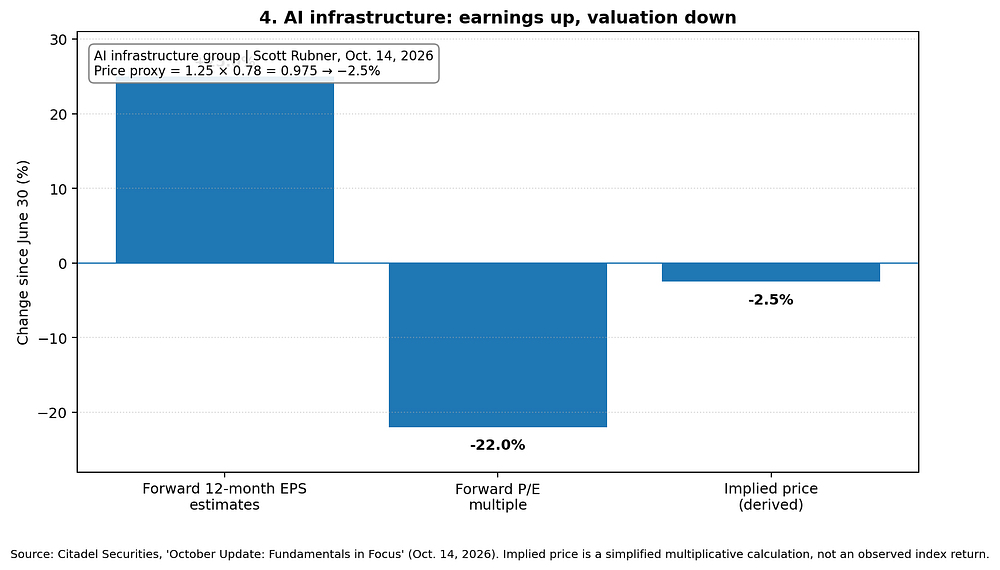
Multiply those together, and the group’s price is roughly flat. The market did not decide AI earns nothing. It paid 22% less for each dollar of expected earnings, while the expected earnings went up. That is a de-rating, not a repudiation. Citadel Securities does not publish how it builds that group, which is worth saying before anyone leans on the number.
The long-run gauge sits in the same uncomfortable place. The Shiller CAPE ratio was 41.08 on 21 October against a record of 44.19 set in December 1999, rather than 2000. Valuations are within a few points of the most extreme reading in the measure’s history on a technology story that is at least producing revenue this time.
One correction breaks the tidiest explanation.
The standard account says that rates did this: money got expensive; a risk-free 5% makes a pricey stock hard to justify, so the multiple compressed.
The ten-year Treasury was indeed at 5.12% on 20 October, and the Fed raised by 25 basis points on 16 September to a 3.75% to 4.00% range, with September CPI at 3.7% year over year. But during the selloff week, the ten-year yield fell about 15 basis points. Money got cheaper that week, which is what a flight to safety looks like. Whatever repriced AI in mid-October, it was not the bond yield moving against it.
