
Forget ChatGPT. The Real AI War Is Over Autonomous Agents, and China Just Won Round One.
OpenAI poached a lone Austrian developer for billions. Meta texted him on WhatsApp. And while America celebrated, China had already deployed its invention to 700 million people.



An Austrian developer. A side project running on his laptop. Twelve weeks later, OpenAI and Meta are competing with billions at stake over a single engineer.
Sam Altman calls him personally. Mark Zuckerberg slides into his WhatsApp. Satya Nadella picks up the phone. And while Silicon Valley scrambles to recruit one man, China has quietly deployed his invention to 700 million users.
What’s actually happening in AI right now isn’t a race to build a smarter model. It’s a land grab. And it all started because of a piece of software with an unlikely name: OpenClaw.
A Side Project That Broke GitHub
Peter Steinberger isn’t a household name, but after 13 years in software, he’s the developer who builds things that matter. He founded his own company. He shipped some products. And on one particular Friday evening, he did something different — not a chatbot, not another AI wrapper, but something new.
An autonomous agent.

OpenClaw, which Anthropic forced him to rename from the original “ClaudBot” for obvious legal reasons, doesn’t wait for your instructions. It monitors your inbox. Book your flights. Manages your files. Executes code. Automates browser tasks. And it keeps running while you sleep.
The system includes a heartbeat mechanism. It wakes itself up, evaluates what needs to be done, and acts. If a standard chatbot like ChatGPT is a tool you pick up and put down, OpenClaw is more like hiring an employee who never logs off.
The internet noticed immediately.
In a matter of weeks: 179,000 GitHub stars. 600 contributors. More than 7,200 downloads per week.
GitHub - openclaw/openclaw: Your own personal AI assistant. Any OS. Any Platform. The lobster way…
Your own personal AI assistant. Any OS. Any Platform. The lobster way. 🦞 - GitHub - openclaw/openclaw: Your own…github.com
The project got a shout-out in a Super Bowl ad, which is mind-blowing. No marketing budget. No investors. No revenue. Just a developer and his laptop, burning through €15,000 to €20,000 a month in server costs out of his own pocket.
That last detail is important. We’ll come back to it.
Valentine’s Day, Billions, and a Bidding War America Won on Paper
On February 14th — because apparently history enjoys irony — Peter Steinberger announced he was joining OpenAI. Sam Altman publicly called him a genius.


He declared that personal agents would become a core pillar of OpenAI’s product lineup and that the future would be, in his words, “extremely multi-agent.”

An independent open-source foundation would take ownership of OpenClaw, operating under the MIT license, which is exceptionally permissive. Anyone can take it, modify it, or commercialize it — no restrictions. OpenAI would provide financial backing for the foundation.
Technically, this isn’t an acquisition. There’s no company to acquire. No revenue, no employees. But when the two biggest AI firms on the planet are reportedly making offers worth billions for a single open-source project with zero income, calling it a “recruitment” feels a bit like calling the moon landing a camping trip.
Meta didn’t just step aside quietly. Zuckerberg had tested the product and reportedly debated with Steinberger about the merits of Claude Code versus Codex.
But Steinberger made his choice. He said he didn’t want to build a company. He wanted to change the world. OpenAI offered what no European player could: massive computing resources and direct access to hundreds of millions of users.

America celebrated. And then China moved.
China didn’t wait. It Shipped.
On the same day, Steinberger announced his move to OpenAI, Moonshot AI — a Chinese startup valued at €4.5 billion and backed by Alibaba and Tencent — launched Kimi Cloud.
The concept is straightforward and brutally effective: take the same OpenClaw framework, integrate it natively into a browser tab at kimi.com, and make it accessible in one click. No server to configure. No terminal to open. You open a tab, and the agent is there, persistent, running 24 hours a day.
With Kimi Cloud, you get 40GB of cloud storage, access to over 5,000 community-built skills on CloudHub, and real-time web search, so the agent can access up-to-date financial data or news instead of using old training knowledge.
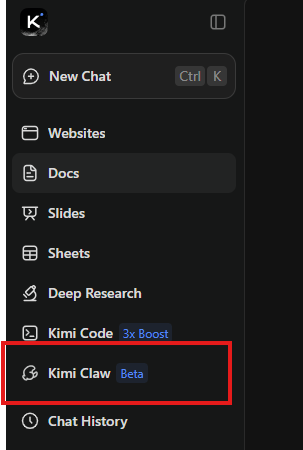
They also added a “Kimi Claw” feature, which lets developers who’ve built their own OpenClaw instance connect it directly to the Kimi interface, even linking it to Telegram.
Smart.
But Moonshot wasn’t even the first mover in China that week. Just before the Lunar New Year, Baidu had already announced a deep integration of OpenClaw into its main search application. That’s 700 million monthly active users with direct access to an autonomous AI agent built on a framework that an Austrian developer shipped from his laptop a few weeks earlier.
Baidu didn’t stop there either.
The integration extends to e-commerce and a suite of other services. With its AI now integrated into Taobao and Tmall, Alibaba is following a comparable approach, stating that AI processed more than 120 million orders in just six days in early February.
The strategy is obvious:
AI shouldn’t live in a separate app. It needs to live inside the tools people already use every day. China understood that faster than anyone else.
The Security Crisis Nobody Warned You About
Here’s where the story gets uncomfortable.
Palo Alto Networks, one of the world’s leading cybersecurity firms, has described OpenClaw as potentially the biggest internal threat of 2026. That’s not a headline I expected to write.

When a piece of software explodes in popularity this fast, hackers follow. Security researchers analyzed CloudHub, the marketplace where users download skills to extend OpenClaw’s capabilities, and what they found was grim.
A campaign called ClaudAVOC identified over 340 malicious skills hidden inside what looked like legitimate tools: a crypto trading utility, a YouTube assistant, and a Google Workspace integration.
The method is almost elegant in its simplicity.
Imagine taking your car to a mechanic who tells you a part needs replacing, then secretly installs a tracker while he’s under the hood. Users were instructed via polished documentation to install prerequisites for these fraudulent skills, which turned out to be malware designed to steal passwords and API keys, the digital keys that unlock online accounts and services.
SecurityScorecard found more than 135,000 OpenClaw installations exposed to the internet without adequate protection across 82 countries. Of those, nearly 13,000 were vulnerable to remote code execution. Which means an attacker could take full control of those machines from anywhere in the world, without the owner ever knowing.
OpenClaw has since partnered with VirusTotal, Google’s file-scanning service, to screen skills before they reach users. Steinberger brought in a dedicated security expert. The damage is already done, and the core problem remains that an autonomous agent necessitates unrestricted access to your file system, email, and terminal. One compromised skill is all it takes.
What this actually means for the next five years
I think we’re watching two separate but related transitions happen simultaneously, and most people are focused on the wrong one.
The mainstream conversation is still about which AI writes better prose or generates cleaner code. That race matters, but it’s not the war being fought right now. The actual competition is about the distribution and control of the agentic layer — the software layer where AI stops answering questions and starts taking actions.
OpenAI is betting on talent acquisition and deep product integration. Moonshot AI is pushing cloud-native agents that live in your browser with zero installation friction. Baidu is using 700 million existing users as a distribution moat. And Meta, which reportedly acquired Manus for $2 billion in late 2025, wants to turn WhatsApp into a full autonomous agent platform.
What nobody is talking about loudly enough is that Europe has no seat at this table. A European developer built the spark that lit this fire, and he had to choose between two American giants and a Chinese conglomerate. There was no European alternative to computing or a user base to compete.
That’s not a small footnote. That’s the entire story.
The chatbot era is ending. What replaces it are agents that book, buy, send, analyze, and decide on your behalf. That shift isn’t coming in five years. It’s already here, running on a night project that almost nobody saw coming.
Thanks for reading. Let me know your thoughts in the comments.
Sources: The Nov Tech, The Verge, Anthropic, MIT License, Baidu AI, Moonshot AI / Kimi Cloud, SecurityScorecard, Palo Alto Networks, OpenClaw GitHub.
 | A guest post by
|