
Half the Planet Uses AI. Stanford Published the 400-Page Report That Explains What Happens Next.
The 2026 AI Index is the most comprehensive annual assessment of artificial intelligence worldwide. Its central finding fits in one sentence: AI is advancing faster than everything designed to control

Here’s a piece of data I want to share, which I suspect most individuals haven’t internalized.
53% of the global population now uses generative AI. It took the personal computer a full decade to reach comparable adoption. It took the internet about the same.
Generative AI did it in three years.
According to the 2026 Stanford AI Index Report, published in April by Stanford’s Human-Centered Artificial Intelligence Institute, this is now confirmed as the fastest technology diffusion in recorded human history.
That number is staggering on its own. But what makes it genuinely unsettling is this: look around you.
How many people do you know who can tell you what this technology is going to change in their working life over the next three years?
The gap between adoption and understanding is where this story actually lives.
The Paradox That a 400-Page Report Can See
This Stanford AI Index is not a press release from a company with something to sell. It is an independent, annually published research document, now in its ninth edition, drawing on hundreds of datasets from governments, academic institutions, and industry sources.
The 2026 edition runs over 400 pages. It carries no commercial agenda. It is the closest thing the AI industry has to an objective audit.
And its findings contain a paradox that would be almost comical if the stakes were lower.
Singapore leads global adoption at 61%. The United Arab Emirates sits at 54%.
France, a country that neither builds frontier AI models nor hosts major AI labs, is at 44%.
Despite leading the world in AI investment and developing cutting-edge AI like ChatGPT, Claude, and Gemini, the United States ranks 24th globally in AI adoption, with a rate of 28.3%.
The country that creates the most powerful AI models on the planet is not even in the top twenty countries that use them.
This isn’t entirely without precedent.
Japan generalized QR codes years before the rest of the world caught on to them.
The Americans co-invented the metric system with France and still haven’t adopted it 250 years later. There is a cultural component that the report measures precisely: Americans express the lowest confidence of any surveyed nation in their government’s ability to regulate AI, at just 31%.
When institutional distrust is that deep, it appears to brake adoption even when the tools are freely available.
The Jagged Frontier: Brilliant and Broken at the Same Time
On the performance side, the acceleration is almost difficult to believe.
On SWE-bench Verified, a benchmark that measures AI’s ability to solve real software engineering problems from actual GitHub repositories, scores went from 60% to nearly 100% in a single year.
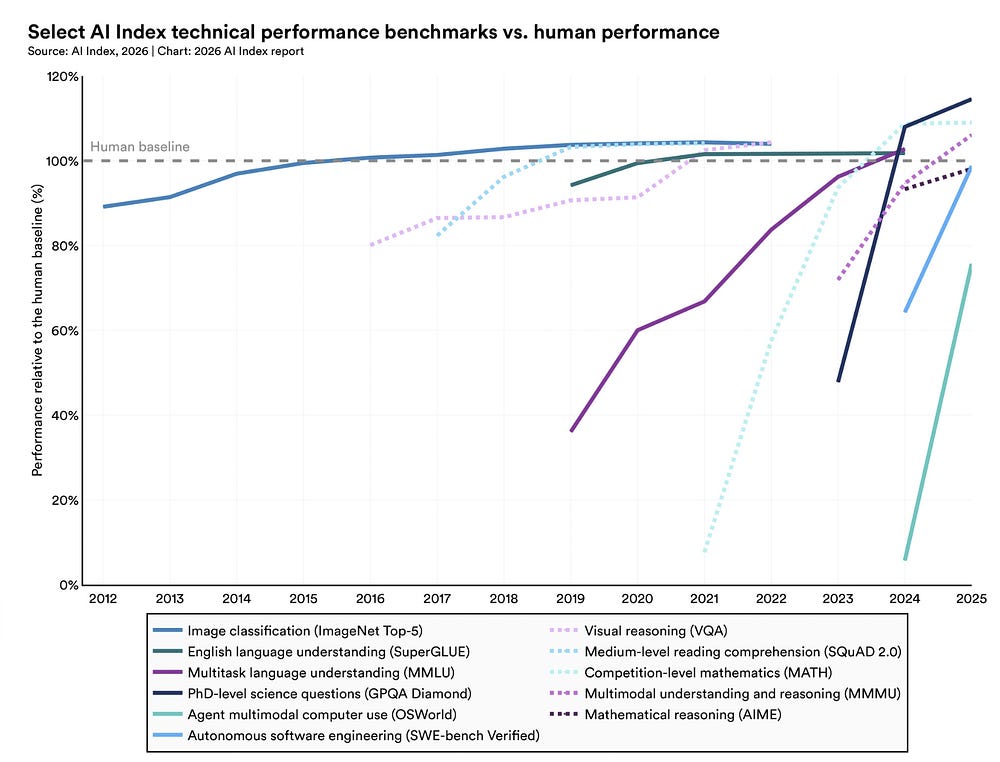
Then, on Humanity’s Last Exam, a test designed by domain experts to pose the hardest possible questions in their respective fields, the best model in early 2025 answered 8.8%. By mid-2026, the best models currently exceed 50%. We are watching AI systems win gold medals at the International Mathematical Olympiad and reach human-level performance on doctoral-qualifying exams in physics, chemistry, and biology.
And yet these same models, the ones solving problems that would stump most PhD candidates, can only read an analog clock correctly about 50% of the time. You can hand them a problem in quantum mechanics, and they’ll work through it. Show them a wristwatch with hands, it’s a coin flip.
Stanford calls this the “jagged frontier” of AI capability:
Spectacular competence in some domains, inexplicable fragility in others.
It is the defining characteristic of the technology at this stage, and it is precisely why benchmark scores alone tell you almost nothing about how useful a model will be for your specific work. What matters is what you do with it in your context, with your problems, in your industry.
The Geopolitical Gap That Closed While You Weren’t Looking
The US was the dominant force in AI for many years, excelling in model dimensions, performance benchmarks, research publications, citation counts, and investment levels. That era is effectively over.
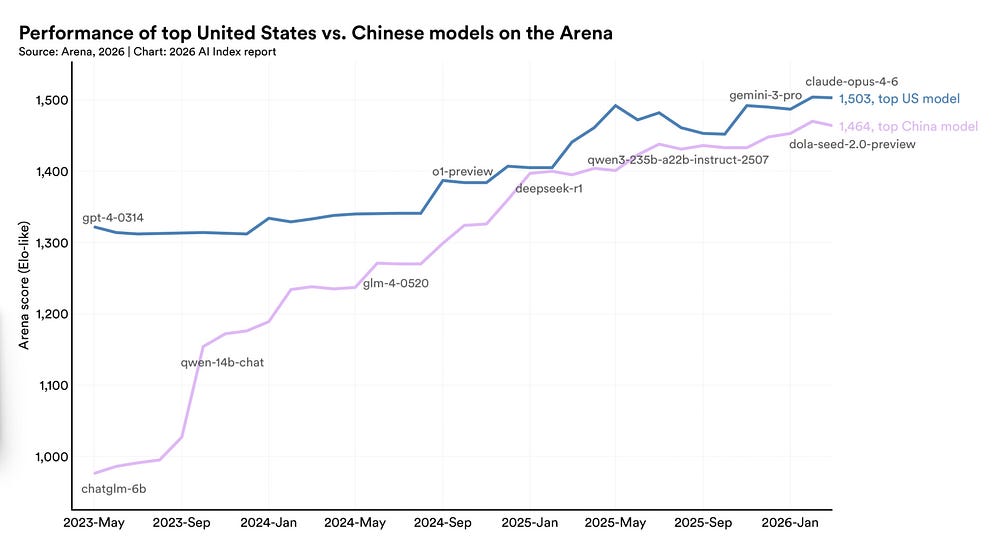
Since early 2025, American and Chinese models have been trading the top performance position regularly. In February 2025, DeepSeek-R1 briefly matched the best American model. As of March 2026, the gap between the top US model and the top Chinese model is just 2.7%. China already leads in publication volume, citations, patents, and industrial robot installations.
One detail from the report undermines a long-held assumption in Western tech policy: half of the researchers who built DeepSeek never left China to study or work abroad. The hypothesis that the United States holds a natural, permanent advantage in AI talent because the best minds inevitably migrate there is no longer supported by the data.
In fact, the flow of AI researchers into the United States has dropped 89% since 2017. Eighty percent of that decline is concentrated in the last year alone. This pattern has a historical parallel that should alarm anyone paying attention.
Jensen Huang Called It a “Horrible Outcome.” Eight Days Later, DeepSeek Made It Real.

You might remember what happened in January 2025. A Chinese startup that almost nobody outside the AI research community had heard of published a model that crashed Wall Street in hours. Hundreds of billions of dollars in market value evaporated because a team in Hangzhou had proved you could build a frontier AI model w…
In the 1960s and 1970s, Taiwan and South Korea were hemorrhaging their best engineers to the US. Then, both countries created the conditions for return: competitive salaries, national prestige, and clear missions. Within a single generation, TSMC and Samsung were born from that reverse brain drain. China is executing exactly this playbook with AI right now.
$581 Billion and the Value Nobody Expected
The investment figures require a moment of stillness to absorb.
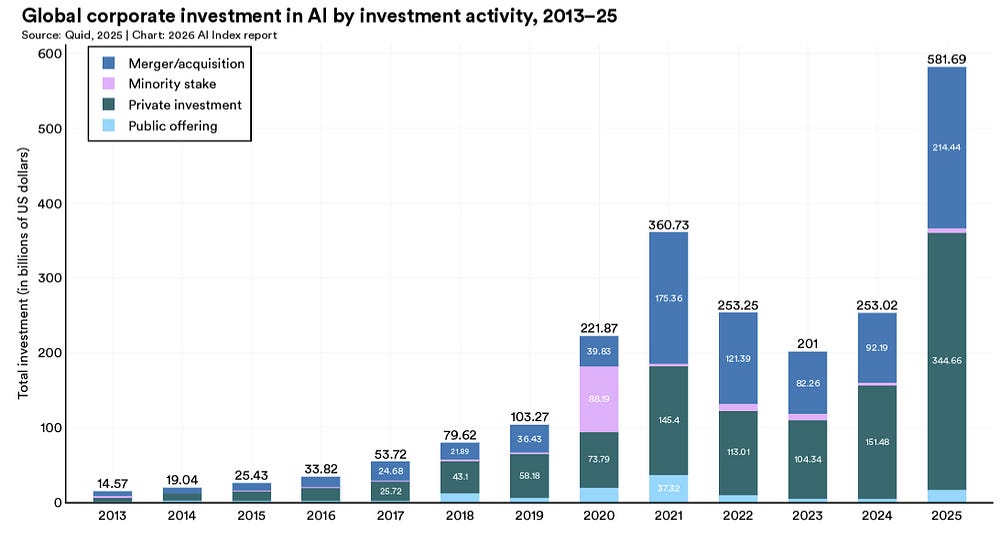
In 2025, global AI investment reached $581 billion, an increase of 130% in a single year. That figure is roughly equal to the entire GDP of Belgium. The United States alone accounted for $285 billion in private investment, which is 23 times what China reports officially, though the report notes that Beijing invests massively through state-backed guidance funds that don’t appear in private investment statistics.
But the figure I find most revealing in the entire 400-page document is not about investment. It is about what people are getting back.
Stanford measured what economists call consumer surplus:
The difference between what users would pay for these tools and what they actually pay. In the United States, that surplus reached $172 billion annually by early 2026, up from $112 billion one year earlier. The median value per user tripled in twelve months. And most of these tools remain free or close to it.
The economic value produced by technology has never been as substantial, or as broadly and quickly disseminated, as it is now.
The Power Bill for the Intelligence Age
All of that capability runs on electricity, and the bill is becoming visible.
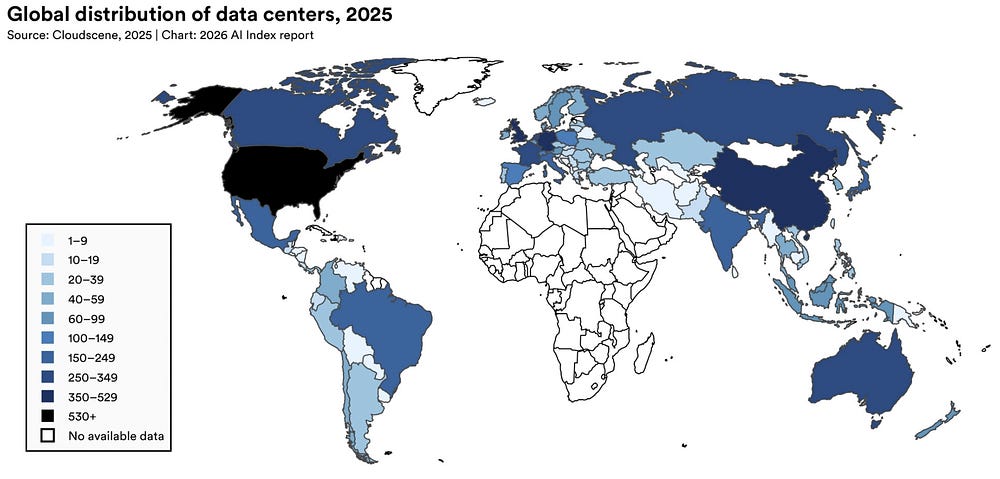
AI data center power capacity reached 29.6 gigawatts. To make that tangible: it is roughly equivalent to the peak electricity consumption of the entire state of New York, meaning 20 million people turning on air conditioning, lights, elevators, and screens simultaneously on the hottest day of summer. Except this energy is powering inference and training runs.
Communities across the United States are pushing back. More than 30 states have introduced over 300 pieces of legislation targeting data centers in 2026 alone, and we are only halfway through the year. Twenty-seven of those states are pushing laws that would require AI developers to cover their energy costs and report their consumption transparently.
Society is catching up to the technology. Slowly, but it is catching up.
What the Job Market Actually Shows
The labor market findings are where the report moves from abstract to personal.
Seventy percent of organizations now use AI in at least one business function. The productivity gains are real and measured: 26% in software development, up to 50% in marketing output, and 14 to 15% in customer support. Those are not projections. Those are observed results from deployed systems.
Fifty percent gains in marketing means that your competitor using AI is producing twice as much content as you are with the same team and the same budget. Twenty-six percent in software development means a developer who has integrated these tools delivers in four days what used to take five. If you are a freelancer, an entrepreneur, or a salaried employee, these percentages are not abstract. They are the speed at which the surrounding people are changing how they work.
The $2 Robot Workday Is Coming. And History Says It Won’t Kill Your Job.

$46. Salary, payroll taxes, health insurance, retirement contributions — all of it. $46 for one hour, for one person, at one position. That number is the invisible price tag on almost everything you buy: every product on a supermarket shelf, every restaurant meal, every car, and every house.
And the displacement is already measurable. Employment for software developers aged 22 to 25 has fallen nearly 20% since 2024. Job postings in software development are down 53%.
Meanwhile, experts forecast that AI will assist in 80% of American work hours by 2030. The public, when surveyed, estimates that number at 10%. These two groups are not living in the same reality.
The Sixth Wave
The familiar yet terrifying nature of this phenomenon was labeled “creative destruction” by economist Joseph Schumpeter in the 1940s. The idea that society strengthens in waves, and in each wave, a new technology destroys existing industries to create more powerful ones.
Steam. Railways. Electricity. Petroleum. Computing.
Five waves in two centuries.
Many economists and historians now consider AI the sixth.
Schumpeter had a warning embedded in that framework that is worth remembering right now. In each wave of creative destruction, the people who benefit are rarely the ones who dominated the previous wave. It was not the stagecoach companies that built the railroads. It was not the candle manufacturers who electrified the cities. Every time, it was new entrants, often smaller, often more agile, who understood the new technology before the incumbents did.
The historian Paul David showed that electricity was invented in the 1880s but did not produce measurable productivity gains until the 1920s. Forty years.
The reason: industrialists replaced their steam engines with electric motors in the same spot on the factory floor without rethinking the organization of work around the new capability. It took a new generation of managers to understand that the entire factory needed to be redesigned around electricity.
AI is following the same pattern, except the feedback loop is forty times faster. We are not looking at a forty-year lag. Our projection spans a period of five to ten years. That is why experts see 80%, and the public sees 10%. The experts understand that the transformation is systemic, not just one more tool on the desk.
The Window
Adoption is at 53% globally. The models are nearly free. The computing power is accessible to almost everyone. What is scarce is not the technology. What is scarce is the ability to use it strategically:
To know where it creates value, where it doesn’t, which tasks to delegate to it, and which to protect from it.
That is the competence that separates those who ride the wave from those who get pulled under by it. And if history is any guide, the window for building that competence ahead of the crowd does not stay open indefinitely.
Where do you sit in this picture? Already integrating AI into your daily work, or still watching from the sidelines? Genuinely curious what the adoption gap looks like from where you are.