

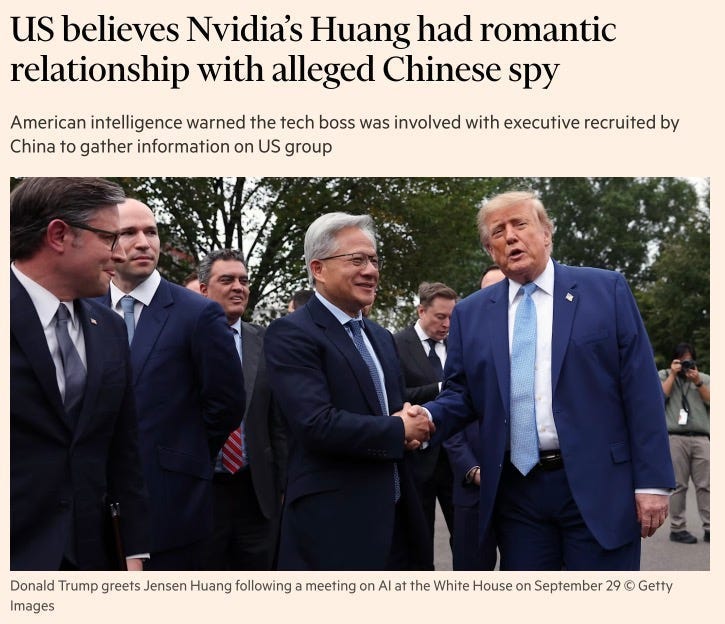
I read corporate reassurance the way I read “no known issues” in release notes, with one eyebrow up. On Sunday 8 November, Nvidia’s CEO told his staff he had been unfaithful to his wife, and the same day the company’s board opened an independent investigation into reports that he was the target of a foreign intelligence effort. The personal part is his family’s business. Then, the part that reaches the rest of us is that, according to Axios, Huang has been a key voice in Washington pushing to loosen limits on AI chip sales to China, and the woman at the center of the reporting is someone US intelligence officials reportedly believe was recruited by Chinese intelligence.
The next dates are close. Nvidia holds its third-quarter earnings call on 17 November at 2 p.m. Pacific, and three House Republican committee chairs have asked Huang to sit for a closed-door briefing on 18 November, according to CNBC.
What Jensen Huang admitted and what Nvidia’s board said
The admission is confirmed because it is Huang’s own memo to staff, which Axios published in full.
“I was unfaithful to my wife. My actions hurt her and our children. There is no excuse for what I did. I am deeply sorry.”
The board’s part is also on the record. Per TechCrunch, a committee of independent directors, working with outside counsel, will run the investigation, and Huang says he will cooperate. Nvidia’s statement adds that the board has “no reason to believe” national security or company secrets were compromised.
That sentence is the one I keep rereading.
A board saying it sees no reason for concern on the day it opens the inquiry is a board describing what it knew before the work started. It may well turn out to be right. But an investigation’s findings are the evidence, and today, there are none.
What is reported about Alice Huang and Megaspeed?
This is the layer where I want to be careful because it rests on officials talking to reporters. The New York Times reported that policymakers in the Trump administration received a memo last spring identifying Alice Huang, no relation to Jensen, as someone US intelligence believed had been recruited by China’s Ministry of State Security, per CNBC’s summary.

She worked at Megaspeed, a Singapore data-center company the US has suspected of helping China get around chip rules.
I didn’t find the intelligence assessment itself, and in what I read, nobody has charged her with anything. Everything about her role reaches us through the Times and the Financial Times citing officials.
Nvidia’s side is on the record too.
Huang told Bloomberg that his contacts with Megaspeed employees were typical of the relationships he has with many Chinese customers, as the Los Angeles Times reports, and a company spokesman told the Times the interactions were consistent with meetings Huang has with any customer, per CNBC. The money trail is the part with numbers. The Times reported a Malaysian affiliate of Megaspeed bought about $4.8 billion of AI equipment between June 2024 and February 2026, which raised questions among US officials about where it ended up, according to The Economic Times.
That is reported, not confirmed, and it fits a pattern I wrote about in my article “China Gave Away Its Best AI for Free. Nobody Read the Fine Print.”, where the chips never have to cross a border at all because a data center in Malaysia or Singapore can rent compute to a company in China.
Why does the China chip question make this a business story?
Huang has argued, per Axios, that keeping American technology in the Chinese market strengthens US competitiveness, and it is an argument with veritable force. I covered an earlier round of it when he warned about DeepSeek running on Huawei chips in “Jensen Huang Called It a ‘Horrible Outcome.’ Eight Days Later, DeepSeek Made It Real.”
The reporting now hangs a question on that argument. According to the Times, as relayed by Axios, the allegation is that she was recruited to seek information and potentially push for Nvidia’s advanced chips to be made available in China. Nothing public shows that happened. But when a key advocate for a policy is the person whose judgment is now under review, every past argument gets read twice, and that is a governance problem even if the board finds nothing.
The market had already priced some of this. Nvidia shares fell about 3% after the first report in late October, investinglive notes. On Sunday night, they traded roughly 3.4% lower near $180, against a Friday close of $186.64, a Reuters figure relayed by TIKR. The same review puts China at 9.1% of fiscal 2026 sales, with company guidance already assuming no China data-center compute revenue. So the guidance already leaves China data-center compute out. The exposure left is to policy.
Whether Washington keeps listening to the man who sells the chips.
Separately, Sen. John Cornyn called a Times report “outrageous” over reporting that the Commerce Department cleared a Chinese firm, New Matrix, to assemble chips for Nvidia in Beijing, with little evidence of operations at its listed address, again per CNBC.
What to watch next
Three dates will show whether this stays a personal scandal or becomes a policy story. Nvidia’s results and call on 17 November will show whether management addresses the investigation. The closed-door briefing requested for 18 November will show whether Huang appears. And the board has given no date for its findings, so the only honest line today is that the investigation is open.
Anthropic Wants America to Win the AI Race. Its Strategy Makes That Impossible.

On May 14, 2026, while Donald Trump was shaking hands with Xi Jinping in Beijing with the CEOs of Nvidia, Apple, Tesla, and BlackRock standing behind him, Anthropic published the most aggressive policy essay the company has ever written. The timing was not an accident. The title gives it away:
Thanks for reading. Your thoughts in the comments will be appreciated.