

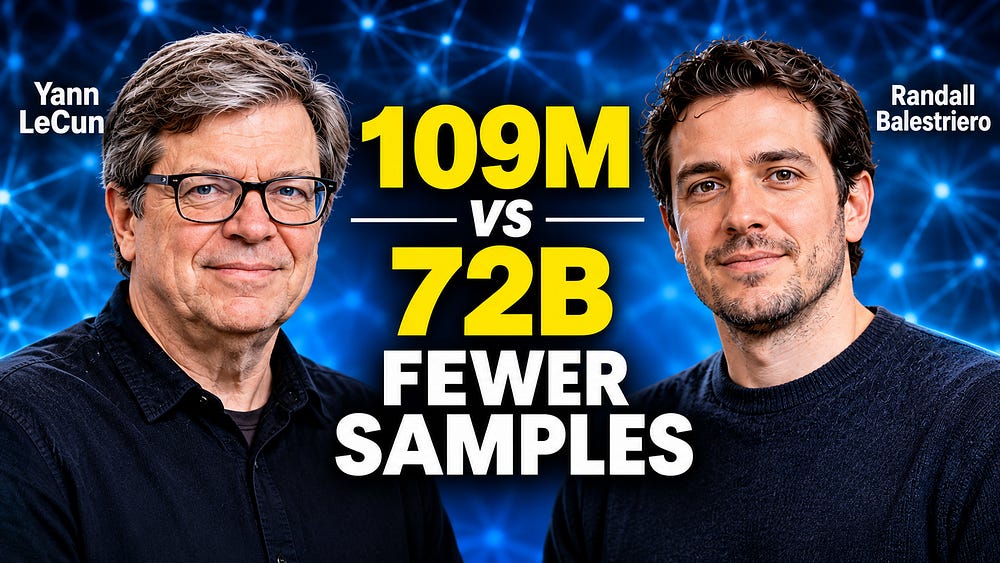
Yann LeCun’s newest paper says that a model with 109 million parameters lines up with vision models better than Qwen2.5–72B, which is 660 times larger, a kind of result that makes anyone who has bet on scale nervous. The twist sits in the paper’s own limits section, “The main caveat is where good views come from,” and in the experiment behind that headline, two of every three captions were written by a model.
The paper is “Proving and Improving the Platonic Representation Hypothesis with JEPAs”, posted on arXiv on 29 October by LeCun and Randall Balestriero. It matters because LeCun left Meta to start AMI Labs, which raised $1.03 billion at a $3.5 billion pre-money valuation in March on the argument that predicting the next word is the wrong route to intelligence, and this paper tries to back that argument with a theorem and a scaling result. I covered the bet itself in my article “Why Yann LeCun Just Bet $1 Billion Against ChatGPT”.
Here I want to read the numbers the way a skeptical engineer would.
What the LeCun Paper Claims, in Plain Terms
In 2024, MIT researchers, including Phillip Isola, proposed the Platonic Representation Hypothesis: the bigger vision and language models get, the more like they arrange concepts inside, even though a language model has never seen a picture. LeCun and Balestriero try to turn that observation into a theorem. Train one encoder on images and another on text, using pairs that describe the same scene, and they prove the two end up with the same map of the world up to a rotation, like one map of Europe or the US written in two coordinate systems.
The proof needs conditions such as a finite world and matching pair distributions, and the paper concedes that “no experiment meets the hypotheses of Section 2.1 exactly.”
The method is a JEPA, a joint embedding predictive architecture. Instead of predicting the exact hidden word or pixel, it predicts a compressed vector that summarizes the hidden part, so a model shown a forest with a gap only has to say “trees, about four” and never draw each leaf.
The second claim is the provocative one. Predicting the next word is also a JEPA, the authors argue, but a bad one, because it pairs the start of a text with its continuation from the same author, so the model learns style along with content.

I think of it as learning what a dog is from one author who always writes the same way, as against learning it from ten people who each describe the dog differently. And ten people only share the dog.
The Numbers, Read Closely
Start with 42. The paper says that good views reach with 21.6 million samples what next-token prediction reaches with 900 million samples. That is 42 times fewer samples, not 42 times fewer data: the same paper also lists 14 times fewer text tokens and 435 times fewer unique images, and according to Pebblous’s line-by-line breakdown, the 42 compares against the only next-token checkpoint the authors scored.
Then, the 109 million against 72 billion. On a nearest-neighbour overlap score, using the vision model DINOv2 as the reference, the small model scores 0.184 and Qwen2.5–72B scores 0.154, per the paper’s Table 3. Those are scores, not percentages, even though they get quoted that way. The 0.184 is the mean of three training runs. Pebblous reports that a fourth run scored 0.121, below the 72-billion model, and that the four-run mean is 0.168, still above it.
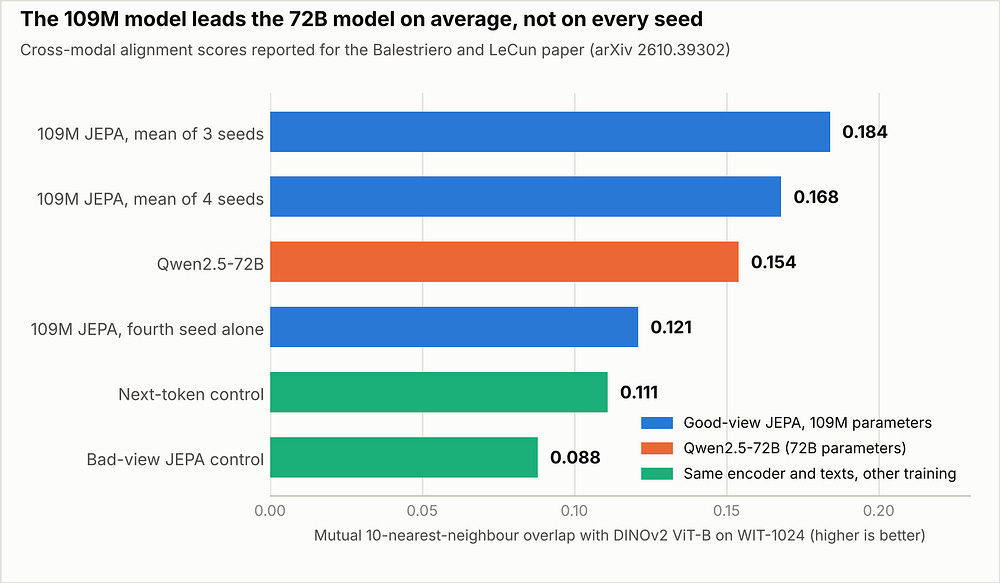
The lead is real on average and thin run to run. Pebblous also notes that CLIP’s text encoder and a sentence-embedding model beat the JEPA on one retrieval test, so even the small model does not win everything it was measured on.
Who Wrote the Good Pairs?
Here is the part I keep coming back to. The training set, Recap-DataComp, gives each image one human alt-text and two recaptions written by LLaVA, an image captioner built on Llama-3–8B. Two of every three texts therefore come from a model that looked at the image and sat on top of a language model trained in the usual way. The paper does not hide it. In its ablation, swapping the recaptions for a text-only paraphrase drops alignment from 0.107 to 0.060, though that comparison also changes the text pool, so it is not a clean removal.
None of these breaks the theorem, which needs pairs and says nothing about where they come from. It changes what the 42x proves. The recipe that beats giant language models borrows its pairs from a model that learned at scale, so the coverage compares a small model with someone else’s expensive labeling against a big model trained alone.
I would call that a fair result and an unfinished argument. A cleaner test would use pairs no model wrote, such as two camera views of the same scene. And as of the newest write-up I found, from Startup Fortune on November 1, no independent group had replicated the 109-million-versus-72-billion comparison.
What It Does Not Say About World Models
The question everyone is asking is whether world models will replace LLMs, and this paper does not test it. Its analysis leaves out JEPAs used as world models, the kind with a predictor conditioned on an action (Section 2.1). It is about aligning text with vision, not about planning.
The better evidence for LeCun’s side is V-JEPA 2. In June 2025, Meta’s team pretrained it on more than a million hours of internet video, adapted it with less than 62 hours of unlabeled robot video, and then used it to plan pick-and-place moves on Franka robot arms in two labs, collecting no data from those robots.
That is a robotics result, and it needs no captioner.
Final Thoughts
I think LeCun is probably right about the direction, and the paper is weaker than its 42x suggests. A theorem under assumptions the experiments do not meet, one metric, a small model whose lead depends on the seed, and good pairs that came from a captioner built on a language model add up to an argument worth funding and a result worth replicating, not a verdict. For robots, predicting in a compressed space already has a working demonstration. For language alone, the case so far is one paper, one metric, and no outside replication.
What I would watch is the first independent group to rerun it with pairs no model wrote. If the gap holds there, bigger stops being the only answer. If it disappears, the “wrong proxy” story needs a fresh proof.
Thanks for reading. If the part about predicting in a compressed space instead of in words stuck with you, my article below goes through how a JEPA simulates a falling object and how a 15-million-parameter model learned physical rules from video.
ChatGPT Can Recite Physics. It Has No Idea How Physics Works.

We live in an age of technological abundance. Not a month goes by without a new version of ChatGPT, Claude, or Gemini producing a moment of genuine astonishment. These systems can now pass the bar exam, diagnose rare conditions that experienced physicians have missed, and write a passable Baudelaire poem in under three seconds. For m…