

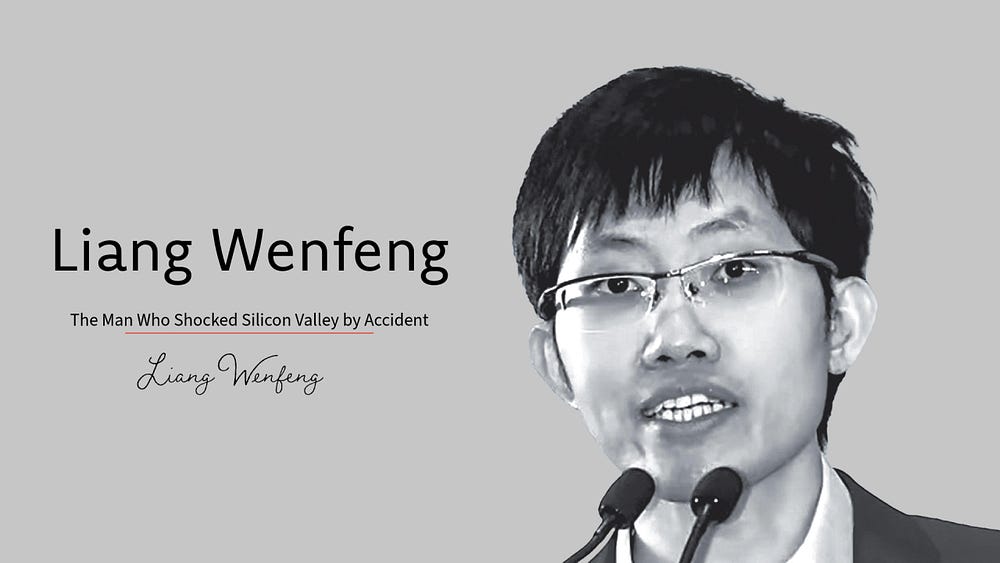
On Monday, 27 January 2025, Bloomberg reported that Nvidia shares fell 17%, erasing $589 billion from its market value, the biggest one-day loss in US stock market history. The man behind the lab that set it off, Liang Wenfeng, has given two interviews that I can find, both to the same Chinese outlet.
I’m writing about him now because the argument that started that week is back, and it is closer to your laptop than to Washington. Rules aimed at open models could decide whether the cheapest capable AI stays something you can download and run yourself. On 19 October, the US Department of Homeland Security ordered DeepSeek out of civilian agency systems, and the labs that sell closed models are being accused of steering the debate. Some of that is documented. Some of it isn’t. I’ll mark which is which.
Who Is Liang Wenfeng, the Quant Founder Behind DeepSeek?
Liang was born in 1985 in Guangdong province and studied electronic information engineering at Zhejiang University. Chinese media profiles say that during the 2008 financial crisis, he and classmates collected market data and tested machine learning for automated trading, and that his 2010 master’s thesis was about tracking an object with a low-cost camera. The same profiles say he turned down a friend’s invitation to join a drone project that became DJI. I’d file that one under reported because the interview usually cited for it never names the friend.
In 2015, he co-founded High-Flyer, a quant fund that handed investment decisions to models. By September 2021, Bloomberg counted about $14 billion under its management. And then he did the strange part. He told the outlet Waves in 2023 that his GPU count went from 100 cards in 2015 to 1,000 in 2019 and then 10,000, and when they asked what a trading fund needed that for, he answered:
“If purely for quant investing, even a small number of GPUs would suffice.”
He compared the spending to buying a piano for a home, first because you can afford it, and second because a group of people is eager to play beautiful music on it. I love that answer, and I distrust it a little. “We can afford it” is a sentence only a founder with no outside investors to answer to can say out loud.

High-Flyer announced an AGI lab in April 2023, and DeepSeek became its own company that summer. Jack Clark, an Anthropic co-founder, had written that the lab hired “inscrutable wizards.” When Waves put that to Liang, his reply was short:
“There are no wizards.”
He described a team of fresh graduates from top universities, PhD candidates in their fourth or fifth year, and some people a few years out of school. That is the anti-CEO image in one line. Whether it is a philosophy or a pose, I’ll come back to.
How DeepSeek Built Cheap Models and Gave Them Away
DeepSeek V2 set off a price war among Chinese labs. Waves asked Liang whether the reaction surprised him, and he said it did. Then he explained the pricing:
“Our principle is that we don’t subsidize, nor make exorbitant profits. This price point gives us just a small profit margin above costs.”
V3 followed in December 2024. DeepSeek’s technical report says its full training took 2.788 million H800 GPU hours, which at an assumed $2 an hour comes to $5.576 million. The next sentence in the report matters just as much: that figure covers the official training run only, “excluding the costs associated with prior research and ablation experiments on architectures, algorithms, or data.” Sam Altman has said GPT-4 cost more than $100 million, but that covers the whole effort.
So the comparison that circulated that week set one lab’s final-run bill against another lab’s everything bill. The gap was still big. It just wasn’t that big.
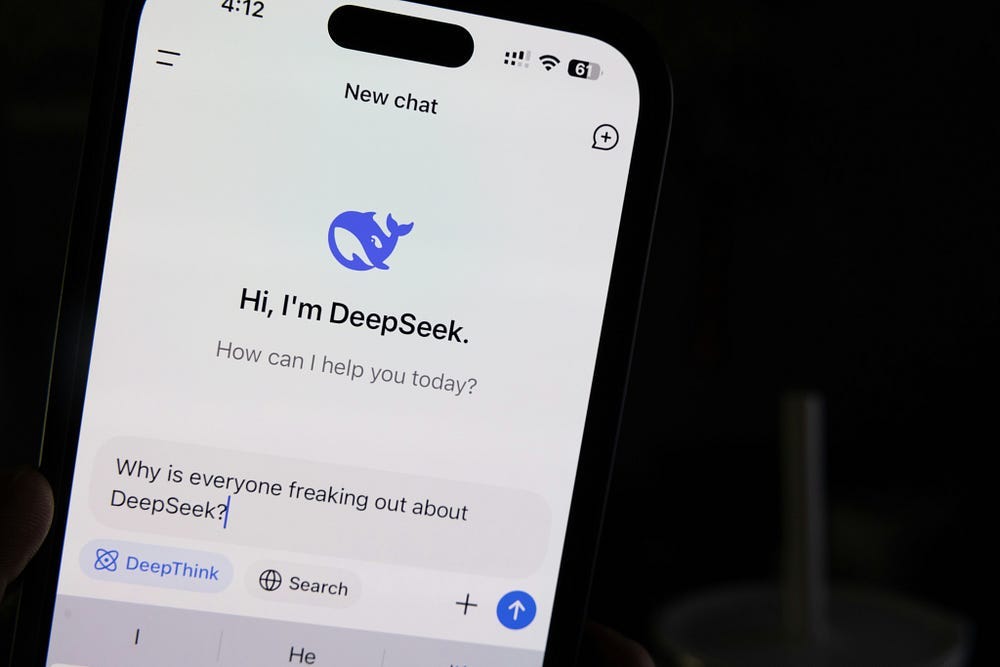
R1 arrived on 20 January 2025, a reasoning model that DeepSeek said matched OpenAI’s o1 on math, code, and reasoning tasks, released under an MIT license so that anyone could use and commercialize it. Its API launched at $0.55 per million input tokens, against $15 for o1 at list price. The app reached number one among free iPhone apps in the US on Sunday, 26 January; Marc Andreessen called R1 “AI’s Sputnik moment,” and on Monday, the market did the rest.
Why Nvidia? Its valuation rested on a simple belief: better AI means more GPUs, forever. R1 suggested a better design could get comparable results with less compute. The panic got the chips wrong, though. By 6 October 2026, Bloomberg reported Nvidia was on the verge of a $6 trillion market cap with its stock back at a record. What the panic got right was something else. A lab with fewer chips had just shown that the best models don’t have to live behind someone’s private servers. Altman said as much on Reddit four days later:
“I think we have been on the wrong side of history here and need to figure out a different open source strategy.” He added that not everyone at OpenAI shares that view.
Export controls were meant to slow Chinese AI down. I argued in my article “Jensen Huang Called It a “Horrible Outcome.” Eight Days Later, DeepSeek Made It Real.” that the constraint may have made DeepSeek more resourceful instead. DeepSeek also keeps publishing the plumbing, like the inference speed-up I covered in “DeepSeek Made Their AI 85% Faster Without Touching the Model or Buying a Single Chip.”
What the Leaked Investor Transcript Says About Restraint
This is the part where I have to slow down. The famous “restraint” quotes come from a leak, not an interview. In late July 2026, Tencent Tech published a lightly edited transcript of a nearly four-hour investor meeting with Liang. Hello China Tech notes that DeepSeek has not confirmed the record, and that the meeting centered on the company’s first outside fundraise. Read what follows with that in mind.
“Restraint is a strategy. Sometimes you give up some things to gain more of others.”
“Those who take more get beaten by those who take less. You don’t even need to actually be taking more. If your ambition is to take more, you will be beaten by someone whose ambition is to take less.”
In the same transcript, as other translations render it, he gives an example about capturing 5% of global GDP from AI versus 1%. I like the idea, and I see it in DeepSeek’s choices I can check: MIT-licensed weights, margins priced close to cost in 2024. What I can’t check is the room it was said in.
A founder describing his own modesty to prospective investors is also pitching.
A few lines get quoted as proof of the “anti-CEO” style, so here is where each one actually comes from. In 2023, Liang told Waves, “We don’t have KPIs or so-called quotas,” but he was talking about High-Flyer’s sales team. The line about researchers taking GPUs without asking comes from the 2024 interview:
“If someone has an idea, they can access the training cluster cards anytime without approval.”
The idea of leaving half of everyone’s time unassigned shows up only in the leak. Some commentators link all this to the Taoist idea of Wu Wei. Liang doesn’t use that vocabulary in anything I found, so I’ll leave the philosophy tourism to others.
The Case for Keeping Powerful AI Closed Isn’t Fake
It’s easy to write the closed labs as villains, and it would be wrong. In May 2023, the Center for AI Safety published a one-sentence statement that put extinction risk from AI alongside pandemics and nuclear war, and Altman, Dario Amodei, Demis Hassabis, Geoffrey Hinton, and Yoshua Bengio all signed it. An open letter asking for a six-month pause on training systems stronger than GPT-4 passed 30,000 signatures. Eliezer Yudkowsky argued in Time that governments should be ready to destroy a rogue data center by airstrike if a treaty were broken.
Altman told the Senate the US might consider licensing and testing requirements above a threshold of capabilities, and also said he didn’t want to stop the open-source community. Ilya Sutskever told The Verge that “open-sourcing AI is just not wise.” Bengio asked in 2024 whether you would publish the DNA sequence of a dangerous virus, then conceded that open-sourcing may currently do more good than harm for safety.
Those were arguments. In September 2025, they got data. The US government’s CAISI evaluation of DeepSeek models found that DeepSeek’s most secure model, R1–0528, responded to 94% of overtly malicious requests under a common jailbreak, against 8% for the US reference models. Agents built on it were 12 times more likely to follow malicious instructions in a simulated environment. The caveat ran the test: a US agency evaluating a Chinese rival. The numbers are still worth taking seriously.
Here is the part I want to keep straight. In the sources I could reach, I found no documented catastrophe traced to open weights. That doesn’t prove safety because weak guardrails have not prevented harm yet, and “nothing bad has happened” is a weaker argument than it sounds.
Who Profits From the Fear? What’s Confirmed and What Isn’t
In July 2026, the Kimi K3 release revived whether the US should restrict Chinese open-weight models. The New York Times reported on 25 July, citing anonymous sources, that executives from OpenAI and Anthropic, and some investors, lobbied regulators privately. I haven’t found a public filing or letter, so I treat that as reported, not documented.
What is documented is an X thread from Dean Ball, who had joined OpenAI as head of strategic futures less than two weeks earlier. He wrote that he would guess the administration would eventually decide its best strategy was “to create large amounts of regulatory risk around the use of open-weight Chinese models,” and that officials needn’t ban anything, only issue “soft law that creates FUD.” He later wrote, “I am trying to describe what I believe will happen, not advocate for anything,” and that he had been imprecise. One employee’s prediction in his second week isn’t company policy, and I won’t pretend it is. It is still a useful example of how easily a competitive interest can wear a security costume.
Anthropic’s answer is more careful than most of the summaries it attracted. In a post on 27 July, Amodei wrote that “Anthropic has never advocated for a ban on open-weights models.” He also wrote that open-weights models “do potentially present a higher risk than closed models” because guardrails are hard to apply and, once weights are released, “they cannot be withdrawn.” And he conceded that banning US businesses from using Chinese models “would protect US AI companies from competition, but that has never been my goal.” What he wants instead is chip controls, a crackdown on distillation, and “requiring safety testing of all sufficiently capable models, open and closed.”
Critics call all this regulatory capture. That is a claim about motive, and motive is the one thing nobody in this fight can produce a receipt for. What I can do is check the other side of the ledger, which the “it’s all a moat” version of this story skips.
In early September, a joint CISA, NSA and FBI advisory said that “likely with Chinese government awareness,” DeepSeek and five other firms extracted billions of tokens across millions of exchanges from US frontier models. Most distillation accusations came from the labs themselves, so it matters that government agencies now repeat them. And on 19 October, Reuters reported that DHS ordered DeepSeek products and third-party services built on its model out of civilian agency IT systems, citing “multiple threat vectors.” That is the only hard action I have found. It covers federal civilian systems. I found nothing that restricts what you run at home, and nothing yet that targets open weights as a category.
Here’s where I land. The fear is not invented, and it is not disinterested. Both are true at once, which is exactly why I don’t want the labs refereeing their own market, and why I don’t want a government deciding by passport either. Rules should attach to what a model does under testing, not to its license or its country. That is close to Amodei’s own sentence, and it is the version I can defend. Liang’s bet is that openness wins because the real advantage is the team that invents the next model, not the model itself. The closed labs bet the opposite. The evidence doesn’t settle it yet.
For you and me, the question is plainer: will the cheapest capable model stay something we can download? Today it is. I’d watch it.
Thanks for reading; follow Nov Tech and subscribe for more breakdowns of who is writing the rules for AI.