


If you are waiting for a layoff letter to find out that AI has reached your job, you are watching the wrong signal. On 26 October, Microsoft offered about 60,000 employees a way out, and the public version of its memo never mentions AI.
Most of us picture that moment as a news bulletin: a company announces thousands of cuts, the stock moves, someone starts a hashtag. I think the quieter version deserves more attention because it leaves almost no trace.
Here is my argument. Nobody automates a job. They automate a workflow, one at a time, and each one flips on its own day. Inside a team, the change is instant. From national statistics, it looks slow and almost calm. Layoff counters, the unemployment rate, and company-wide headcount all watch the building from the sidewalk. To test that, I went through a memo from Microsoft, an earnings call from Amazon and a research note from Goldman Sachs, and checked each against the numbers behind it.
Microsoft offered 60,000 exits and never mentioned AI
The memo comes from Amy Coleman, Microsoft’s executive vice president and chief people officer. The offer covers employees in the US, Canada, India and the UK at level 70 and below, about 27% of Microsoft’s 223,000 people, according to CNBC. Coleman describes it this way:
“The Voluntary Exit Offer reflects an important part of how we’re growing our approach to change: creating greater flexibility and, where possible, more ways for employees to shape their next chapter.”
In plain English: we are inviting you to write the next chapter of your career somewhere else.
I care less about the phrasing than the mechanism. Nobody is being laid off. Microsoft opens a door and lets people walk through it. Employees have until the first week of December to decide, GeekWire reported, and a person briefed on the plan told CNBC that those who accept leave on 31 December, and that Microsoft has no target in mind. The offer builds on a retirement program earlier this year that over 30% of eligible employees took, Microsoft said in July.
Now, look for AI in the memo. In the published version, it is not there, and neither are the words artificial intelligence. CNBC’s headline ties the offer to an AI efficiency push, citing the cost of Microsoft’s AI infrastructure build-out. A Microsoft spokesperson told GeekWire the offer is not a sign the company needs fewer employees. I cannot tell you AI is why anyone at Microsoft is leaving, and nobody outside the company can.
That is not a hole in my argument. It is my argument.
The tallies share a blind spot. Challenger, Gray & Christmas, which tracks announced US job cuts, published its October report on 5 November: 43,994 cuts, the lowest since 2023 and 71% below the same period a year earlier. It addressed Microsoft directly:
“Microsoft also announced voluntary exit offers (VEOs) to 60,000 employees in October. Challenger records voluntary programs by the number of employees who accept an offer or by a company’s stated reduction target, so the offers are not included in October’s total.”
Challenger does not treat the offers as nothing:
“These offers tend to signal more layoffs to come. Voluntary exit offers are a softer way to shrink.” That reading, a polite first act before a layoff, may prove right. What I can say is that everyone who accepts leaves a seat behind, and if nobody fills it, no layoff list will ever contain it.
One sentence in the memo matters more to me than the rest:
“Some organizations are providing the Voluntary Exit Offer, and some are not. Participation varies based on each business’s priorities, customer commitments, and workforce needs.”
CNBC’s source said some marketing, sales, and engineering teams decided not to take part. Microsoft is not changing all at once. Its teams are one after another.
Nobody automates a job. They automate a flow.
Everyone says AI will replace accountants and developers. What gets automated is smaller than a job, and it has a name: a flow. This flow is the path a request follows from the moment it arrives to the moment it produces a result. A parcel enters a warehouse and leaves on the right truck. A customer asks a question and needs an answer. Any job is a label on a payslip, and behind the label sit several flows.
An automated flow does not fade.

Think of mail merge in Word. You need to send the same letter to hundreds of customers, each with the right name and address. You write one letter, leave blanks for the name and address, and hand Word your customer list. It fills in the blanks and produces one letter per person. The catch is that until the setup is right; it produces nothing usable. You spend an hour working out why the first name lands where the last name should be, and meanwhile, your colleague has typed 20 letters by hand.
He is ahead.
Then the setup finally works. Three customers or 30,000, it is the same click. You press it, and everything goes out at once, and your colleague is on letter 21. Keep that picture: automation is a switch, not a dimmer. It does nothing for a long time. Then, it does everything at once.
What AI changes is what you can wire behind the switch. Tasks that used to require understanding something, like answering an unhappy customer or checking that a file is compliant, can now sit behind it. This can work with no one being let go since the flow no longer relies on manual handling.
Amazon and Alphabet grew while their workflows flipped
Three days after Microsoft’s memo, on Thursday, 29 October, Amazon reported its third-quarter results. On the call, chief executive Andy Jassy said Amazon has over 1 million robots in its fulfillment network, then added:
“We will always have a lot of teammates in our fulfillment centers. But I think a lot of the jobs that we have that are more repetitive that we have humans doing will be done by robots.”
Notice the scope: not Amazon as a whole, not logistics, repetitive tasks inside warehouses. That is a flow, and for that flow, the switch is being pressed. Chief financial officer Brian Olsavsky said Amazon doubled its fleet of robotic arms like Cardinal and Sparrow in 2026.
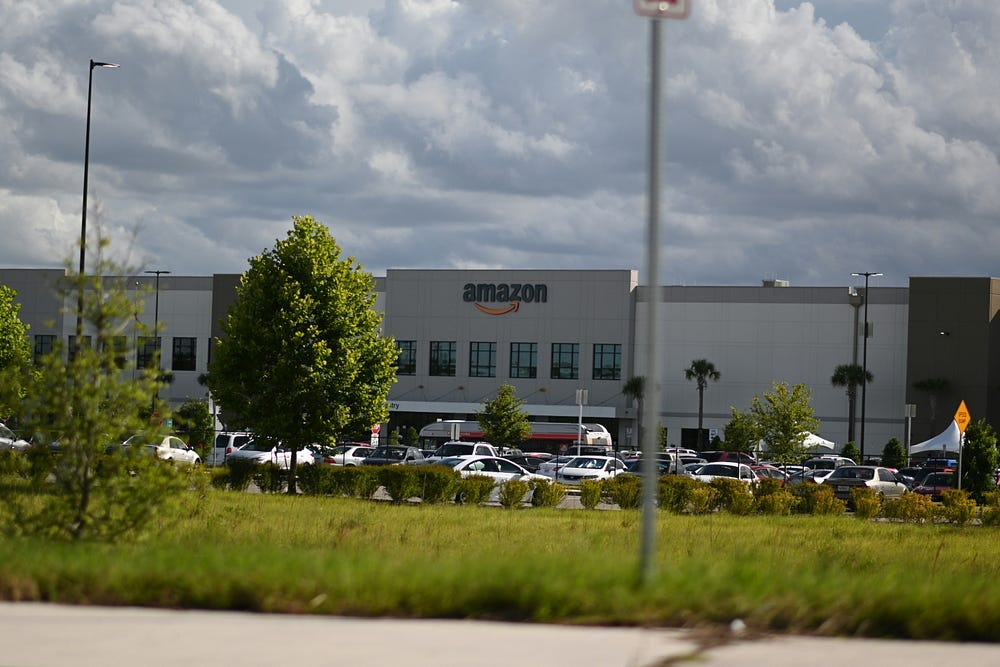
A less-quoted number sits in Amazon’s earnings release: 1,638,000 employees at the end of September, against 1,578,000 a year earlier. That is 60,000 more people, almost exactly the number Microsoft invited to leave three days before, a coincidence of scale and nothing more. Both things are true at once. The warehouse flow is flipping, and the company is growing.
Alphabet tells the same story. Its release shows 204,757 employees at the end of September, up 7.7% from 190,167 a year earlier, partly through the Wiz acquisition that closed in March. In the same quarter, Google Cloud revenue more than doubled, up 103% to $30.7 billion, on demand for AI infrastructure. Google also confirmed to Reuters that it began offering voluntary exit packages in June in Canada, France, Germany, Japan and Switzerland.
So an entire company never falls in one move. Flows inside it flip, and the same company can add people in one corner while it offers exits in another.
If you understand that, you can work out where to stand.
Why every flow does not flip tonight
If automation is a switch, and AI can already answer customers and write code, why doesn’t everything flip tonight? Because of errors. A mail merge does the same thing every time. If the first letter is right, so is the 30,000th. AI can give a perfect answer to one customer and a badly off-target one to the next on almost the same question. In a live demo for investors, getting it right 95 times out of 100 earns applause. In production, a 5% error rate on 100,000 requests is 5,000 people badly served, some with serious consequences.
So the fight is not being right most of the time. It is chasing the last decimals, and each one costs months. Some flows get there in weeks, while those touching money or safety may take years. That is my read, not a forecast.
When companies press the switch too early, it shows. In June, Ford told Motor1: “AI is a powerful tool for catching potential quality issues, but it’s only as good as the people using it.” It said it has added over 350 experienced tech specialists, through internal promotions or new hires. The pattern is common enough to have a nickname, the AI boomerang: automate first, then call the humans back, usually quietly. The reversals are as hard to see as the switch.
The statistics show a calm building. Young workers do not.
I like images, so here is one.
Picture an office building at 7 a.m. on a winter morning, still dark. Employees arrive one after another, and each turns on the light at their desk. For the person inside, it is instant: one click, and the room goes from dark to lit. From the sidewalk, you never see a click. You see a facade lighting up window by window across the morning.
AI works the same way. Each workflow flips all at once, like a lamp. But they do not all flip on the same day, so the big national statistics show a slow, almost peaceful change. Those statistics are the view from the sidewalk. Your job is the office, and the day your workflow flips, it will not be gradual for you. It will be instant.
The sidewalk view is calm. The Bureau of Labor Statistics reported on 6 November that employers added 165,000 jobs in October and that unemployment held at 4.1%, inside the 4.1% to 4.3% range it has stayed in since March.
Since ChatGPT arrived, two camps have been shouting past each other. One reads the national statistics and says nothing is happening. The other looks at companies one by one and calls it a massacre. They are looking at the same tower from different places. Even the Stanford researchers behind a payroll study write that they “do not see widespread, economy-wide job displacement associated with AI.”
But the same Stanford study finds a window that has already gone dark. In ADP payroll data through June 2026, employment of workers aged 22 to 25 in the most AI-exposed occupations is 19% below where it would be had it kept pace with peers in less-exposed jobs. Experienced workers show no comparable gap, and the gap has widened since earlier versions of the paper put it at 13%.
It works mainly through reduced hiring rather than separations, and it is concentrated where AI substitutes for work rather than complements it. Nobody is fired. The door won’t budge. So the first people hit are not the ones holding a job but the ones knocking on the door. The paper does not say why beginner work flips first.
My reading is that the tasks we hand beginners so they can learn the trade are the most routine ones, and routine tasks flip early. It is the same mechanism as Microsoft’s memo: a seat that is never filled appears on no layoff list.
Goldman followed the people instead
Even the official tally of AI layoffs is blurry. Challenger counted 1,206,374 announced US job cuts in 2025 and attributed 54,836 of them to AI, about 4.5%, fewer than one in 20. Through September 2026, AI was the top reason companies gave: 120,136 of 573,195 cuts, about 21%. Then, the October report changed the ranking. AI accounted for only 1,265 cuts in October, the lowest month of 2026, and market and economic conditions, at 130,531 for the year, moved ahead of AI’s 121,401.
Andy Challenger put it this way:
“The reasons employers give have shifted from technology to the economy. AI dominated layoff announcements through the spring and summer, but this fall, companies are pointing to demand and economic conditions. That is a more cautious signal, though the overall pace of cutting remains low.”
My opinion is that part of the jump in AI-cited cuts is real, and part is storytelling, because telling shareholders you are investing in AI sounds better than admitting you hired too many people during the pandemic. I covered one case in “Block Cut 4,000 Jobs and Blamed AI. Dorsey Admitted the Overhiring.” The mirror image is Microsoft, which sells AI to the entire planet and presents its exit plan as a matter of flexibility. Between companies that inflate AI’s role and companies that stay silent about it, there is one way left to find out who is actually being displaced: follow the people.
That is what Goldman Sachs economist Pierfrancesco Mei did in a note published on 29 October and covered by Fortune. No official survey asks people whether AI cost them their job, so Goldman built its own indicator from how exposed each occupation is to AI, how heavily its industry uses it, and whether the position was eliminated, then treated the top 30% as likely AI-displaced. It applied the score to over 15,000 displaced workers who lost jobs between 2016 and 2025 and tracked what happened next.
Goldman finds no clear gap for job losses before 2023. Since 2025, the gap is sharp. Workers displaced from AI-exposed jobs took about a month longer than other displaced workers to find a new job, and were roughly 10 percentage points more likely to still be unemployed a year later. Goldman calls those effects comparable in magnitude to earlier waves of technological change, which it describes as long-lasting.
Age matters too.
Workers 35 and older needed about five weeks longer than other displaced workers to get back to full-time work, compared with about three weeks for those under 35. Mei writes that younger workers “may adapt more flexibly” and calls that “an encouraging sign.” Young people struggle to get through the front door, but they rebound faster.
The most unsettling detail comes next. When these workers find new jobs, they often land in roles just as exposed to AI, or more, and Goldman says that is especially true for older workers. My reading is that they leave a workflow that just flipped and enter one that has not flipped yet. The risk travels with them. If you are over 35, this part is about you.

Goldman adds it is still too early to assess the full impact.
One last number reaches beyond AI. According to the BLS, as Fortune reports, about 49% of long-tenured workers who lost full-time jobs from 2023 through 2025 and found full-time work again were earning as much as or more than before, down from about 62% in the prior survey. It is not specific to AI, but it is the scar Goldman is warning about.
The work lands on its feet. The wage does not.
This is what layoff announcements do not show. When a workflow flips, the work itself always lands on its feet. It gets done somewhere else, and often faster and cheaper. The wage struggles to land. That, to me, is the actual subject behind all the talk of a bloodbath. It is not the disappearance of work. It is the separation of work from income.
Each time a workflow flips to automation, the economy produces as much, sometimes more. But part of the money that used to pay salaries moves to the people who own the machines. If all your income comes from your hours inside one particular workflow, every flip takes a slice. If you own a piece of the machine, the same flip pays you instead of taking from you.
I stay optimistic anyway, and it is because of exactly that point: owning a share of the AI system, and knowing how to use it. That does not mean millions in the stock market, and it does not mean owning a data center.
Three dated checkpoints will show whether the sidewalk view is catching up. Microsoft’s employees decide in early December, and those who accept are on leave on 31 December, according to a CNBC source. Challenger’s November report, due in early December, will show whether AI keeps its roughly 20% share of 2026 cuts. The BLS jobs report on Friday, 4 December, will show whether unemployment leaves its 4.1% to 4.3% band.
OpenAI's Economists Just Resigned Because the Company Refuses to Publish the Truth About AI and Jobs.

Major researchers just walked out of OpenAI. Not for better salaries. Not to join Google or Meta. They left because they refused to participate in what they considered a large-scale propaganda operation.
Thanks for reading. From the sidewalk, the facade will keep filling in slowly. Inside, somebody has already flipped a switch.