

Today, Tesla is holding its launch event for the Cybercab in Austin.
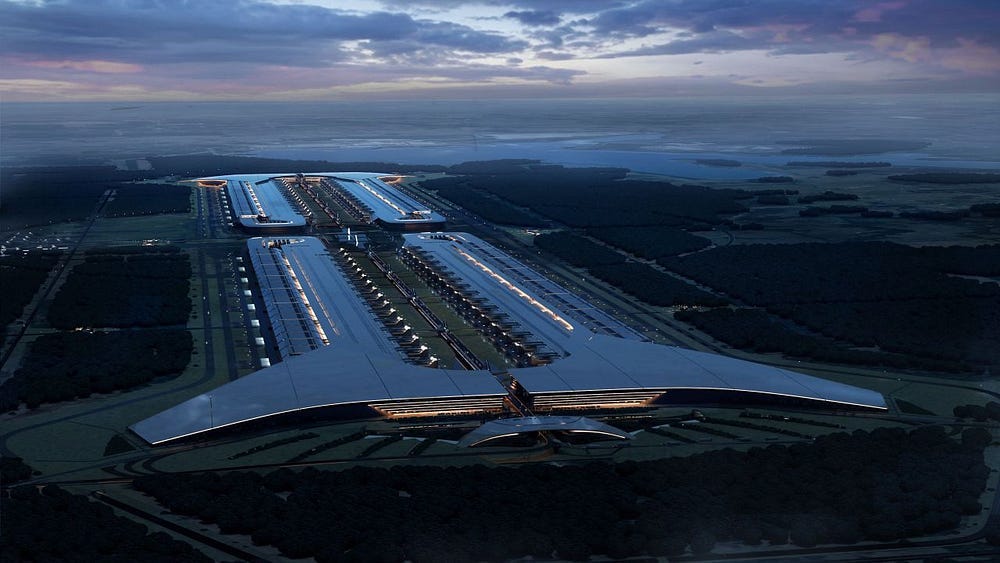
No steering wheel. No pedals. A car designed from the outset is fully automatic, never needing a driver. The vehicle has been quietly accumulating unsupervised miles since the Austin robotaxi service began, and production versions are now being prepared for delivery. In three weeks, on September 24, the Semi factory in Sparks, Nevada — 1.7 million square feet, purpose-built for 50,000 electric trucks a year — officially opens with a public event. Meanwhile, a contractor in Grimes County, Texas, north of Houston, is about to dig the foundations for what will be the largest building in the history of human construction.
These are not separate stories. They are three chapters of the same sentence.
The Problem Nobody Saw Coming Two Years Ago
I want to be honest about how quickly this situation developed, because the timeline matters. Two years ago, none of this was obvious. The problem nobody was discussing in 2024 is the same one Musk is now spending over a hundred billion dollars to solve: every company he runs needs compute, and the world cannot produce enough of it.
Tesla needs chips for the Cybercab’s autonomous driving stack. It needs chips for Optimus robots, which it plans to produce by the millions. SpaceX needs radiation-hardened processors for a satellite constellation of orbital data centers that has to survive the space environment indefinitely. xAI needs GPU clusters to train and serve Grok. And X, formerly Twitter, with hundreds of millions of users, needs significant compute just to run daily operations. Five companies, five industries, one bottleneck — and the bottleneck gets worse every quarter because each product line is growing simultaneously.
Musk’s own assessment: current global semiconductor production, everything every fab on the planet outputs today, covers roughly 2 percent of Tesla’s and SpaceX’s combined projected demand. That figure is almost certainly exaggerated. But even discounting it aggressively, even assuming it’s off by a factor of five, the gap is enormous, structural, and not closing on its own.
What Terafab Actually Is
On August 6, Tesla and SpaceX confirmed Terafab will be built in Grimes County, Texas, with an initial capital investment of $16.8 billion and a total program budget of approximately $119 billion across four phases. Construction runs from December 2026 to December 2028. Governor Abbott announced a $30 million Texas Enterprise Fund grant, which is essentially a rounding error against the project cost but signals the full weight of state support.
With 100 million square feet dedicated to manufacturing, this facility will be ten times the size of Giga Texas and fifty times the size of the Pentagon. Elon Musk called it, without apparent irony, “the most valuable building on Earth by far.” The NASASpaceflight community’s reaction to that number was essentially silence followed by checking the math twice.
Terafab’s unique selling proposition lies in its end-to-end control of manufacturing operations. Today, a single chip can travel over 25,000 kilometers before it reaches a finished product. The silicon wafer is grown in one country; the chip design comes from another source; the lithography etching happens somewhere else. The memory packaging is contracted to a third party. Testing happens somewhere else again. Terafab’s stated goal is to compress all of that under one roof: from the initial etching of circuits to final packaging to finished silicon, in a single building four kilometers long. Starting at 100,000 wafers per month and scaling to one million. At full capacity, that output would represent approximately 70 percent of TSMC’s current global production from a single facility.
The target compute output from all of this is 1 terawatt of AI processing capacity per year. One terawatt. For reference, the entire US electrical grid operates at an average of roughly 0.5 terawatts of power. Musk is building a compute infrastructure equivalent to twice the electrical output of the United States, expressed in AI processing terms.

Two Chip Families, Two Philosophies, One Roof
Terafab will produce two completely different processor families that share almost nothing except the foundry.
The first family runs from AI5 through AI6, and eventually AI7, designed for operation on Earth. These chips from xAI will be responsible for managing Grok model inference, operating Tesla’s Cybercabs, and powering the Optimus robots. We covered AI5’s tapeout at Samsung’s Taylor, Texas fab last month — the chip is locked and ready for production. At roughly 2,500 TOPS of performance per board, consuming approximately 250 watts, it is the brain designed for a robot operating in your living room: fast, power-efficient, and optimized for real-time inference in unpredictable environments.
The second family is D3. And this one is different in kind, not degree. These chips will be designed to operate in the vacuum of space, surviving radiation levels that would destroy any standard commercial processor, temperature swings between extreme heat in direct sunlight and extreme cold in shadow, and doing so continuously for years with no possibility of maintenance. SpaceX is building the Starmind orbital AI constellation — data centers in orbit, running AI inference above the atmosphere powered by permanent solar exposure.
No grid.
No cooling water.
No permitting fights.
D3 is what makes those satellites compute rather than just orbit. No other foundry on the planet currently produces chips to this specification at any meaningful scale.
Two engineering philosophies: one optimized for speed and energy efficiency, the other for survival.

The Intel Partnership and the Problem It Solves
Tesla and SpaceX have never built advanced chips before. Rockets and electric cars are genuinely impressive manufacturing achievements, but they involve nothing like the sub-7-nanometer precision required for frontier semiconductors. Semiconductor manufacturing at this level requires cleanrooms at near-absolute atmospheric purity, extreme ultraviolet lithography machines that cost hundreds of millions of dollars per unit and take years to deliver, and yield rates that take entire decades of institutional knowledge to develop. A defect invisible to the naked eye — a contamination at the scale of a few atoms — can ruin an entire wafer of chips.
Intel joined the project in April. Terafab will use Intel’s 14A process node, which is the most advanced fabrication process Intel is currently developing. For Intel, this contract was described by its own CEO as existential. The company had publicly stated that if it couldn’t secure major external customers for its foundry operations, it would exit contract manufacturing entirely and face potential insolvency. Tesla became that customer. Intel’s stock rose 4 percent the evening the partnership was confirmed.
This is true and worth sitting with. Tesla and SpaceX’s business was crucial for a historic American semiconductor company to maintain its viability. That’s not a small statement about the current state of the semiconductor industry.
Tesla also hired a veteran of the semiconductor world with approximately twenty years at Intel to serve as Terafab’s first head of manufacturing operations, bringing in someone who has built production lines at the exact scale and precision the project requires. Regardless of Musk’s successes with vehicles and spacecraft, chip manufacturing is a distinct field. The partnership structure acknowledges that honestly.
The Machine Henry Ford Never Built
The second half of this story is about manufacturing philosophy, and it’s the part most coverage skips entirely because it looks like an operational detail rather than a strategic bet.
Essentially, the same principle has governed automobile production globally since 1913: a car body advances along a line, with components being added incrementally at designated stations. Wiring, then climate control, then glass, then seats, then dashboard, then exterior panels, in a fixed order. Station by station, forward. Henry Ford’s Model T assembly line cut the time to build a car by a factor of six, and it worked so well that over a century later, nobody had replaced it. Toyota refined it. Volkswagen refined it. BMW, Stellantis, everyone else refined it. The refinement became the discipline.
The system has one structural vulnerability: sequential dependence. If one station fails, the entire line slows down. If one component arrives late or is wrong, the entire line stops.
Musk experienced this brutally firsthand during the Model 3 production ramp, which he has described as “production hell.” His initial belief was that full automation would solve everything. The machines would be faster, more consistent, and endlessly scalable. The reality corrected him hard. He had to remove automation, reintroduce human workers, and rebuild sections of the line under live production pressure. It was publicly discussed at the time as a near-disaster for Tesla.
What he took from it was not that automation was wrong. It was that the underlying system was wrong. That the sequential linear chain, unchanged since 1913, had a structural flaw that no amount of better robots could fix.
The solution Tesla developed is the Unboxed process. Instead of advancing one vehicle body along a single line, the vehicle is decomposed into modules — front section, rear section, floor pan, battery pack, seats, exterior panels — each of which is assembled in parallel on its own branch. Every module remains open and fully accessible throughout its own assembly, because it hasn’t been mated to any other module yet. The robots work on all sides simultaneously. When each module is complete, they all converge at a central point, and the vehicle is assembled in a final joining operation. The production tour happening today at Giga Texas will give the first public look at this process running at production scale.
The practical consequences are real. Parallel assembly means that if one branch failing doesn’t stop the entire line. Full accessibility means robots can work at angles and positions that a car body moving through a sequential line never allows. Tesla has been calibrating this specifically for the Cybercab for over three years, which is part of why the production ramp has been slower than some timelines suggested. You don’t rush calibrating something you’re betting the next decade on.
The same underlying logic — decompose the process, run in parallel, integrate at the end — is what produced reusable rockets at SpaceX. Orbit launches were extremely expensive before SpaceX, costing $150 million to$400 million each, and the Space Shuttle cost over $1 billion. Falcon 9 brought that number to approximately $67 million. When you divide the cost of orbital access by five or ten, you don’t just save money. You create a market that didn’t exist. Starlink would have been mathematically impossible at $300 million per launch. It becomes a viable business at $67 million.
This is the actual contribution. Not the rhetoric, not the social media presence, not the provocations. The ability to look at a process that has been solved for over a century and decide it needs to be rebuilt from a different principle. It happened with rockets. It is happening now with car manufacturing. And through Terafab, it is being attempted with the foundry business itself.
The Flywheel and Whether It Closes
Here is how the entire system is supposed to work as a closed loop.
Terafab produces AI chips. Those chips go into Cybercabs, Optimus robots, and space-based data centers. The Cybercabs and robots operate in the real world, generating behavioral data that goes back into training better AI models. Better models create demand for more chips. More chips allow for more capable robots and vehicles. More robots and vehicles generate more data. The Unboxed factory removes production bottlenecks, which previously limited the speed of scaling physical hardware. And above it all, orbital AI data centers provide compute that doesn’t depend on terrestrial grid infrastructure.
Each component reinforces the others. The question is whether it all closes at the claimed scale, and the honest answer is: nobody knows yet. The semiconductor challenge is genuinely different from anything Tesla or SpaceX has previously tackled. ASML, the Dutch company that makes the extreme ultraviolet lithography machines required for anything below 7 nanometers, is the only producer of that equipment on Earth. If it disappeared tomorrow, the advanced chip industry would effectively cease. They shipped 48 EUV machines globally in 2025 and are targeting 65 in 2026, scaling toward 80 to 85 in 2027. Their CFO has confirmed that the 2027 and 2028 production expansion plans already account for Terafab’s anticipated orders.
Terafab needs hundreds of these machines to reach its stated capacity targets. Goldman Sachs has revised its global wafer fabrication equipment spending forecast to $150 billion in 2026, rising toward $300 billion by 2028 — and the revision was driven substantially by Terafab. This is the paradox: a single project has already moved the forecasts for the entire equipment industry. When your factory changes what analysts project for a global market, you are not building a factory. You are building infrastructure.
The pattern Tesla has run before is well-defined. When batteries were the bottleneck, it developed the 4680 cell; when the Model 3 production process failed, it rebuilt the system rather than optimizing a broken one. When launch costs were the ceiling on the space economy, it made rockets reusable. Identify the bottleneck, partner with whoever has the knowledge you need, internalize the capability, then scale.
Semiconductor manufacturing is a harder problem than any of those. But the schema is the same, and the direction of travel has never once reversed.
These foundations in Grimes County were poured in December. The Cybercab is going to Austin today. The Semi factory opens in three weeks. Whatever you think about the timelines and the personalities, the hardware is real, and it is moving.
I appreciate your time reading this. Follow me, comment your opinion, and don’t forget to subscribe to or support my newsletter for early access content.