
The Company That Rewired the Internet Is Now Running Out of Time
How OpenAI went from unstoppable to scrambling in under three years

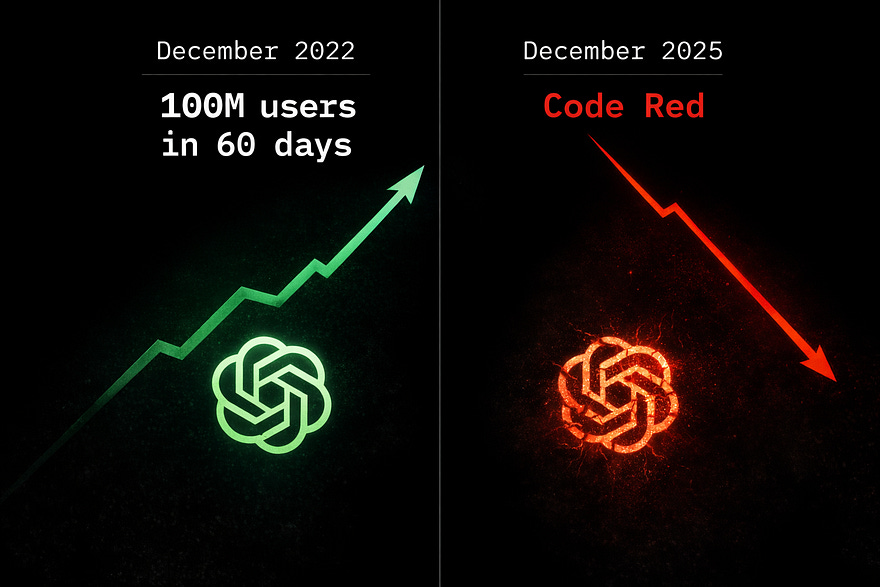
I still remember the moment I texted Bloom in December 2022: “Dude, have you tried this ChatGPT thing? I think the internet just changed.” Then, I wasn’t wrong. A single tweet from Sam Altman — announcing a new AI chatbot anyone could try for free — quietly rewired the world.
Not a launch event.
No red carpet.
Just a link.
100 million users in two months. It took Facebook four years to reach that number.
And now, in early 2026, that same company is burning $26 billion a year, and Sam Altman is sending panic memos to his staff. That’s the story nobody expected to write so soon.
The Formula That Stopped Working
To understand what went wrong, you need to understand what went right first.
OpenAI’s entire rise was built on one elegant bet: the scaling laws. More data, more computing power, more intelligence. It worked beautifully. GPT-3, GPT-3.5, GPT-4 — each release felt like a generational leap. The curve was nearly vertical. The press couldn’t keep up with the superlatives.
Then, in 2025, OpenAI ran into the wall of diminishing returns.
The expectation was that GPT-5 would permanently outperform its rivals. The internal hype was enormous, the teasers cinematic, and Sam Altman compared it to the Death Star from Star Wars, which, in hindsight, was perhaps the wrong cultural reference to reach for. When launch day arrived, the community’s verdict was swift and damning: hallucinations, marginal improvements, and a cost-per-improvement ratio that made even loyal users raise an eyebrow.
The models that followed — GPT-5.1, GPT-5.2 — were described by parts of the developer community as steps backward. In the interim, GPT Atlas (a Perplexity competitor that nobody solicited), GPT Health (scrapped before release because of privacy issues), and Agent Builder all met with little success. OpenAI had gone from setting the pace to chasing it.
The Memo That Was Never Supposed to Leak
December 2025. Sam Altman sent an internal memo to OpenAI staff declaring a “Code Red.” The irony is almost too neat: three years ago, Google declared its own Code Red when ChatGPT launched. The roles have now completely reversed.
This wasn’t marketing. A leaked internal note, described by multiple sources, outlined a brutal triage: anything not generating immediate revenue gets shelved.
Is the personal assistant project called Pulse? Killed.
The shopping agent? Gone.
AI advertising experiments that had been months in development? Paused.
The directive was stark: focus exclusively on ChatGPT’s core quality, because Google’s Gemini 3 had just surpassed it on nearly every benchmark, and Anthropic now holds roughly 40% of the enterprise AI market compared to OpenAI’s 27%.
That last number deserves a second read. Last year, OpenAI’s share of the enterprise market was 50%, and Anthropic’s was 12%. That reversal didn’t happen slowly.
The response to the Code Red memo reads less like a company recalibrating its strategy and more like management by fear. OpenAI went from a proactive innovator to a reactive follower almost overnight. Google, for reference, didn’t panic when ChatGPT launched. They restructured, refocused, and came back harder. There is a difference between a startup and an empire, and right now, OpenAI is discovering it the hard way.
The numbers are actually terrifying
Here is where it gets genuinely uncomfortable to look at.
OpenAI reported a net loss of $5 billion in 2024, with revenues of $4 billion against expenditures of $9 billion. You could chalk that up to aggressive growth-stage spending.
In 2025, revenue reached $11.6 billion. Impressive on its surface until you see the other side: $26 billion in expenses. A $14.4 billion net loss, which is unprecedented in the history of the technology industry. For context, even Uber during its most chaotic growth years never approached losses at this scale relative to revenue.
The significant structural flaw in this situation is the straightforward fact that 5% of those who use ChatGPT subscribe to it. The revenue from that 5% doesn’t even cover the electricity cost of answering questions for the other 95%. If you’re in Europe and paying €20/month for ChatGPT Plus, you’re essentially subsidising hundreds of free users per month. That is not a sustainable model.
Sebastian Mallaby, a senior fellow at the Council on Foreign Relations, published an essay in the New York Times in January 2026 with a simple, chilling prediction: OpenAI could run out of money within 18 months. HSBC’s analysts went further, projecting a $207 billion funding shortfall through 2030, even if everything else goes according to plan. OpenAI’s own internal forecasts project a $14 billion loss in 2026 alone.
And so, the company that Sam Altman once said would never run ads has announced ads in ChatGPT starting in 2026. The same Sam Altman who called advertising a “last resort for us as a business model.” That quote aged poorly.
When the people who believed in it walk out
Money problems are solvable. Mission problems are existential.

Originally a nonprofit, OpenAI was founded with a peculiar mission: to develop artificial general intelligence for the benefit of all humankind, not solely for profit. That idealism attracted some of the sharpest minds in machine learning, people who could have gone anywhere but chose OpenAI because the mission felt real.
Of the 11 original co-founders, only two remain: Sam Altman and Greg Brockman. Mira Murati, the former CTO and one of the most respected technical minds in AI, left and launched her own company, Thinking Machines, immediately attracting a wave of top OpenAI researchers with her. Ilya Sutskever, the scientific soul of the company, also departed. In 2025 alone, over 20 senior researchers left.
The story of one researcher captures the shift precisely. The proposal he took to Sam Altman was for fundamental research, mirroring the kind of dedicated effort that produced GPT-4 for OpenAI.
Altman’s response: focus on ChatGPT; we need to ship features. We need to monetise.
For many who followed this episode, that conversation marked the moment OpenAI stopped being a research organisation and became a subscription product with quarterly earnings pressure.
OpenAI restructured in 2025, moving from a nonprofit toward a public benefit corporation structure, theoretically to balance commercial returns with its mission. The Nobel laureates, legal scholars, and former employees who wrote open letters opposing the change were brushed aside. When 74% of your capital comes from private investors, the governance structure on paper matters less than the financial incentives underneath.
Three Futures, One Uncomfortable Question
When you strip away the press releases and the billion-dollar valuation headlines, OpenAI right now has three plausible trajectories.

The most likely outcome is a quiet absorption by Microsoft. Microsoft already owns 49% of OpenAI and provides the Azure infrastructure on which the company runs. If the cash situation deteriorates, converting debt to equity is a straightforward move. OpenAI would survive, but as a Microsoft research division, not unlike what DeepMind became inside Google.
The second scenario is the hardware pivot. Altman has been in discussions with Jony Ive — the designer behind the iPhone — to create a physical AI device. The idea is seductive: get off the cloud and put something in everyone’s pocket. But it is also an enormous bet. The AI hardware graveyard already includes Humane Pin and Rabbit R1, both celebrated before launch and forgotten within months.
The third scenario is the one that would actually matter. What if the silence is a strategy? What if OpenAI quietly drops the chatbot race and comes back with something no one saw coming — genuine reasoning, real autonomous agents, a system that doesn’t just respond but actually acts on your behalf? Google was written off completely after ChatGPT launched. They came back and now dominate most technical benchmarks. OpenAI recently recruited Peter Steinberger, creator of OpenClaw, a project that generated significant buzz in early 2026 around autonomous task management. That hire suggests at least one part of the organisation is still thinking long-term.
The AGI bet is still alive. But whether OpenAI gets to take that shot before the money runs out is the defining question of the AI era.
What do you think happens next? Acquisition, hardware gamble, or phoenix from the ashes? Drop your take in the comments — genuinely curious which scenario you believe in.
Sources: Fortune, The Nov Tech, Yahoo Finance, Fortune, Futurism, Bloomberg, Built In, The Hans India, Windows Central, Yahoo Finance.