

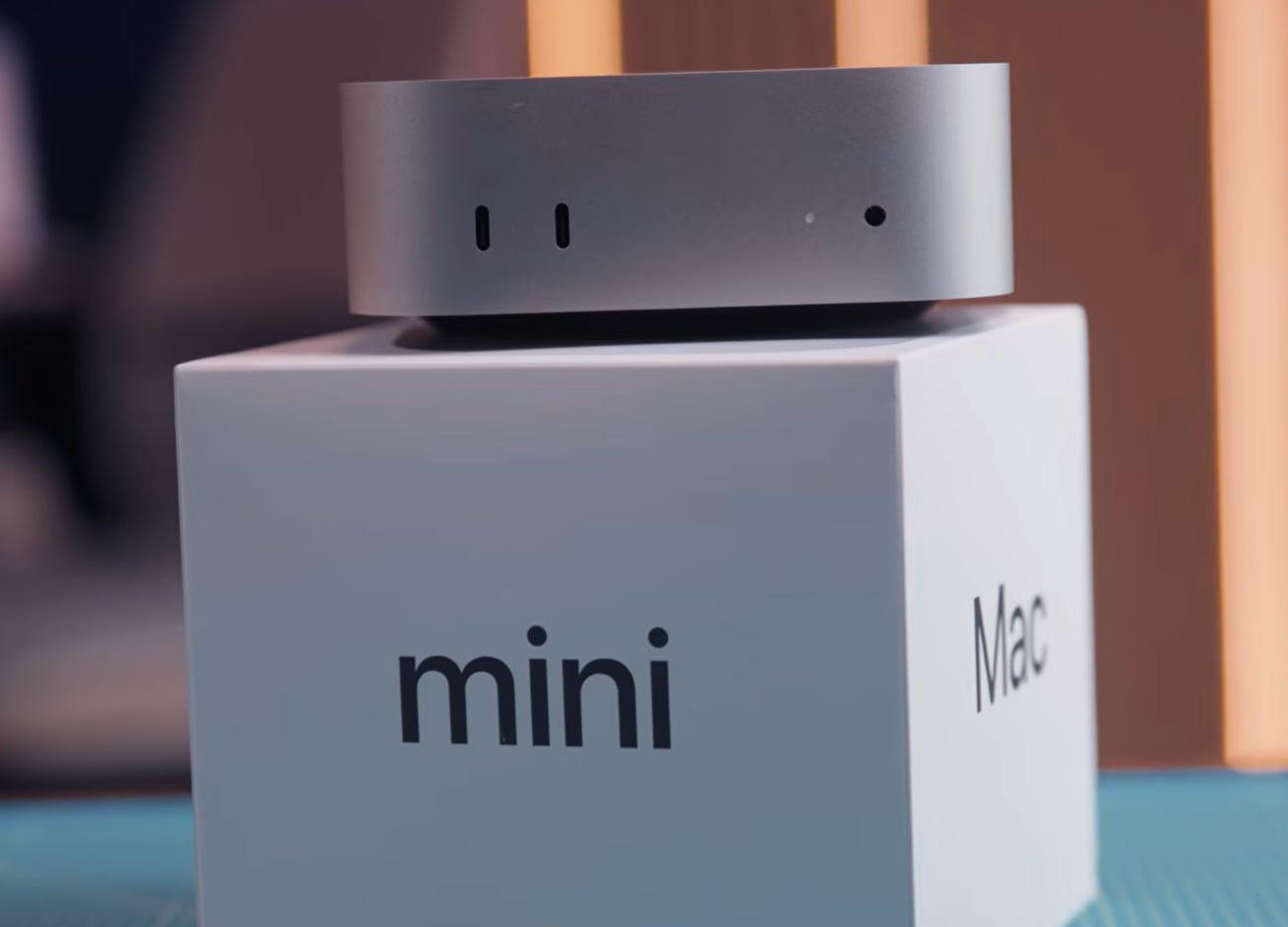
The Mac mini M6 costs a lot more than the M4 did when it came out. And yet, if there’s one Apple device I’m recommending this year, it’s this one. I’ve been using it every day for a few weeks, so I’m giving you the 10 reasons you should buy a Mac mini M6 in 2026.
Reason 1 is the Apple ecosystem.
The famous Apple ecosystem, a nightmare for some and bliss for others. Honestly, nobody does it better, and the Mac mini is the perfect way in.
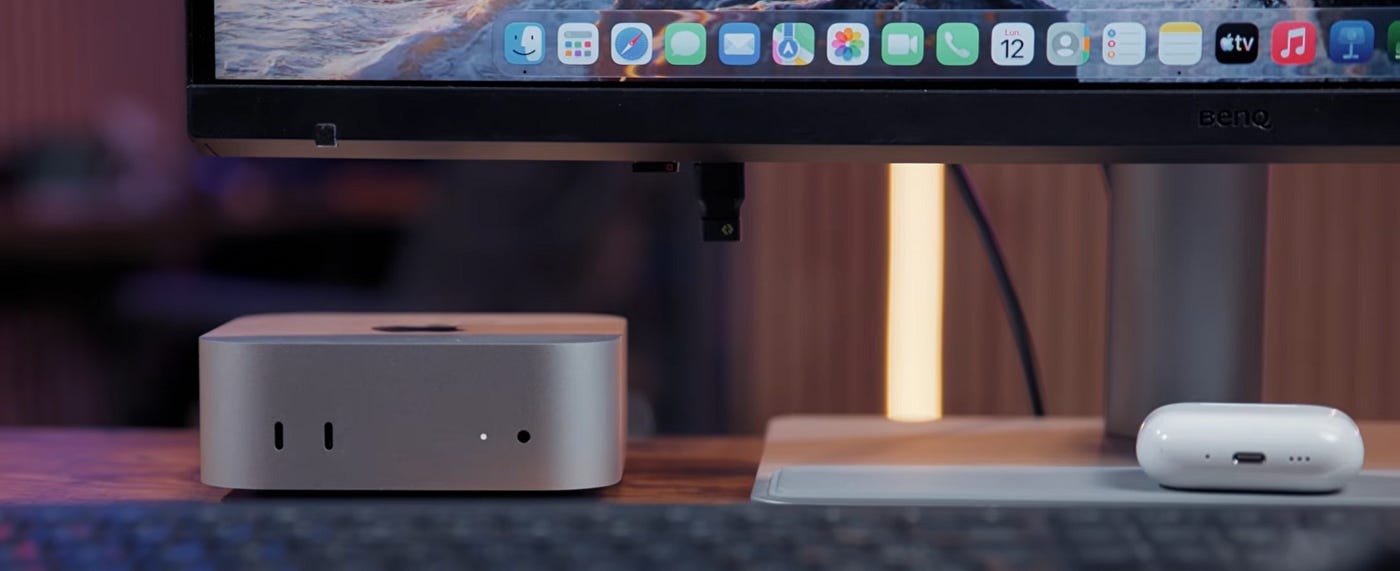
With a Mac, all your iCloud data sits in one place, including documents and photos. You copy a text or a link on your iPhone and paste it straight on your Mac. One feature I use constantly is document scanning, and it’s impressively simple. Right-click on the desktop, choose Scan a document, and your iPhone’s camera opens, frames the page, and saves it to the Mac in seconds. You can also take calls from the Mac, unlock it automatically with your Apple Watch, use your iPad as a second screen, or control the Mac mini and a MacBook side by side with the same keyboard and mouse thanks to Continuity. I could spend 10 minutes listing everything. And if you’re still on Windows and hesitating to make the jump, the Mac mini M6 is clearly the ideal machine for it.
Reason 2 is that you get all of that in a tiny box.
It’s 12.7 cm on each side and 5 cm tall, so no enormous tower grabbing attention on your desk. It sits there, discreet and elegant in its aluminum chassis. Sure, there are Windows mini PCs, but most of them hang a big external power brick off the cable, while on the Mac mini the power supply is built into the chassis. It goes anywhere and takes up less room than a laptop in a bag. I kept a screen, keyboard, and mouse at the office and at home for years, and whenever I wanted to work remotely, I just slipped my Mac mini into my backpack. The compact format also means silence. The sound is so subtle you can hardly hear it, which is crucial when your setup is in the living room or bedroom.
Reason 3 is the ports.
On the back, you get three Thunderbolt 4 ports, and an NVMe SSD plugged into one of them can reach around 3 GB/s. The 40 Gb/s of bandwidth lets you drive 6K displays, even daisy-chained, and I’ve shown a three-screen setup running on a Mac mini M4 before.
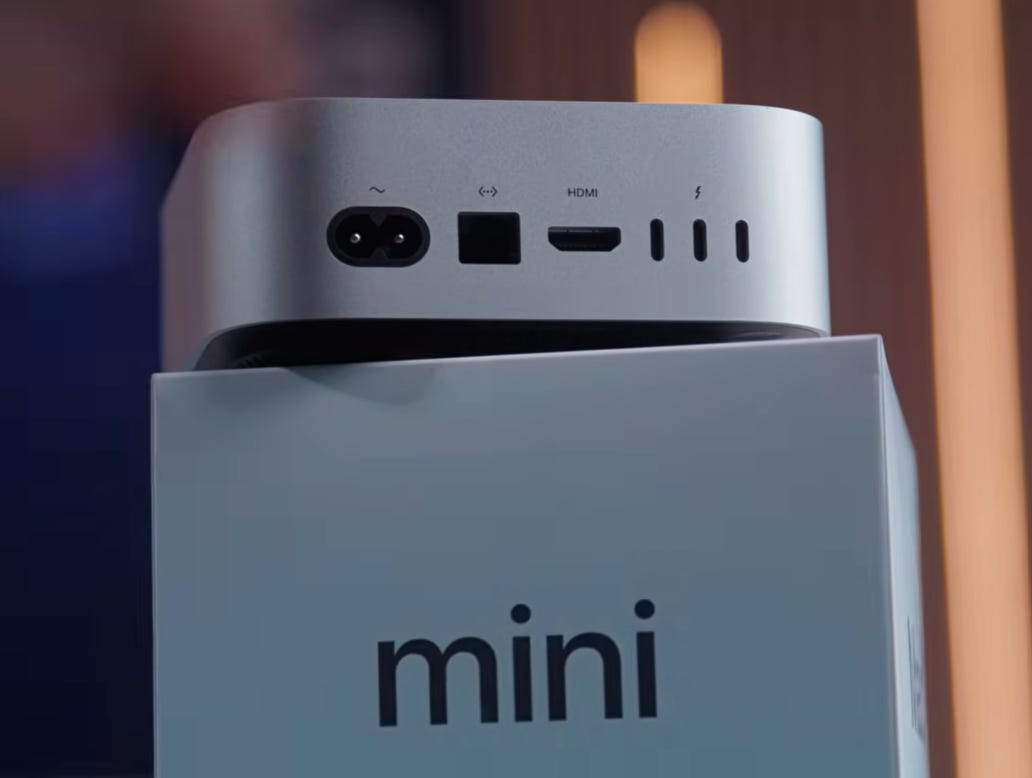
Next to those, there’s an HDMI port and 2.5 Gb Ethernet as standard. On the wireless side, you get Wi-Fi 7 and Bluetooth 6 thanks to the new N1 chip. For a machine this small, the connectivity is really premium. But none of it would matter without what’s under the hood.
Reason 4 is the M6 chip itself.
A funny fact: Apple’s newest technology, the 2 nanometer process with the dual Neural Engine, only exists on the Mac mini M6 for now. The iMac, Mac Studio, and MacBook Pro all still run the M5 generation. That might change soon, since Bloomberg’s Mark Gurman reports Apple plans to announce an M6 MacBook Pro on October 27, so treat that rumor with a grain of salt. It doesn’t mean the M6 beats them everywhere, but it’s ironic to see the smallest Mac in the lineup get it first.
And that finer process isn’t just a number on a spec sheet. It allows a second Neural Engine, plus two more CPU cores and two more GPU cores than the M4, going from 10 to 12 on each side. That’s already 20% more raw power. The CPU cores aren’t ordinary ones either, because Apple says it has the world’s fastest single-threaded performance. The GPU gains Neural Accelerators, dedicated units for AI model inference that cut the wait before the first response, and the M4 had nothing like that. Memory bandwidth also climbs to as much as 170 GB/s against 120, about 42% better, though the base 16 GB configuration tops out at 153 GB/s.
On paper, that’s already a big jump in a single generation, but in some tests the gap is even bigger than the spec sheet suggests. In Final Cut Pro, exporting a 4K HEVC video takes 1 minute 27 seconds against 2 minutes on the M4, exactly the same time as a MacBook Pro M5 Pro. In Blender, the Party Tug test render drops to 40 seconds, 2.5 times faster than the M4, and the far heavier Swamp project finishes in 9 minutes 10 seconds, where the MacBook Pro M5 Pro needs almost 12. Musicians will love it too, because Logic Pro goes from 130 to 210 tracks. Even web browsing benefits, with a Speedometer score of 77 against 47 on the M4, the biggest jump on a Mac mini since the M1.
Reason 5 is AI, and that’s where the M6 makes the biggest difference.
The dual Neural Engine and the Neural Accelerators in the GPU speed up everything that touches AI. Apple claims up to 4x faster AI performance than the M4, and an independent llama.cpp test measured prompt processing at roughly 3.5 times faster. The craziest part is that in my own tests it lands at the level of a MacBook Pro M5 Max, a machine that costs far more.
Take Lightroom. A preset with smart masks that detect the face, skin, eyes, and lips applies in under 2 seconds. Add AI noise reduction on top, and it’s 3 seconds per photo against 12 to 15 seconds on an M5 chip. On a batch of 200 photos, that’s where it gets concrete: about 8 minutes on the Mac mini M6, against 55 minutes on a MacBook Pro M5 and 1 hour 15 minutes on a Mac mini M4. For a photographer coming back from an event with thousands of files, that’s an hour saved every session, and the MacBook Pro M5 Max takes the same time as this Mac mini.
The same story holds in Final Cut Pro with the magnetic mask that automatically cuts out a subject. On a 10-minute 4K Canon Log 2 video, it takes 5 minutes on the Mac mini M6 against 15 on the M5, three times faster, and again nearly level with the M5 Max, which has three times as many GPU cores. Is it the dual Neural Engine or the new super cores doing the work? Hard to say. But if your job relies on AI tools, say photo or video, I don’t think there’s a better-value Mac today. Apple sells a more powerful Mac mini with the M5 Pro, so this is the best value, not the fastest.
Reason 6 is gaming.
You don’t buy it for that first, but the Mac mini M6 is a real 1440p gaming machine. In 3DMark Steel Nomad Light, it goes past 52 fps against 30 on the M4, a gain of over 70%. In proper games, my tests give an average of 30% more FPS, with 65 fps on average in most compatible AAA games at 1440p. Concretely, it’s smooth, it’s playable, and it’s very pleasant for the occasional session. That’s largely thanks to the 12 GPU cores and the memory bandwidth, and the more a game is optimized for Apple Silicon, the wider the gap with the previous generation. On the catalog side, Apple also launched its own gaming platform, Apple Games, which is a bit like Apple’s Steam. You’ll find App Store and Apple Arcade games there, all centralized in one place. I play little myself, but that’s still an advantage.
Reason 7 is that the Mac mini is a blank page.
Unlike an iMac or a MacBook, you choose your screen, keyboard, mouse, and audio. It works with pretty much everything on the market, so you fit the setup to your usage and your budget. For photo editing, go for a well-balanced 5K screen; for gaming, a 1440p screen with a high refresh rate. Coming from Windows, keep your current screen and peripherals and only swap the computer. And the day you want a better display, you change the display, not the whole computer like with an iMac.
Personally, I paired mine with the BenQ MA270S, the 27-inch 5K monitor I covered in my review, which is gorgeous and honestly feels designed for this Mac mini. For keyboard and mouse, I’m on the Logitech MX Keys and MX Master 4, and I use my AirPods 4 ANC for audio. For me, that’s the perfect setup. There’s one more advantage you don’t always think about. If you keep your Mac mini for a long time, you upgrade your setup piece by piece without ever buying everything again.
Reason 8 is that you keep a Mac mini for a long, long time.
That isn’t just a feeling, and there are three concrete reasons.
First, software support. The Mac mini M1 from late 2020 still runs the latest macOS 27, so with an M6 that just came out, you can reasonably count on many years of updates, including new AI features. With 16 GB of RAM as the minimum standard, it has room to absorb whatever Apple adds in future versions.
Second, almost nothing inside can wear out. No battery losing capacity over the years like on a MacBook, no built-in keyboard or screen that can give up. An aluminum case, a chip, and that’s it. Third, resale. A 2020 Mac mini M1 still sells for €500 and even €600, while a PC bought at the same time for the same price is worth almost nothing. When you move to a newer model, a good part of your investment comes back. So yes, the Mac mini M6 costs more than the last generation, but spread over the years you’ll use it, the math is quick, which leads to the awkward question.
Reason 9 is the price.
Let’s be honest, this year the Mac mini is more expensive than ever, €1,049 for the base configuration. And yet even at that price, I find it unbeatable. Why? Because on AI tasks, I showed you it holds its own against a MacBook Pro M5 Max, a machine that costs far more. Find me another computer this size that does what the Mac mini M6 does.
The days of a Mac mini around €600 are long gone. With AI demand, memory prices exploding, and the entire market taking a hit, even a Mac mini M4 is hard to find under €900. So do the math. For roughly €150 more, you get Apple’s very latest chip, 20% more cores, huge gains on anything AI-related, and a machine that will resell much better in a few years because it’s the most recent model. Between an M4 at €900 and an M6 at €1,049, for me there’s no real debate. But you still have to find one.
Reason 10: Stock and a Prediction
Perhaps I’m wrong, but I believe the Mac mini M6 will be in short supply over the next few months for two reasons. First, component shortages. Second, its AI performance. For €1,049, it keeps pace with a MacBook Pro M5 Max on machine learning tasks, which makes it the best-value machine on the market for anyone who wants to run small AI models locally — developers, creators, and companies alike. And when a machine ticks every box, it goes fast. I already wrote about how an open-source AI agent project once emptied Mac mini shelves.
If new stock gets scarce, used ones will follow. Don’t expect to find a discounted Mac mini M6 on any reselling platforms in 6 months. I wouldn’t even be surprised to see it resell at the price of a new one, or above. It’s fair to say promotions happen, given that Amazon’s fall sale momentarily cut the base model price to $780 in the US from $899. But my advice remains simple. If you need one and it fits your budget, don’t wait for a hypothetical promotion that would save you €100. Take it while it’s available.
Those are my 10 reasons.
If you’re deciding between the Mac mini M4, M6, and the new M5 Pro, follow Nov Tech and subscribe for the tests I run before you spend your money. Don’t forget to support my newsletter for early access.
A valuable review and advice. Thank you. Your commentary seems rational and useful to me, as I currently have a mind wrestle with whether to upgrade from my 2004 M4 Mac Mini or not.