

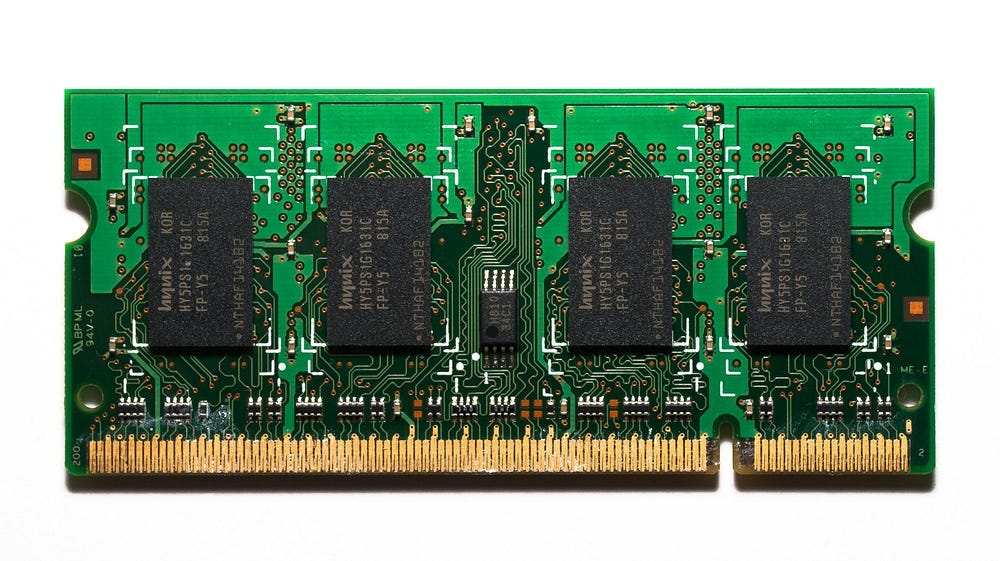
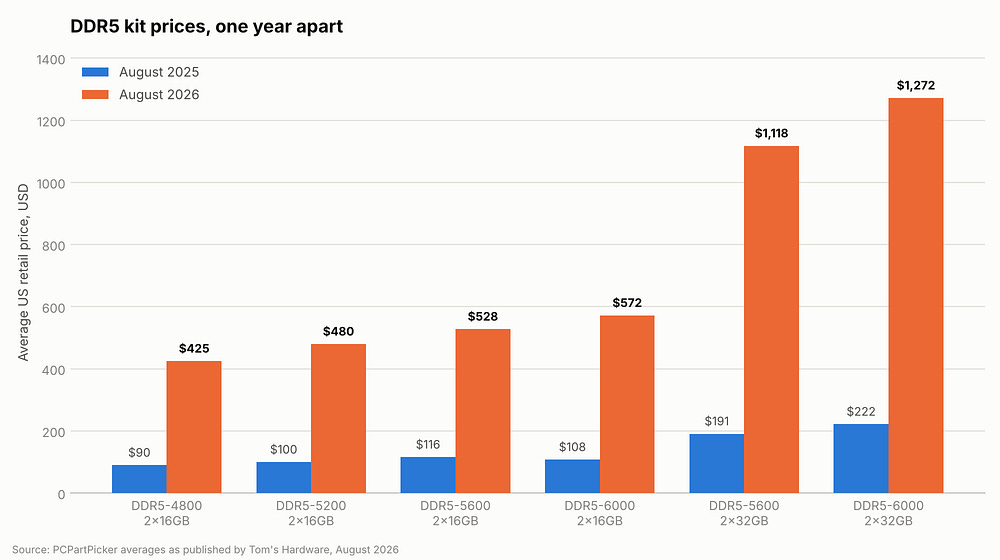
The cheapest 32GB DDR5–6000 kit in the United States hit $449.97 on 14 October. Tom’s Hardware has the lowest price it has ever recorded for that same kit at $72. Not a different kit, not a smaller one. The same two sticks of memory that a PC builder could have bought for the price of a nice dinner now cost more than a mid-range graphics card.
That is the number.
The rest of this article asks whether you should buy now or wait because almost everyone’s instinct is to wait, and I think that instinct is wrong this time.
What memory actually costs right now
Tom’s Hardware tracks the lowest US price for each kit alongside the lowest it has ever seen, and the gap on the high-capacity tiers is the part that stops you. A 128GB DDR5–6400 kit, record low $329, now runs $3,399. Ten times. The 96GB tier has a record low of $189 and sits past $2,000. DDR4 is not the escape hatch because everyone who gave up on DDR5 went there, and DDR4 kits are up anywhere from 120% to nearly 180%.
One detail tells you how the makers themselves read this. In December 2025, Micron shut down Crucial, its own consumer memory brand, and walked away from selling RAM to the public. A company does not exit a retail business it has run for decades because it expects a good year ahead for retail.
The reason is not a factory fire or a flood. More memory bits are being produced this year than in any year before. They are going somewhere else. AI accelerator high-bandwidth memory requires roughly quadruple the manufacturing capacity per gigabyte of standard RAM, and its buyers sign contracts upfront and pay a premium. Samsung’s own executives expect HBM to take about 30% of DRAM makers’ wafer capacity in 2027, up from around 20% this year.
Not every wafer that moves turns into the stick inside your laptop.
What makes this slow to fix is unglamorous work. The limit is not a clever new memory standard because DDR5, LPDDR6 and taller NAND stacks all pack more bits onto a wafer without adding a single square metre of the thing that is actually scarce, which is clean room space. Clean rooms take years and billions, and the decision to build one gets made against a demand curve nobody trusts. I went through how the industry got to three surviving suppliers in “Moore’s Law Is Dying. TSMC and Intel Just Chose Opposite Ways to Survive.”, and the short version is that nobody in this chain has an escape route because nobody controls enough of it.
The forecasts only ever moved one way
This is the part I find hard to argue with, and it is the reason I changed my mind about waiting.
Gartner published its forecast on 26 February. Worldwide PC shipments are down 10.4% in 2026 and smartphones down 8.4%, driven by a 130% surge in combined DRAM and SSD prices by the end of the year, which Gartner expected to push average PC prices up 17% and smartphone prices up 13%. Ranjit Atwal, the analyst behind it, said buyers would hold their devices longer and that the sub-$500 entry-level PC segment would disappear by 2028.
IDC’s number of phones for that February was a 12.9% decline. In June, it revised that to 13.9%. In August, it revised again to 16.7%, calling it the steepest annual contraction the industry had ever recorded, with average selling prices up 27.6% to $581.
Then the actual quarter landed. On 15 October, IDC’s preliminary data put third-quarter shipments at 255.3 million units, down 22.0% year on year, the largest decline of any quarter it has on record. Counterpoint had it at 20%. Samsung and Apple gained share while Oppo fell from 39.1 million units to 25.6 million and vivo dropped 31.5%.
Underneath that is a segment quietly dying. The 173 million phones under $100 that shipped last year are the ones the memory bill hits first because there is no margin to absorb it. That tier fell almost 60% year on year in the second quarter, and Gartner expects basic smartphone buyers to leave the market five times faster than premium buyers. The upgrade you skip is not the flagship. It is the cheap handset that used to exist.
Three revisions, all in the same direction, and the quarter still came in worse. Nabila Popal at IDC put it plainly:
The sharp downturn the industry has been bracing for finally materialized in the third quarter this year, with shipments declining a record 22% YoY. However, the worst is yet to come. Current indicators suggest that the market has not yet reached the bottom.
Note what that is not. It is not two forecasters disagreeing about the size of a problem. It is a series of estimates that have been chasing the same number downhill all year, made by people with access to the same supply data you and I do not have. The direction itself is the information when all corrections align in the same direction.
Apple stockpiled memory and raised prices anyway
If any company on earth could buy its way around this, it is Apple. It has the deepest supplier relationships in consumer electronics and two decades of running the leanest inventory in the business. What it actually did is the most useful data point in this complete story.
Apple’s inventories hit $11.09 billion at the end of June, up 87% year over year, with $5.46 billion of cash consumed building that position over nine months. That took it from roughly 10.7 days of inventory to about 18.5. Apple deliberately broke its own supply chain discipline to front-load memory. It raised prices for Mac and iPad in June, yet memory expenses remained higher than the total sequential decline in its adjusted gross margin.
Kevan Parekh, the CFO, explained to analysts that over 100% of the margin variation was because of changes in memory costs.
On his final earnings call as CEO, on 30 July, Tim Cook called the market a hundred-year flood on memory pricing, and said that Apple expected to pay more again in September. He stated that with additional suppliers in the DRAM market, supply and potentially pricing would benefit, and that Apple was reviewing all options. I wrote about the component war inside an iPhone in “I Paid €1,329 for an iPhone and Discovered a Terrifying Secret War Happening Inside It.”, and this is that war with the subtlety removed.
Read that sequence again as a consumer.
The best-positioned buyer in the industry stockpiled, absorbed what it could, raised prices anyway, and told shareholders the following quarter would be worse. If hoarding and scale did not protect Apple’s margin, personal timing will not protect your wallet.
The one voice saying it is over sells laptops
I went looking for the bull case because a piece that only quotes pessimists is not reporting. The spread looks like this.
Micron’s CEO Sanjay Mehrotra told the 30 September earnings call that the company expects conditions to be much tighter in calendar 2027 and 2028 than they were in 2026, and added the line that actually matters:
Even with additional industry DRAM clean room space plans with robust demand trends, including new upside requests from customers, we do not have a line of sight to when supply and demand will return to balance.
Earlier industry forecasts had expected balance to return in 2028. Micron just removed the date. Samsung says it will be worse in 2027 than 2026, lasting through 2028. SK Hynix’s CEO calls 2027 the worst year and sees demand above supply beyond 2030. Nvidia’s CFO called it a bottleneck at least through the end of fiscal 2028. KB Securities expects the tightest supply conditions in history in 2027.
ADATA’s chairman said ten more years, which I think is marketing rather than forecasting, but it points in the same direction.
One survey put twenty of these forecasts side by side. Exactly one says that the shortage is already over, and it came in September from the CEO of Acer. Acer buys memory. It does not sell it.
That is no proof that he is wrong. Buyers sometimes see the demand break before sellers admit it, and Acer sits closer to the shelf than Micron does. But when the only optimist in the room is the party with the strongest commercial reason to talk prices down, I am not making a purchase decision about him.
The first crack, and why it has not reached you
Something did finally move the other way, and it deserves its place here.
The spot price of a 16GB DDR4 chip slipped roughly 5% over a month to around $74.10, the first monthly decline since February 2025, after a run that took the same part up around 2,200%. Chinese channel listings moved most, with some 32GB DDR5 kits down as much as 27% there. IDC also notes that memory inflation is slowing: the sequential increase in the third quarter was in the low double digits, against roughly 50% to 100% in the quarters before it.
Slowing is not falling. And none of it has reached the contract market, where the companies that build your laptop actually source memory. TrendForce’s 30 September read still has conventional DRAM contract prices rising another 10% to 15% in the fourth quarter and NAND up 15% to 20%. Spot sales make up only a tiny portion of total shipments, so adjusting channel listings has minimal impact on what Dell or Lenovo pays, which determines the price you see.
The honest version is that the rate of increase is easing while the level keeps climbing, and the thing that reaches a retail price tag is the level.
The shortage is somebody’s best year ever.
Worth saying plainly, because it explains why nobody is rushing to fix this. Micron’s fiscal fourth quarter, reported on 30 September, brought in $54.23 billion of revenue, up 379% year on year, with adjusted earnings per share of $33.42 against $3.03 a year earlier. Long-term supply agreements climbed to $32 billion from $22 billion in June, and the company now holds 26 multi-year contracts covering roughly 35% of revenue through the end of the decade.
Look at what that last number does. For forty years, the memory business was the most violently cyclical corner of the semiconductor industry: demand rises, everyone builds, capacity floods, prices collapse, the weakest die. Toshiba, Hitachi, Elpida and Qimonda all went into that grinder. The survivors learned the lesson, and what they have built now is a business where a third of revenue is locked years ahead at prices agreed in a surplus.
A company in that position has no commercial reason to race more conventional DRAM onto the market. It has every reason to keep pointing capacity at the customer paying the most, which is the one building data centers. That is not a conspiracy; it is just what the incentives say, and it is why I would not bet on supply discipline breaking on its own.
So buy now, or wait?
If you need a machine in the next six months, buy it. Not because prices are good; they are terrible, but because every piece of dated evidence points to worse rather than better, and the people saying otherwise are buying rather than selling.
If you are upgrading an existing machine, buy the memory before the rest of the build. It is the line item moving fastest, and it is the one that can leave a half-finished PC sitting on your desk.
If you can wait two years, wait two years. That is the sole timeline anyone trustworthy is prepared to link a recovery to, and even that timeline lost its date in September.
What I would not do is the middle option, which is the one most people pick. Holding off until spring because a price this absurd must be temporary is a bet that the whole industry has been wrong in the same direction all year and is about to be wrong the other way. Gartner expects PC lifetimes to stretch 15% for business buyers and 20% for consumers, and the sub-$500 PC to stop existing by 2028. Memory is on track to reach 23% of a PC’s bill of materials, up from 16% in 2025, and in notebooks the processor, memory and SSD together now account for about 68% of parts cost, up from roughly 45% in early 2025. IDC expects shipments to fall again in 2027 and sees no recovery before 2028. That is not a dip. That is a new floor being poured while everyone waits for the old one to come back.
What still surprises me is how mundane the reason is. No cartel, no disaster. Data centers outbid you for a component you both need, and they will keep outbidding you because the return on a rack of accelerators is measured against revenue, and the return on your laptop is measured against patience. You were never in that auction. You only need to pay the clearing price.
AI Is Eating the World’s Memory. Apple Is the Only Company That Doesn’t Care.

There’s a component inside every device you own that you’ve probably never thought about. It’s called RAM: random access memory. Without it, your processor is a genius sitting in an empty room with no desk, no paper, and no way to work. RAM is the surface where your computer spreads out everything it’s doing at once: every open tab, every running applic…
Thanks for reading. Follow us and subscribe if you’d rather see the price tracked than the panic repeated.
This is after earlier in the year when they projected that things would go back to normal around 2028 or something like that and now they’re saying there’s no horizon for when things will stabilize again. That’s because as long as they can make more money they are going to.
Personal compute has been taken for granted; at least that’s what these numbers are indicating. This is so the wrong timeline lol.