

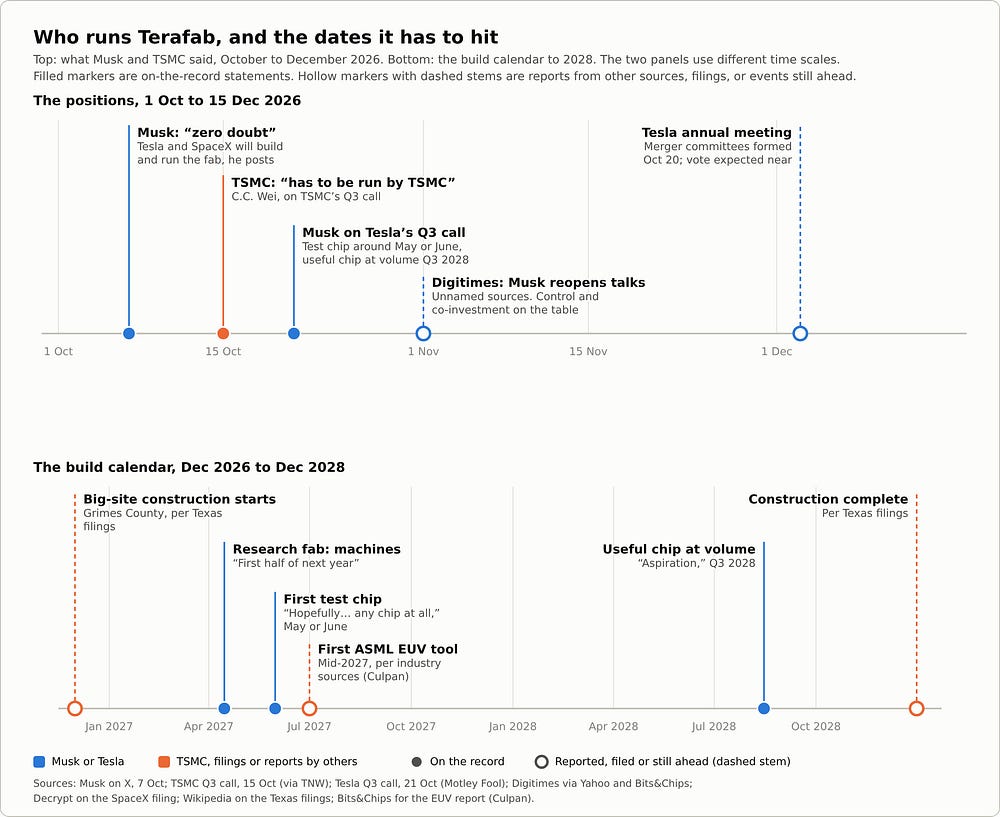
On October 7, Elon Musk wrote on X that Tesla and SpaceX will build and run Terafab themselves, and “Let there be ZERO doubt about that.” Less than four weeks later, Digitimes reported, citing unnamed supply-chain sources, that he may let TSMC run it instead. As far as I found, neither Musk nor TSMC has confirmed that report.
If you own Tesla or SpaceX stock, this decides how much of the 2028 plan is real, because both companies are heading toward a merger and would depend on the same fab. If you only want chips and memory to get cheaper, it says something less comfortable: the people with the most money and the most urgent need still can’t buy their way out of the shortage quickly.
The next dates are Tesla’s December 3 annual meeting and a merger announcement later that month. First, I lined up the statements.
Terafab and TSMC: Three Statements in Four Weeks
Musk’s October 7 post said TSMC might sublease part of the site, “but nothing more than that.” Eight days later, on TSMC’s earnings call, CEO C.C. Wei said the two sides are “still in discussion” and that “the fab got to be run by TSMC.”
He added that large US customers asked for more capacity and that TSMC has sent teams to Texas to look at a site beyond its Arizona base. He gave no timeline.
The third statement stands on the weakest ground. Bits&Chips relayed the Digitimes report on November 3 under the headline that Musk is open to TSMC running Terafab and framed it as conditional.
“If the Digitimes report is correct.”
What I can say on the record is narrower. Musk’s October 7 position and Wei’s October 15 position can’t both hold, and the report says one of them is moving. My opinion is that the October 7 post was an opening bid, and the people closest to the fab business have heard opening bids before.
Musk Says He Has No Idea How to Make Chips
Three days after that post, Musk told an Austin livestream audience, according to a KuCoin summary, “I have no idea how to make chips” and “we’ll figure it out.”
He also said, “It might take us quite a few years.” I put the skeptics’ case for Terafab in March, in my article below, and that admission is the nearest thing to a concession so far.

Then came Tesla’s third-quarter earnings call on October 21, and Musk’s own schedule. The Austin research fab commissions machinery in the first half of next year. If things go well, a first test chip comes around May or June, “just to see if we can make any chip at all.” The aspiration is “some kind of useful chip at volume around Q3 of 2028,” which he called “lightning fast by fab standards.”
Honest and ambitious. Hmmm.
It also means that the first public proof that Terafab can make a working chip lands in mid-2027, and a useful one at volume more than a year after that.
On cost, he said, “certainly in the tens of billions” in equipment through early 2028 and “north of $100 billion long term,” with Tesla and SpaceX still working out who pays for what. For scale, the first phase in Texas filings is $16.8 billion (about €15 billion), and Wikipedia’s summary of the Texas filings lists up to roughly $119 billion (about €106 billion) across all phases, with construction at the Grimes County site because of start December 1.
The reason I think the schedule is tight has little to do with money. A wafer is a silicon disc about 30 centimetres across, and hundreds of chips get etched on it at once. Some of them come out faulty, and the share that works is called the yield. Competitors often buy the same machines, so the machines don’t separate TSMC from everyone else. Yield is learned wafer by wafer over years, which is how I read the industry. And Musk’s usual method of failing fast fits it badly.
A rocket that fails explodes where everyone can see it. A chip that fails says nothing until the wafers are tested, weeks or months later.
I think that is why he built a research fab next to Giga Texas, and why the door to TSMC may have reopened.
ASML, Intel and Texas: What Musk Doesn’t Control
Start with the machines. ASML is the only company that makes the extreme ultraviolet (EUV) lithography tools that draw the finest chip features, and on October 14 it said that its capacity plans mean it “cannot fully meet demand in 2027 or 2028.”
Journalist Tim Culpan reports, per Bits&Chips, that Terafab is expected to receive its first ASML EUV system in mid-2027, possibly before the research fab is ready to host it. Intel joined the project in April, per the same Wikipedia summary, and Terafab is meant to use Intel’s 14A process, so the process know-how is a partner’s too.
Then there is Texas. As of AP’s count on November 11, Gina Hinojosa, a Democrat, was marked the winner over Gov. Greg Abbott, and AP’s calls can change. Fortune reports that she has questioned the $1.66 billion JETI tax break tied to the plant and filed a lawsuit against Abbott’s office on October 19.
Fortune also notes that the election does not automatically cancel commitments already made.
None of these stops a bulldozer. It adds one more variable to a project that already leans on a machine maker, a process partner and, maybe, a foundry.
The Tesla and SpaceX Merger Makes the Fab a Bigger Question
Both boards formed special committees on October 20, and Musk recused himself from both. He called the arrangement “an odd kabuki dance where two groups of people are talking, and I can’t be in the conversation.” Decrypt, reading SpaceX’s 10-Q, says Musk controls about 85% of SpaceX’s voting power, that Tesla shareholders would need to approve with 50% of all outstanding shares, and that a vote is expected at or near the December 3 annual meeting.
Bloomberg, as reported by Reuters, says a deal could be announced as early as December and that “No transaction terms have been agreed.” Those two timelines don’t line up neatly, so I’d treat both dates as soft until a filing or an announcement says otherwise.
The fab is the reason the question matters. I argued in my article “Terafab Is Not a Chip Factory. It’s the Reason the Cybercab Can Exist.” that chips, robots, and orbital computing feed one another, and on the Q3 call Musk called Terafab “an incredibly important asset, if not a necessary asset” for scaling Optimus. I went through Tesla’s dated claims on that call in “Tesla Says Optimus Is Now in Production. Musk Needs at Least a Year.” Every robot, robotaxi and satellite in that chain waits on a fab that has not yet made a test chip.
My thought: the interesting part is not whether TSMC gets the keys. It is that the plan to depend on no one now depends on ASML’s deliveries, Intel’s process, Texas politics, and possibly TSMC’s yield. Musk has the land and the money.
The skill he is still shopping for. The next checkpoints are the December 3 Tesla meeting, whether Musk or TSMC confirms or denies the Digitimes report, and the May or June 2027 test chip, which is the first date on the board where Terafab has to show it can do the one thing nobody has seen it do.
China Built Its Own EUV Machine. It Fills an Entire Factory Floor.

The most intricate device ever conceived by humankind is now in prototype form in China. Apart from the Netherlands, no other nation has the expertise to develop such a technology. Except this prototype fills an entire factory floor. For comparison,
Thanks for reading. I’ll keep tracking this one: if Musk or TSMC confirms or denies the report, or the Tesla vote date lands. Follow us and subscribe to our newsletter for more.