

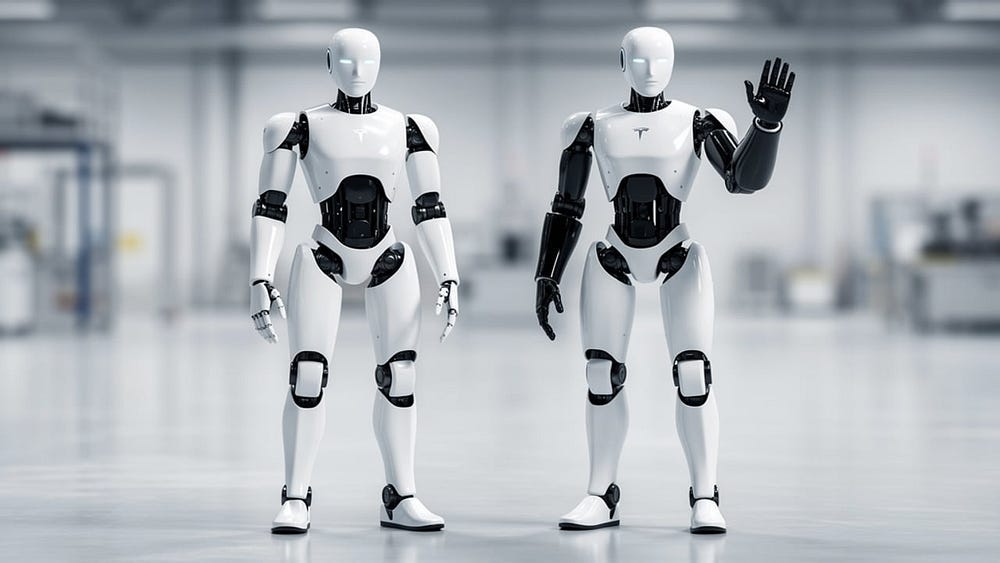
15,000 Optimus humanoid robots. That is roughly how many units’ worth of parts Tesla has reportedly ordered for 2026 alone, on a ramp toward 1,000 a week by late September and 2,500 a week by December. Texas is home to a new factory being constructed specifically to produce 10 million Optimus robots each year.
Those are the numbers coming out of Tesla these past few weeks, and things are moving fast. Elon Musk’s project is finally coming together. For this one, I grabbed the Elon Musk book from my shelf, as his long-held dystopian vision is now becoming a reality with a production schedule for millions of robots.
In January, Musk admitted that not one Optimus robot was doing useful work in his factories. Not one. Nine months later, Tesla has parts on order for 15,000 of them. And on September 22, the design of the third generation leaked. Not from a factory, but from the code of Tesla’s Android app: renders of Optimus Gen 3 sitting in the installation files, spotted by a researcher. Tesla has neither confirmed nor denied them. Put those images next to what we now know about the robot’s insides, and the story is fairly clear. A prototype is becoming a product.
Tesla Optimus Gen 3 Is Built to Be Mass-Produced
To understand why Optimus Gen 3 is not just one more robot, you need to understand what Tesla is trying to do. It is not about building a robot for the sake of building a robot. It is building the machine that builds the robot. The nuance matters.
Tesla does one thing better than almost anyone on the planet: producing complex objects in series at a cost nobody thought possible. It happened with cars. It happened with SpaceX too. Before SpaceX, an orbital launch cost somewhere between $150 and $400 million, depending on the rocket. Musk applied the same industrial principles he used on cars to rockets, and a Falcon 9 launch now lists for about $67 million. When you cut the price of something by a factor of four or five, you open a market that did not exist before. Starlink would never have been viable with launchers at $300 million apiece, and we now know the geopolitical weight Starlink carries. It all started with an industrial process applied to rockets, and that was his stroke of genius.
With Optimus, the same pattern is taking shape, applied to an object more complex than a car or a rocket: a humanoid that walks, manipulates, sees, talks, and adapts. Western makers still price their humanoids in six figures, while Chinese makers like Unitree already sell the G1 for $13,500. Musk is aiming for $20,000 to $30,000 per Optimus, about €17,700 to €26,600. For that to work, every millimeter of the robot has to be designed for mass production. That is exactly what Optimus Gen 3 reveals.
Optimus Gen 3 Design and Hands: 22 Degrees of Freedom
Put the Gen 2.5 and Gen 3 renders side by side, and the difference is easy to see. Gen 2.5, impressive as it is on paper, still looks like a prototype. Gen 3 is the opposite. The body is enclosed. Musk said on Tesla’s Q3 2025 call that Gen 3 would look like a person in a robot suit, and the renders make that clear.
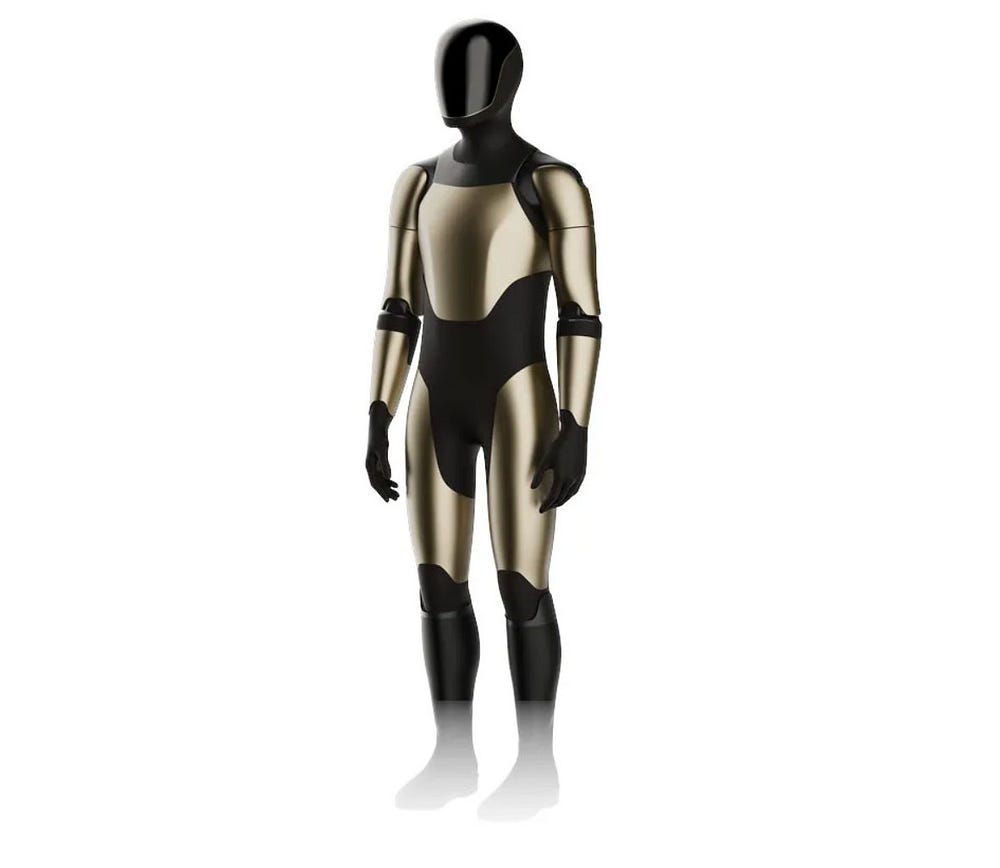
It would be easy to think this is cosmetic, that Tesla put a delicate shell on the same machine. It is not; it is the opposite. In an industrial setting, an enclosed body reduces the risk of pinching the people working next to it. What I find smart is that every design choice here is a mass production engineer’s choice. Tesla is not making the robot prettier to please people. It is making the robot easier to manufacture, by the million.
The most revealing detail in the leaked images is the proportion of the arms. The Gen 3 forearm is clearly thicker than the 2.5’s, and the wrist got thinner. That is no accident. On Gen 2.5, many of the actuators sat near the hands, which made them bulky and hard to assemble. For Gen 3, everything points to Tesla moving them into the forearm and adopting tendon transmission. It is the principle of the human hand. The muscles that move your fingers are not in your fingers; they sit in your forearm, linked by tendons that carry the force over a distance. That lets a hand be light and precise without a motor in every phalanx. The result: Gen 3 goes from 11 degrees of freedom per hand to 22. Double.
Freedom, for anyone who has not met the term, is an axis along which a joint can move. Your wrist can rotate, bend forward and back, or bend left and right, so that is 3 degrees of freedom for the wrist alone. Your entire hand has over twenty. That lets you turn a key in a lock, unscrew a cap, or hold something fragile between two fingers. A hand with 11 degrees of freedom grabs. A hand with 22 manipulates. With less mass at the end of the arm, finger movements become finer and object handling gets more controlled.
The legs got the same treatment: slimmer calves, minimalist feet. Cut the mass at a robot’s extremities, and you cut the torque needed at the knees and hips. The gait gets smoother and more natural and burns less energy. That is the common thread of this third generation. Every gram removed, and every joint relocated, serves one goal: a robot that behaves more like a human while being simpler to push out of a factory in volume. But a well-built body without a brain is still an articulated doll, and that is where the bigger change happens.
Tesla AI5 Chip: Optimus Gets It Before the Cars
Gen 2.5 runs on Tesla’s AI4 chip. Gen 3 is expected to carry the AI5. To give you an idea of the gap, AI5 is said to offer about 8 times the compute of AI4 and, as first announced, about 9 times the memory. That memory figure moved this week: on October 1, Musk said Tesla had halved AI5’s RAM to 72GB, and the next day he said it would go back up to 96GB. A single AI5 is supposed to match a Nvidia H100 on Tesla’s own workloads, and two together would approach Blackwell for less power. That is Musk’s claim, and nobody has benchmarked it.
The recent signals are concrete. On September 15, Samsung started pilot production of AI5 at its Taylor, Texas plant, on a 2-nanometer process and about two months ahead of the original schedule. Volume production is expected in 2027. Samsung is one of two foundries Tesla picked to make AI5, and the other is TSMC. I covered the Terafab side of that in my article “Terafab Is Not a Chip Factory. It’s the reason the Cybercab Can Exist.”
It is not an off-the-shelf part, obviously. It is a chip created by Tesla specifically for Tesla and manufactured on demand. Musk has said AI5 goes to Optimus robots first, well before it reaches the cars. Optimus does not inherit the car’s processor. It is the other way around. Optimus will be the first customer of Tesla’s most advanced chip, and the cars will come after. I spent an entire piece on that reversal in “Tesla Doesn’t Need AI5 in Its Cars. It Needs It in its Robots.”, because that detail matters.
A humanoid robot has to recognize objects, plan its movements, keep its balance, and anticipate everything in real time, locally, without depending on a cloud server. It all happens on the chip itself. That chip has to run AI locally, the way you can on your own PC. When you run a model on your graphics card, you are doing exactly what Tesla’s engineers do with their robots.
If Optimus loses its Wi-Fi during a task, it must continue working. Same principle as Tesla’s autonomous driving: everything is computed on the onboard chip, with no cloud, at least for the fast decisions. AI5 is also meant to run a language model like Grok directly on the robot for fluid conversation. You can guess why. Gen 2.5 could talk, technically, but the latency turned every exchange into a call with your phone carrier’s customer service. It was not viable.
The battery is an interesting choice because it is restrained. Reports point to about 2.3 kWh, not a big step up from Gen 2.5, and that looks deliberate. Tesla is balancing the robot’s weight, reportedly around 55 kg, the cost of building at scale, and what the robot needs for a working day in a factory. The cells would be 4680, the same family as the Cybercab, Tesla’s autonomous taxi, placed in the torso to keep the center of gravity stable while walking. The reported runtime is 6 to 8 hours on routine tasks and closer to 5 hours under heavy continuous load. When the battery runs low, the robot detects it, walks to a charging dock by itself, and plugs in for one to two hours before heading back out. The charging port moves to the back, so the robot reverses into the dock, charges, and picks its work up again without human help. That is full autonomy. All of this is the new machine Tesla plans to build in volume from the end of 2026, and more precisely from early 2027.
Optimus Production: Fremont Today, a 10 Million Robot Plant in Texas
Now for the machine that builds the machine. Here Tesla does something nobody else does: it already produces Optimus. Several hundred units a week reportedly come out of the Fremont factory in California, on lines that were still assembling the Model S and Model X early this year. Tesla ended those two flagship cars to free the production space, and that signal says more than any Musk speech.
According to supply chain reports from early September, Tesla ordered enough components for about 15,000 Optimus units across 2026. Those reports also point to an annualized pace of 100,000 to 125,000 units from 2027, a figure I could not confirm independently. It is a lot of robots when you remember that in January the count of useful robots stood at zero.
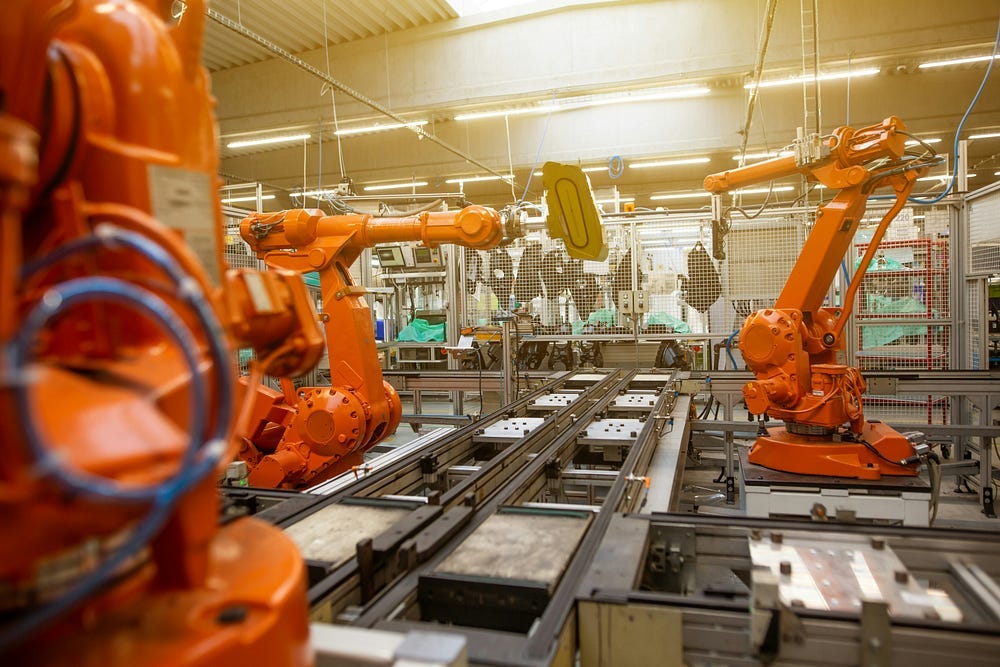
But Fremont is the pilot line, so to speak. The real industrial scale is being prepared in Texas. A new factory is under construction there, dedicated to Optimus, next to Giga Texas. Musk is targeting a capacity of, listen closely, 10 million robots a year, although on the July 22 earnings call he called that number aspirational. For perspective, Toyota and Lexus sold about 10.5 million vehicles worldwide in 2025, with dozens and dozens of factories spread over several continents. Tesla is aiming for the same order of magnitude for a single product in a single factory. I don’t know if you realize the scale.
Tesla arranged $30 billion in new loans and credit lines to finance the ramp-up by late September. The financial infrastructure is in place, and the physical infrastructure is taking shape. Samsung makes the brain, Fremont turns out the first units, and Texas prepares the scale. Everything makes sense.
Optimus Price: Why I Expect $80,000, Not $20,000
On price, Musk holds to a target of $20,000 to $30,000 per robot. For a humanoid that sees, walks, and manipulates with 22 degrees of freedom per hand and carries a processor comparable to a Nvidia H100, that would be a feat.
I think that even with Tesla’s mass production advantage, a price around $80,000, roughly €71,000, looks far more realistic for the first months, maybe the first year. $20,000 looks very low for what this machine is. And I am not saying Tesla is bluffing. Industrial manufacturing is invariably harsher than the polished slides shown to investors. At €71,000, I would also want to know exactly who controls what I paid for.
When Optimus is launched for public sale, Tesla will most likely implement strict user agreements. The robot carries cameras, permanent AI perception, autonomous mobility, and powerful manipulation. We are talking about a ban on modifying the software, mandatory updates, and a remote disable capability. It is a subject that barely gets discussed today, and it will become central the moment the first units reach outside customers, real people. An autonomous robot in a home or a business is not a connected toaster or a connected fridge. The levels of security, privacy, and legal responsibility involved are unprecedented for the tech industry, and it will have to address them, so we ought to prepare now.
What is at stake with Optimus goes well beyond whether a robot can tighten a bolt or sort parts in a factory. When a machine that costs a few tens of thousands of dollars can do the repetitive physical tasks a human does today, the rules of the game change. You do not need to be a genius to see it, and it is coming in the next few years.
One point to keep from all this. The heart of Optimus is not its legs, nor are its hands with 22 degrees of freedom. It is an AI running locally on an onboard chip. All the perception, all the reasoning, and all the decision-making happen without a server, without a cloud, and without a connection, inside the robot. It is the same logic as running a model on your own machine, with the same architecture and the same principles. Tesla is investing billions in it because local AI is what makes a robot autonomous. And it is also what makes a person autonomous in their work with AI.
If the price call stuck with you, I went through how Tesla, Hyundai, and Figure AI are trying to make humanoids cheaper than cars in “The Problem With Humanoid Robots Was Never the Technology. It Was the Price.”, including what Musk says an Optimus costs to build.
If a robot with a remote switch in your living room sounds like a bigger story than the factory building it, follow Nov Tech on Medium for more tech coverage.